
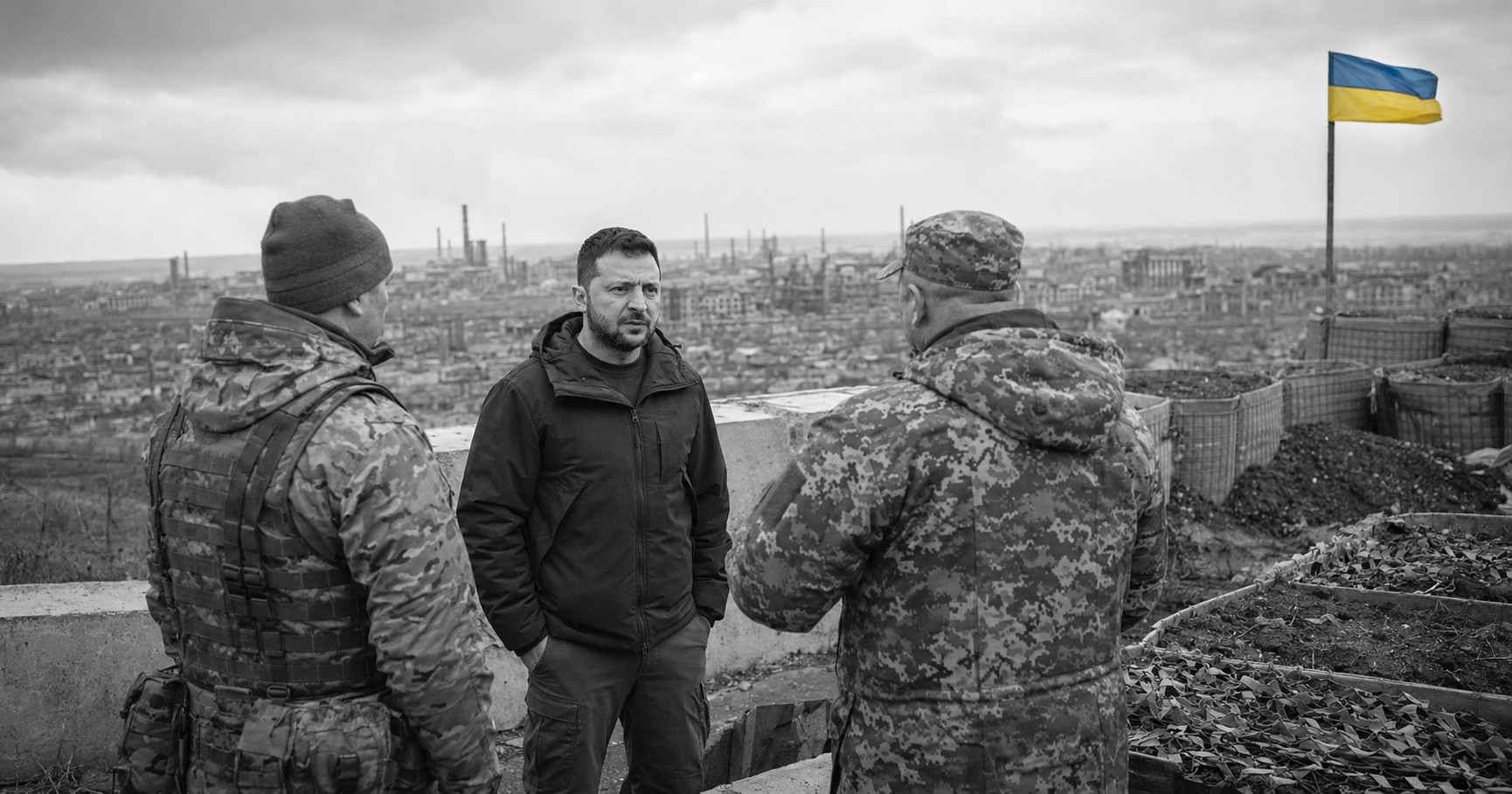
Ukrainian President Volodymyr Zelenskyy has appointed two prominent battlefield commanders to lead reorganised military formations defending the country’s strategically vital “fortress belt” in the Donetsk region. The decision was announced during a visit to troops near the frontline as Russian forces intensify pressure on Ukraine’s remaining eastern strongholds.
New leadership for the Donetsk front
Denys Prokopenko, commander of the National Guard’s First Azov Corps, and Andrii Biletskyi, commander of the Third Army Corps, will take charge of the reinforced groupings.
Both men have extensive combat experience dating back to the beginning of Russia’s intervention in Ukraine in 2014. Their units are regarded as among Ukraine’s most capable formations and are known for using NATO-style operational methods, decentralised decision-making and modern battlefield technology.


Biletskyi founded the original Azov Battalion and later established the Third Army Corps. Prokopenko commanded Azov forces during Russia’s siege of Mariupol and the defence of the Azovstal steel plant before being taken prisoner and subsequently released.
A shift away from centralised command
The appointments reinforce the authority of Ukraine’s new commander-in-chief, Mykhailo Drapatyi, who replaced Oleksandr Syrskyi in July.
Syrskyi had faced growing criticism from soldiers, veterans and military reformers who accused him of excessive micromanagement and relying on a rigid command culture associated with the Soviet military tradition. Supporters of Drapatyi argue that Ukraine requires faster decisions, greater independence for frontline commanders and better integration of drones, intelligence and precision weapons.
Ukrainian drone forces commander Robert Brovdi described the new structure as an important step towards network-centred warfare, in which information and battlefield resources are shared rapidly across different units.
Why the fortress belt matters
Ukraine’s fortress belt is a roughly 50-kilometre chain of industrial cities and surrounding settlements running through Kostiantynivka, Druzhkivka, Kramatorsk and Sloviansk.
The region has been fortified for more than a decade and combines urban areas, elevated ground, rivers, minefields, anti-vehicle barriers and prepared defensive positions. Losing the belt could expose flatter and less defensible territory farther west, potentially giving Russian forces greater freedom to advance towards central Ukraine.
Russian pressure continues to grow
Russian troops have been attempting to infiltrate Kostiantynivka through houses, basements and damaged industrial areas. Moscow has also increased artillery and air attacks against Kramatorsk and Sloviansk as it prepares for possible larger offensives.
Ukraine has nevertheless reported limited gains elsewhere on the 1,200-kilometre frontline. Zelenskyy said Ukrainian forces had recaptured more than 700 square kilometres during a series of operations in the southeast.
Military decision carries political importance
The leadership change comes as Moscow continues to demand that Ukraine withdraw from the remaining Ukrainian-controlled parts of Donetsk as a condition for ending the war.
Kyiv has rejected that demand, arguing that surrendering the fortress belt would remove one of the country’s strongest defensive lines and provide Russia with a platform for renewed attacks. The success of the new commanders may therefore influence both the military balance in eastern Ukraine and Kyiv’s position in any future negotiations.
Newshub Editorial in Europe – 27 August 2026

Ask NF GPT
If you have an account with ChatGPT you get deeper explanations,
background and context related to what you are reading.
Ukrainian President Volodymyr Zelenskyy has appointed two prominent battlefield commanders to lead reorganised military formations defending the country’s strategically vital “fortress belt” in the Donetsk region. The decision was announced during a visit to troops near the frontline as Russian forces intensify pressure on Ukraine’s remaining eastern strongholds.
Recent Comments