
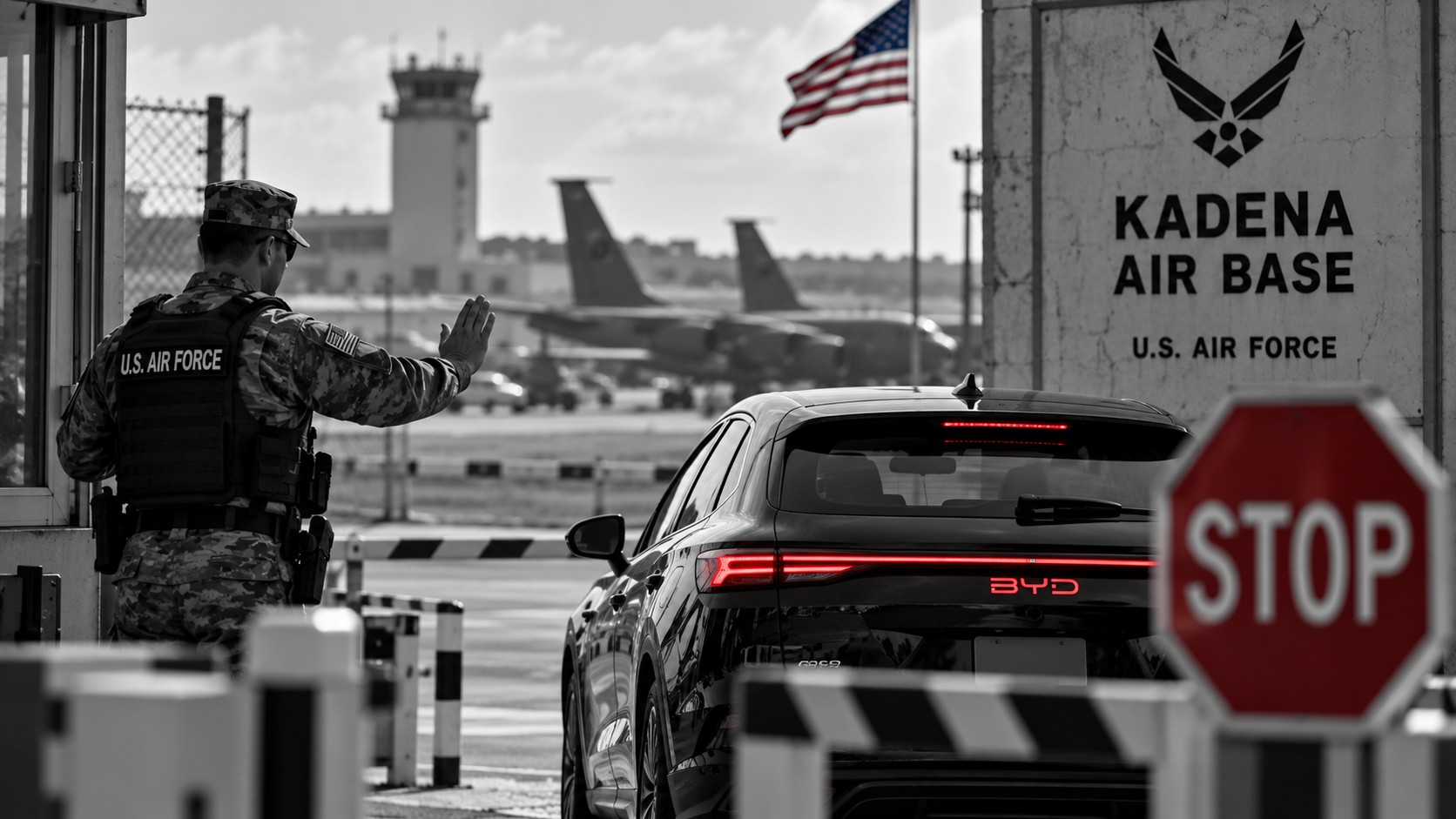
The United States military has banned vehicles manufactured by Chinese electric car giant BYD from entering Kadena Air Base in Okinawa, Japan, describing them as an unacceptable security risk. The restrictions, which took effect on Monday, 26 October 2026, apply to privately owned cars, taxis, delivery vehicles and contractors, reflecting growing American concerns about Chinese technology operating near sensitive military installations.
Security concerns over connected vehicles
US military officials say BYD vehicles present an unacceptable and unmitigable risk to personnel and military operations.
Although specific intelligence supporting the decision has not been disclosed, concerns centre on sophisticated cameras, sensors, GPS systems and internet-connected software installed in modern electric vehicles.


Such technology could potentially collect information about military facilities, aircraft movements and personnel, raising fears that sensitive data might be accessed remotely.
Security personnel at Kadena have been instructed to deny entry to affected vehicles, regardless of their commercial or private use.
A strategically important American base
Kadena Air Base is among the most important US military installations in the Indo-Pacific region.
Located on Okinawa, it supports American air operations and regional security commitments involving Japan, Taiwan and the Korean peninsula.
Its strategic importance has increased amid growing tensions between Washington and Beijing over Taiwan and military activity in the East China Sea.
The restrictions currently apply specifically to Kadena, although officials have not ruled out similar measures elsewhere.
BYD caught in wider technology confrontation
BYD has become one of the world’s leading electric vehicle manufacturers, overtaking Tesla in global battery-electric car sales during 2025.
The company has expanded aggressively into international markets, including Japan, Europe and Latin America.
However, its growing international presence has coincided with increasing scrutiny from Washington.
In June, the Pentagon added BYD to a list of companies it believes have connections to China’s military.
BYD rejected that designation and said it would pursue administrative and legal remedies.
The battle over vehicle data
The restrictions illustrate how modern vehicles are becoming part of the broader struggle over technological security.
Connected cars increasingly function as mobile data platforms, collecting information through cameras, mapping systems and communication networks.
China has previously imposed restrictions on Tesla vehicles near certain government facilities, demonstrating that concerns over automotive data collection extend beyond Washington.
A warning for Chinese manufacturers
For BYD, the immediate commercial consequences of the Kadena ban may be limited.
Nevertheless, the decision represents another challenge to Chinese automotive companies seeking wider international acceptance.
As geopolitical competition intensifies, vehicle security, data protection and national defence considerations are becoming increasingly important factors in global automotive trade.
NewsHub Finance | Technology | 27 October 2026
The United States military has banned vehicles manufactured by Chinese electric car giant BYD from entering Kadena Air Base in Okinawa, Japan, describing them as an unacceptable security risk. The restrictions, which took effect on Monday, 26 October 2026, apply to privately owned cars, taxis, delivery vehicles and contractors, reflecting growing American concerns about Chinese technology operating near sensitive military installations.
Recent Comments