
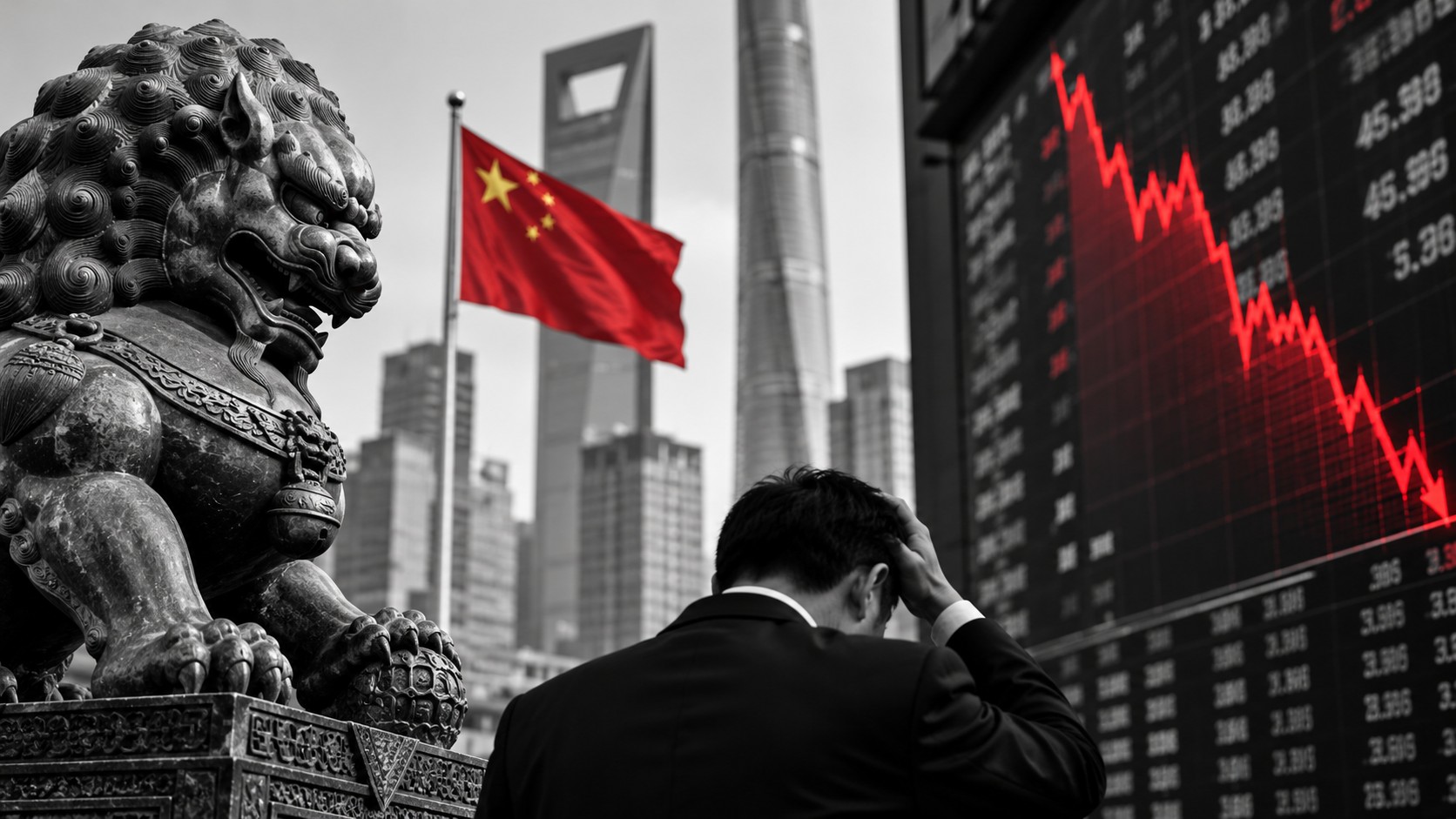
China’s ambitious drive to challenge the United States for global artificial intelligence supremacy is facing a severe financial reality check. Approximately $2.4 trillion has been wiped from Chinese stock market valuations since May, as investors question whether Beijing’s rapidly expanding AI industry can generate sufficient profits to justify enormous investment and withstand growing Western restrictions.
Technology shares suffer dramatic losses
China’s technology-heavy STAR 50 index has fallen approximately 40% from its June highs, erasing around $480 billion in market value.
The broader CSI 300 index has declined roughly 20%, entering bear-market territory as confidence in the country’s technology boom deteriorates.


According to Goldman Sachs, AI-related shares account for approximately 42% of market capitalisation across mainland Chinese and Hong Kong equities, making the sector’s decline particularly damaging.
Leading semiconductor manufacturers, robotics companies and AI infrastructure suppliers have suffered some of the sharpest losses.
Government ambitions collide with commercial reality
President Xi Jinping has positioned artificial intelligence, advanced semiconductors and robotics at the centre of China’s long-term economic strategy.
Beijing has committed substantial state resources to technological independence, including a 60 billion yuan AI investment fund.
However, rapid technological progress has not necessarily translated into profitability.
Many companies face enormous development costs, aggressive domestic competition and limited opportunities to charge sufficiently high prices for AI services.
Weak consumer demand and prolonged difficulties in China’s property sector have compounded these pressures.
Washington adds another layer of uncertainty
The technology rivalry between Washington and Beijing has intensified investor concerns.
American restrictions on advanced semiconductor technology and proposed controls on investments in sensitive Chinese industries threaten to disrupt development and financing.
Chinese suppliers also face the possibility of being excluded from Western data centres and technology infrastructure.
These threats are particularly damaging for companies whose business models depend on international customers and access to sophisticated computing equipment.
Robotics and semiconductors under pressure
China’s robotics industry illustrates the growing divide between technological ambition and financial returns.
Shares in robot manufacturer Unitree have approximately halved since its August stock market debut.
Meanwhile, semiconductor companies CXMT, MetaX and Moore Threads have experienced substantial declines as investors reassess previously inflated valuations.
The sell-off could also make fundraising more difficult for emerging technology businesses.
The global AI race enters a new phase
China remains a formidable competitor in artificial intelligence, supported by extensive research capabilities, engineering expertise and government investment.
Nevertheless, the market correction highlights a fundamental challenge facing both Chinese and American technology companies: turning technological breakthroughs into sustainable commercial returns.
For Beijing, the immediate priority is no longer simply developing competitive AI systems.
It is demonstrating that technological leadership can also deliver lasting profitability.
NewsHub Finance | Technology | 27 October 2026
China's ambitious drive to challenge the United States for global artificial intelligence supremacy is facing a severe financial reality check. Approximately $2.4 trillion has been wiped from Chinese stock market valuations since May, as investors question whether Beijing's rapidly expanding AI industry can generate sufficient profits to justify enormous investment and withstand growing Western restrictions.
Recent Comments