
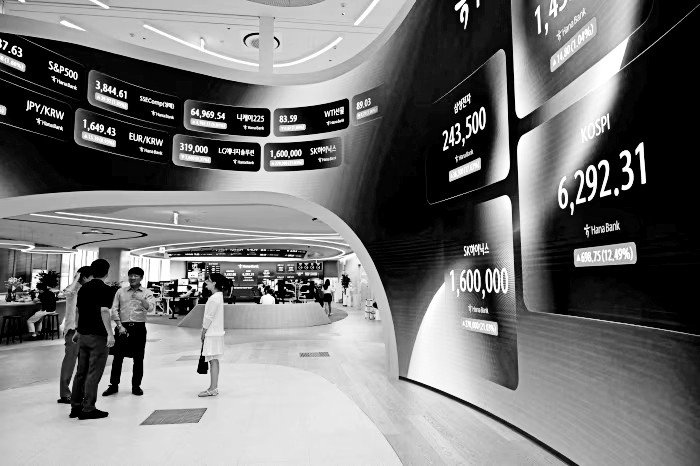
South Korean shares opened sharply higher on Wednesday as investors returned to semiconductor and artificial-intelligence companies following a strong rally on Wall Street. The KOSPI jumped 244.53 points, or 3.85 per cent, to begin trading at 6,603.48.
Technology confidence returns
The opening advance represented another dramatic movement for a market that has experienced extreme volatility. The KOSPI gained 1.62 per cent on Tuesday after falling 5.12 per cent during the previous session.


Samsung Electronics and SK Hynix were among the principal drivers of Wednesday’s rebound. In early trading, SK Hynix rose approximately 5.9 per cent to 1,670,000 won, while Samsung Electronics gained around 4.6 per cent to 251,000 won.
Samsung Electro-Mechanics climbed 11.6 per cent, while SK Square, which holds a major interest in SK Hynix, advanced 7.8 per cent. Gains also spread to automobile, battery, shipbuilding and industrial companies, giving the rally broader support.
Wall Street provides a strong signal
South Korean investors followed substantial overnight gains in the United States. The Dow Jones Industrial Average rose 1.71 per cent to 54,085.88, while the Nasdaq Composite climbed 2.59 per cent to 26,584.99.
Strong corporate earnings helped ease concerns that the global artificial-intelligence investment boom might be producing insufficient returns. Results from American technology and industrial companies renewed confidence in spending on software, data centres and advanced computing infrastructure.
This was particularly important for South Korea because Samsung Electronics and SK Hynix supply memory chips used throughout the global technology industry. Their size also gives both companies an unusually powerful influence over the KOSPI.
Hormuz hopes lift risk appetite
Investors also responded positively to expectations that the United States and Iran could reach an interim arrangement over the Strait of Hormuz.
The possibility of greater shipping access through the strategically important waterway pushed oil prices lower. Reduced energy costs would be beneficial for South Korea, which relies heavily on imported fuel and industrial raw materials.
Lower oil prices could also ease inflationary pressure, reduce production costs and improve the outlook for manufacturers, airlines and transport companies.
Volatility remains a concern
Despite the powerful opening, the scale of recent movements showed that the South Korean market remained highly unstable. Rapid trading in leveraged products connected to individual technology companies has intensified both advances and declines.
South Korean authorities have announced measures intended to reduce speculative activity, including tighter limits on investors’ exposure to single-company leveraged exchange-traded funds.
Wednesday’s opening demonstrated that demand for South Korea’s leading technology companies remained strong. However, the market’s recent history suggested that investors would continue to monitor valuations, regulatory changes and global artificial-intelligence spending closely.
The KOSPI’s 3.85 per cent opening gain was one of the strongest performances in Asia and confirmed that semiconductor shares had once again become the main engine of the South Korean market.
Newshub Editorial in Asia – 5 August 2026

Ask NF GPT
If you have an account with ChatGPT you get deeper explanations,
background and context related to what you are reading.
South Korean shares opened sharply higher on Wednesday as investors returned to semiconductor and artificial-intelligence companies following a strong rally on Wall Street. The KOSPI jumped 244.53 points, or 3.85 per cent, to begin trading at 6,603.48.
Recent Comments