
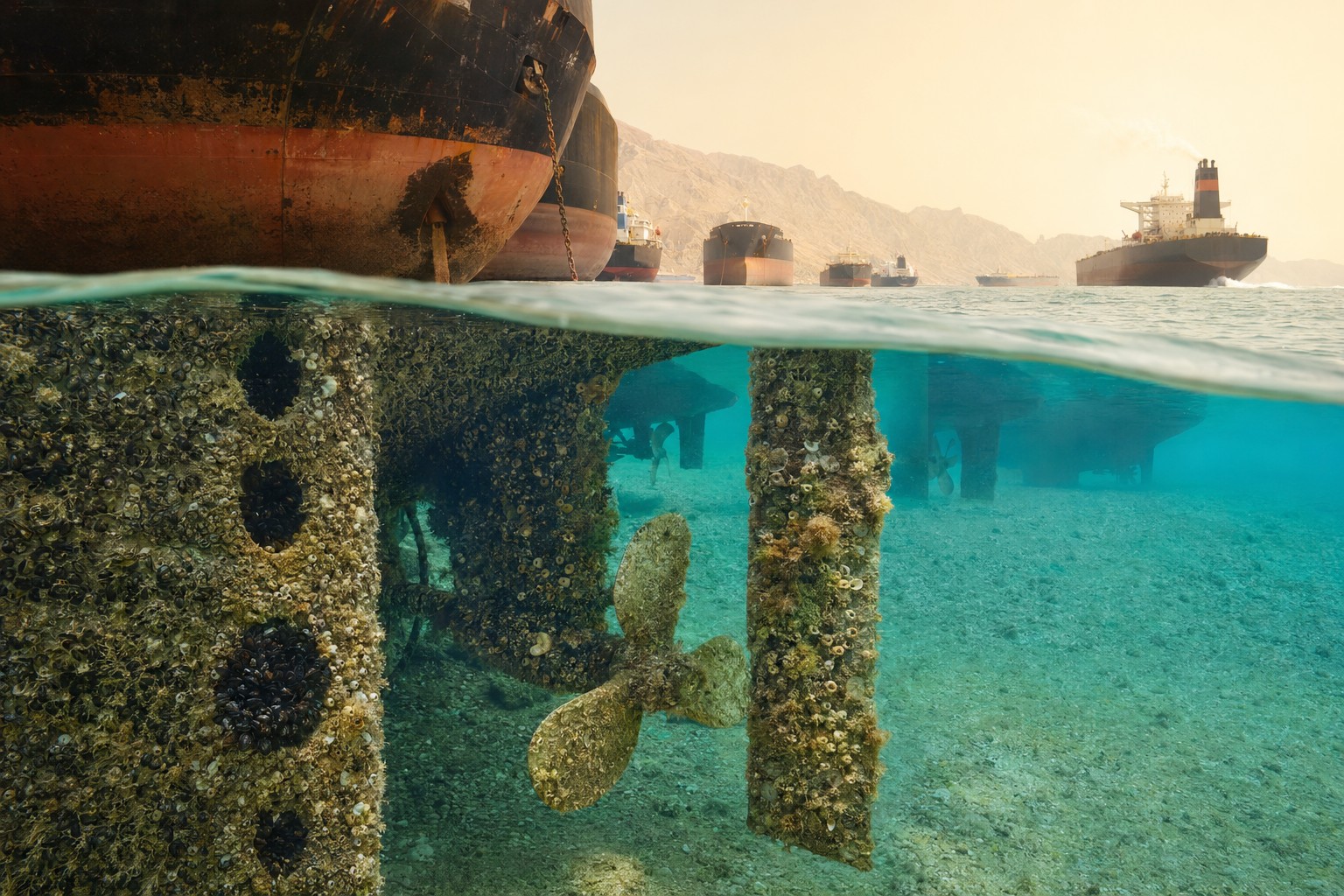
The prolonged disruption of shipping through the Strait of Hormuz may be creating an unexpected global environmental threat, as marine organisms colonise the hulls of vessels that have remained stationary in the Gulf for several months.
An estimated 1,500 commercial ships were stranded in the Persian Gulf following the closure of the strait on 28 February, with hundreds more waiting in the Gulf of Oman.
Researchers now warn that when regular shipping eventually resumes, these vessels could transport unusually large communities of algae, barnacles, mussels, microbes and other marine organisms to ports around the world.


The situation has been described as a potential marine bio-invasion “super-spreader” event.
Months of growth beneath the waterline
The process, known as biofouling, begins when microorganisms attach themselves to submerged surfaces. Algae and larger invertebrates then establish themselves on the developing biological layer.
Growth can occur across a ship’s main hull, but the greatest risks are often found in protected areas such as sea chests, rudders, propellers, bow thrusters and internal seawater pipes.
Cargo ships normally remain at anchor or in port for only one to three days. Research indicates that biofouling on stationary surfaces can enter a rapid growth phase after approximately ten days.
The International Maritime Organization recommends immediate biofouling management before the next voyage when a vessel has remained idle for more than 18 to 30 days. Many vessels around Hormuz have been stationary for considerably longer.
A global distribution network
The environmental danger would emerge when the ships begin moving again.
Organisms attached to their hulls could release eggs, spores and larvae during journeys and at destination ports. If these organisms survive, reproduce and establish permanent populations, they can become invasive.
One analysis of vessels operating in the Gulf region identified a network involving more than 3,000 ships and 3,500 ports and anchorages. This demonstrates how quickly organisms acquired around Hormuz could be transported into the Mediterranean, Europe, Africa and Asia.
Ports with warm and saline conditions similar to the Gulf may face the greatest immediate risk. Researchers have identified Mumbai, Colombo, Singapore, Jeddah, Alexandria and Piraeus among the locations where enhanced monitoring may be necessary.
European ports including Rotterdam and Algeciras could also receive vessels that have spent months in Gulf waters.
Not every organism will become invasive
The presence of marine life on a hull does not automatically create an ecological disaster. Many organisms will die during transit or fail to survive in unfamiliar temperatures and salinity levels.
However, the number of vessels involved creates what scientists call high propagule pressure: the repeated introduction of large numbers of organisms into several different environments.
The Gulf’s extreme temperatures and high salinity may also favour particularly resilient species. If introduced successfully, they could compete with native wildlife, alter food chains, spread parasites and damage coral reefs, seagrass meadows and shellfish beds.
Invasive species can also affect fisheries, aquaculture, tourism, power stations and port infrastructure.
Action required before shipping resumes
The most effective response would be to inspect and clean affected vessels before they leave the region. Cleaning operations must capture and safely dispose of removed material; uncontrolled underwater cleaning could simply release living organisms into Gulf waters.
Researchers have also called for destination ports to receive advance information about incoming vessels, inspect high-risk ships and establish rapid-response systems.
Settlement plates, underwater surveys and molecular monitoring could help detect newly introduced species before they become established.
Shipping traffic through Hormuz remains severely restricted. Only six vessels were recorded passing through the strait on Monday, although ships travelling with tracking systems switched off may not have been included.
When the backlog is eventually released, the priority will be restoring global trade. Scientists warn that without coordinated biosecurity measures, the ecological consequences could continue long after the political and military crisis has ended.
Newshub Editorial in the Middle East – 4 August 2026

Ask NF GPT
If you have an account with ChatGPT you get deeper explanations,
background and context related to what you are reading.
The prolonged disruption of shipping through the Strait of Hormuz may be creating an unexpected global environmental threat, as marine organisms colonise the hulls of vessels that have remained stationary in the Gulf for several months.
Recent Comments