
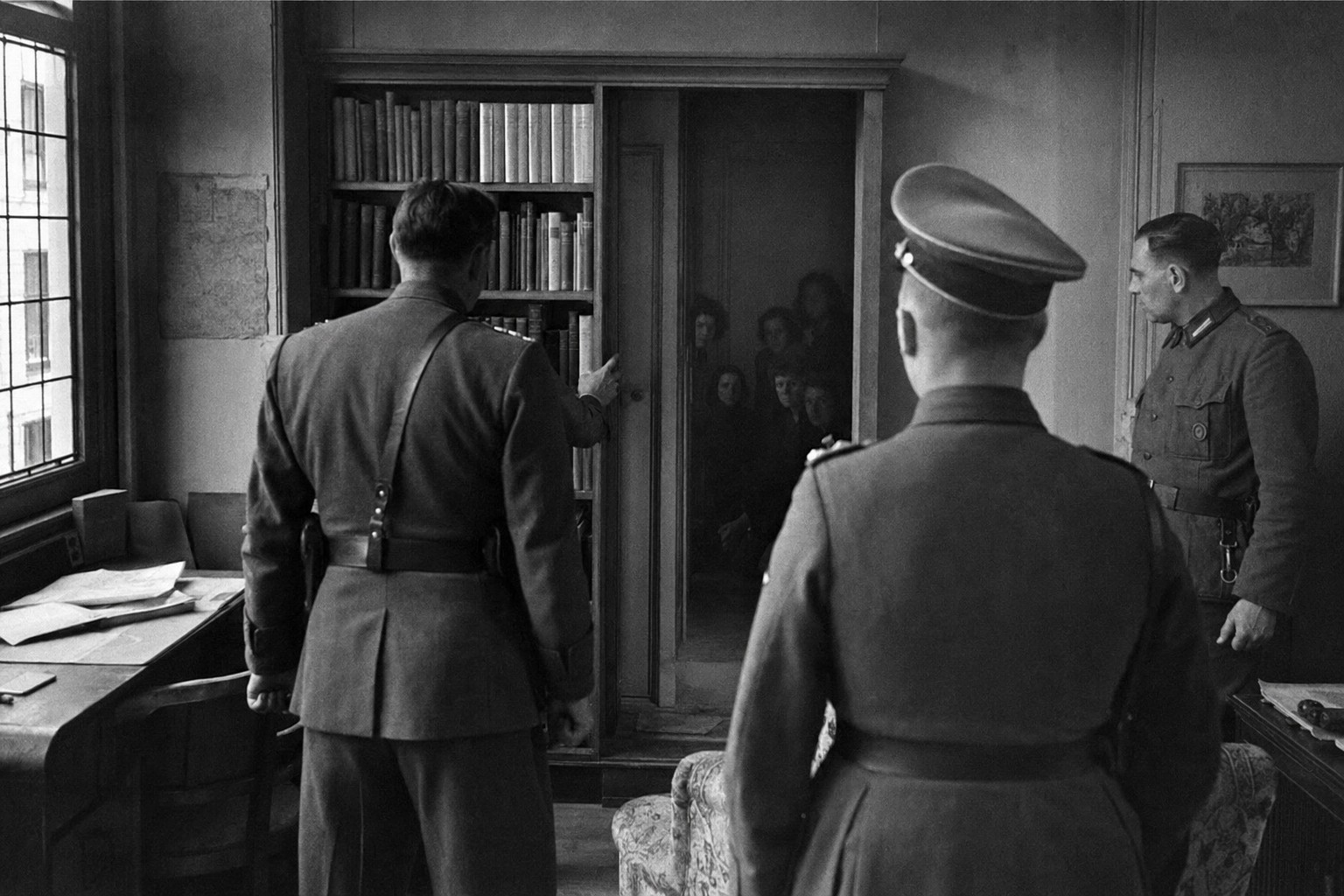
On 4 August 1944, the hidden rooms above a business premises on Prinsengracht in Amsterdam were raided by German security officers. Inside, Anne Frank, her family and four other Jewish people were discovered after more than two years in hiding.
The raid ended one of the most famous attempts to escape Nazi persecution during the Second World War. The eight people hiding in the Secret Annex were arrested and eventually deported to concentration and extermination camps. Only Anne’s father, Otto Frank, survived.
More than two years in hiding


Anne Frank entered the hiding place with her parents, Otto and Edith Frank, and her older sister Margot in July 1942. The family had fled Germany for the Netherlands following Adolf Hitler’s rise to power, but the German occupation of the Netherlands in 1940 placed them in danger once again.
They were later joined by Hermann and Auguste van Pels, their son Peter, and the dentist Fritz Pfeffer. The entrance to the concealed rooms was hidden behind a movable bookcase.
For 25 months, the eight occupants lived in almost complete silence during working hours. They relied on a small group of trusted helpers, including Miep Gies, Bep Voskuijl, Johannes Kleiman and Victor Kugler, who secretly supplied food, news and other necessities.
During this period, Anne recorded her experiences, thoughts and ambitions in the diary she had received for her 13th birthday.
The raid on Prinsengracht
On the morning of 4 August 1944, German security officers and Dutch collaborators entered the building at 263 Prinsengracht. The operation was led by SS officer Karl Silberbauer.
The officers searched the premises and discovered the bookcase concealing the entrance to the annex. All eight people in hiding were arrested. Kleiman and Kugler were also detained for helping them, while Gies and Voskuijl avoided arrest.
The precise circumstances behind the raid remain disputed. For decades, it was widely believed that an anonymous informant had betrayed the occupants. Numerous suspects and theories have since emerged, but no explanation has been conclusively established. Some researchers have suggested that the discovery may have occurred during an investigation into illegal employment or ration-card fraud.
Deportation and death
The eight prisoners were taken to the Westerbork transit camp before being deported to Auschwitz in September 1944. They were later separated and transferred to different camps.
Anne and Margot were eventually sent to Bergen-Belsen, where both died from disease and exhaustion, probably in February 1945, only weeks before British forces liberated the camp.
Otto Frank returned to Amsterdam after the war and learned that he was the only member of the group to have survived.
A diary preserved
After the arrest, Miep Gies and Bep Voskuijl found Anne’s papers scattered across the annex. Gies preserved them without reading them and later gave them to Otto Frank.
Anne’s diary was first published in Dutch in 1947. It has since been translated into dozens of languages and become one of the world’s most widely read accounts of the Holocaust.
The Secret Annex is now preserved as part of the Anne Frank House, standing as a lasting warning about antisemitism, dictatorship and the human consequences of persecution.
Newshub Editorial in Europe – 4 August 2026

Ask NF GPT
If you have an account with ChatGPT you get deeper explanations,
background and context related to what you are reading.
On 4 August 1944, the hidden rooms above a business premises on Prinsengracht in Amsterdam were raided by German security officers. Inside, Anne Frank, her family and four other Jewish people were discovered after more than two years in hiding.
Recent Comments