
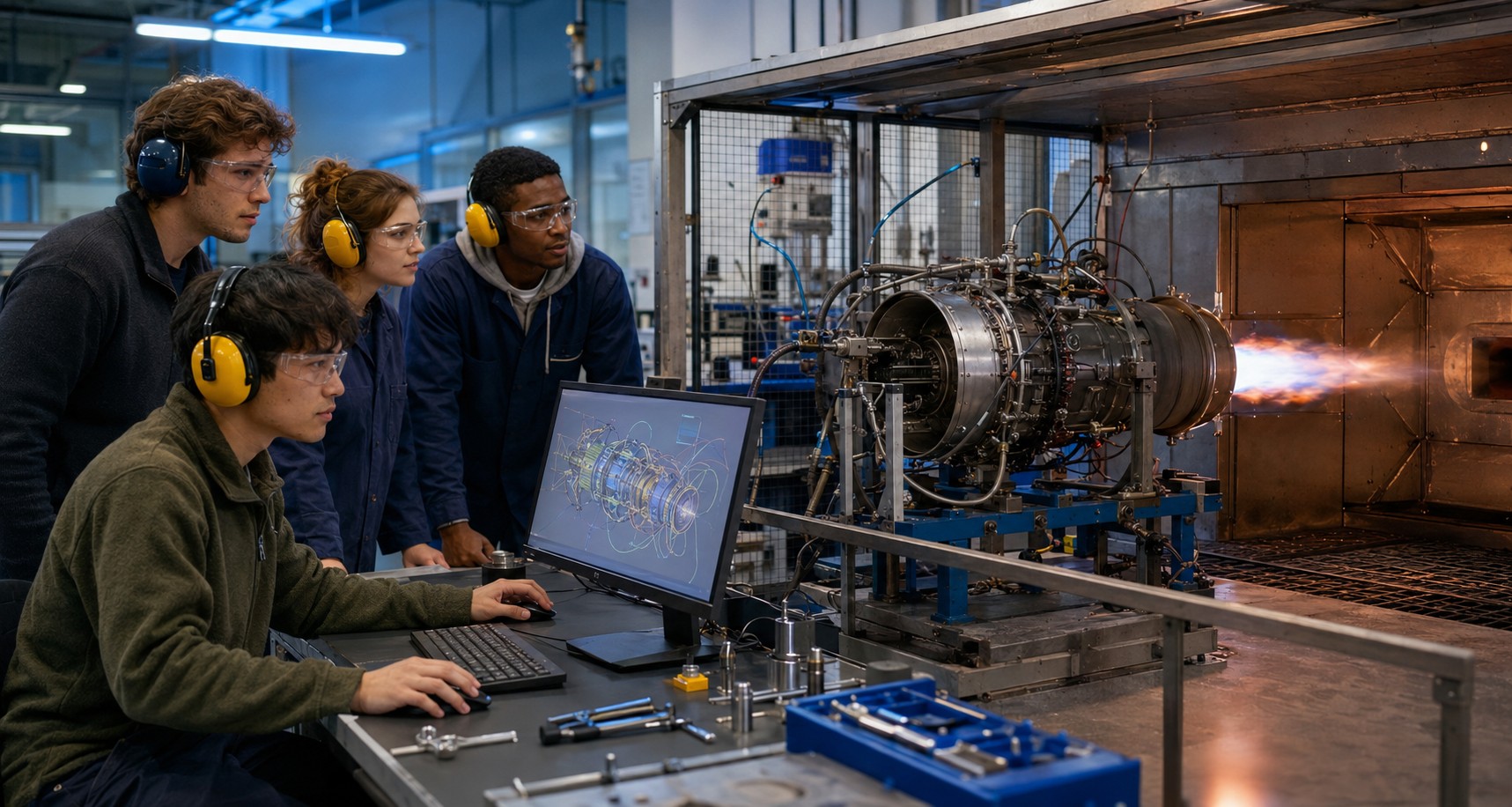
Thirty-one Massachusetts Institute of Technology students have tested whether artificial intelligence can help design and build one of engineering’s most demanding machines: a working jet engine. The inaugural JARVIS Challenge found that AI copilots can accelerate research, organisation and early design decisions, but cannot replace experience, physical understanding or human responsibility.
Four weeks to build an engine
JARVIS stands for Jet-engine AI Research and Validation Intensive Sprint. The programme divided undergraduate students from across MIT’s engineering departments into seven teams and gave them four weeks to design, manufacture, assemble and test a small single-spool gas-turbine engine.
The objective was ambitious. Each team was asked to produce an engine running on Jet-A aviation fuel, generating between 50 and 100 pounds of thrust and capable of completing five separate 60-second runs.


Many participants had little previous experience of gas turbines, compressible airflow or turbomachinery. Some first-year students had not yet studied thermodynamics.
The teams had access to MIT workshops, specialist manufacturing suppliers, commercial engineering software and test equipment. Faculty members and teaching assistants supervised safety, but provided minimal technical direction.
AI speeds research and planning
Students used frontier language models through MIT’s Parley platform, which allows access to several AI systems through a common interface.
The tools summarised textbooks, explained unfamiliar software, compared engine architectures, created spreadsheets, identified suppliers and helped organise project schedules. One team even configured an AI agent to act as its project manager.
During the opening phase, AI allowed students to navigate unfamiliar technical subjects more quickly than conventional research alone. It was particularly useful for producing comparisons and identifying potential approaches before detailed engineering began.
However, its limitations became more serious when teams moved from general concepts to precise physical designs.
Hallucinations meet physical reality
Students found that AI models could confidently provide incorrect information, agree too readily with flawed assumptions and struggle to understand how components would behave once manufactured and assembled.
An error in software can often be corrected quickly. A mistake involving rotating machinery, fuel and combustion can destroy equipment or create a serious safety risk.
The teams therefore needed sufficient knowledge to challenge the AI’s recommendations. When students lacked that foundation, unreliable answers sometimes created additional work rather than saving time.
AI also struggled with practical manufacturing. It could suggest potential suppliers, but could not establish the personal relationships needed to persuade companies to meet an extremely compressed schedule. MIT researchers concluded that manufacturing, rather than design or analysis, remained the principal bottleneck.
Experience remains decisive
Two senior teams eventually completed full engine tests. Fast and Fractured reached the test stage after using AI extensively for design comparisons, but its run ended when the rotor rubbed against the stationary housing and seized.
Team 811 Crew successfully started its engine, transitioned to Jet-A fuel and generated net thrust, winning the challenge. Significantly, its members had greater previous knowledge of propulsion and were more sceptical about relying heavily on AI.
The result did not show that avoiding AI is the best strategy. Another experienced team used the technology effectively to move faster. Instead, the strongest performance came from combining AI’s speed with engineers capable of recognising its mistakes.
The JARVIS Challenge suggests that AI copilots could compress aerospace development cycles and allow small teams to explore more options. Yet the experiment also demonstrated that first principles, practical skill and accountable human judgement become more important—not less—when AI enters safety-critical engineering.
Newshub Editorial in North America – 20 July 2026

Ask NF GPT
If you have an account with ChatGPT you get deeper explanations,
background and context related to what you are reading.
Thirty-one Massachusetts Institute of Technology students have tested whether artificial intelligence can help design and build one of engineering’s most demanding machines: a working jet engine. The inaugural JARVIS Challenge found that AI copilots can accelerate research, organisation and early design decisions, but cannot replace experience, physical understanding or human responsibility.
Recent Comments