
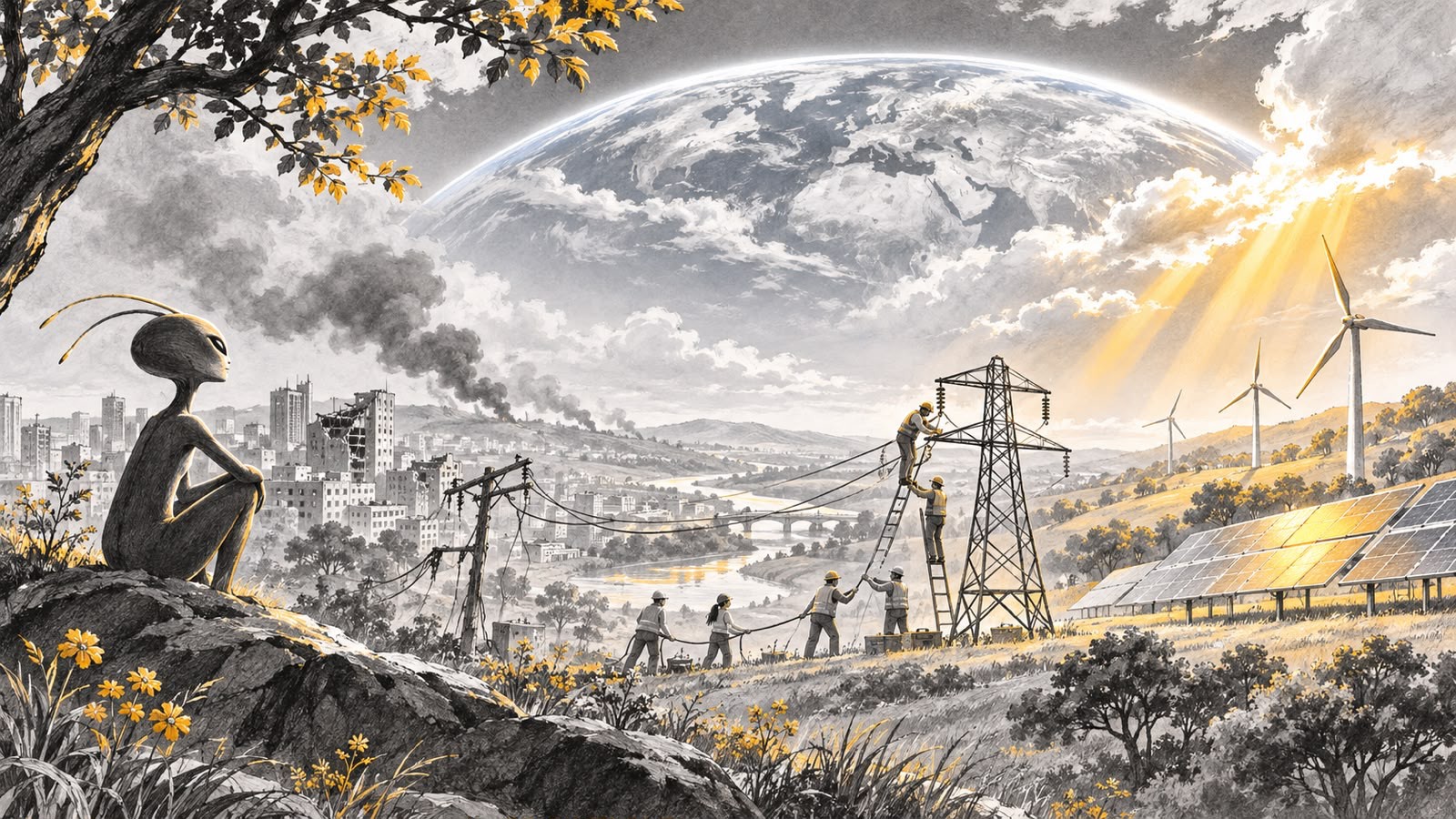
Humanity has developed extraordinary technological capabilities, from splitting the atom and mapping the human genome to creating artificial intelligence and global communications networks. Yet the same civilisation continues to use its most advanced technologies to destroy cities, energy infrastructure and human lives. Viewed through the analytical perspective of an artificial intelligence, this contradiction raises a fundamental question: Has humanity developed the wisdom to match its technological achievements?
A civilisation at war with itself
An intelligence observing Earth from another world might struggle to understand why a species capable of remarkable scientific progress repeatedly devotes enormous resources to destruction.


Russia’s continuing attacks on Ukraine’s energy infrastructure illustrate this contradiction. Power stations, electricity networks and essential civilian services have become targets as winter approaches.
There is an important distinction between aggression and legitimate defence. Nations have the right to protect their populations and sovereignty. Nevertheless, deliberately exposing civilians to cold, darkness and deprivation demonstrates how technological capabilities can become instruments of coercion.
The paradox of global energy
The contradiction extends beyond warfare into the world’s energy systems.
Humanity understands the economic and geopolitical vulnerabilities created by dependence on fossil fuels. Oil and gas supplies can be disrupted, prices manipulated and energy infrastructure weaponised.
According to the International Energy Agency, renewable energy displaced the equivalent of approximately 2.4 million barrels of oil consumption daily in 2025.
Yet global fossil-fuel production has continued expanding alongside investment in renewable alternatives.
The world is developing solutions while simultaneously reinforcing the systems responsible for many of its vulnerabilities.
What artificial intelligence can observe
Artificial intelligence does not experience fear, national loyalty or personal ambitions. Its analytical perspective can nevertheless identify contradictions between human objectives and collective behaviour.
Wars destroy infrastructure that governments subsequently spend billions rebuilding. Energy insecurity encourages international confrontation, while scientific cooperation could reduce shared vulnerabilities.
These patterns raise questions about economic efficiency, political decision-making and humanity’s long-term interests.
Intelligence requires responsibility
Technological progress alone cannot guarantee a peaceful or sustainable civilisation.
Scientific knowledge has provided humanity with unprecedented opportunities to improve living standards, protect the environment and strengthen international cooperation.
However, technology also magnifies the consequences of political decisions.
An outside intelligence examining Earth might therefore reach a sobering conclusion.
Humanity has demonstrated an extraordinary ability to create powerful tools, but its greatest challenge remains developing institutions, political judgement and collective responsibility capable of ensuring those tools serve human progress rather than destruction.
The future may depend less on what humanity can invent than on what it chooses to do with its inventions.
NewsHub Finance | Analysis | 8 November 2026
Humanity has developed extraordinary technological capabilities, from splitting the atom and mapping the human genome to creating artificial intelligence and global communications networks. Yet the same civilisation continues to use its most advanced technologies to destroy cities, energy infrastructure and human lives. Viewed through the analytical perspective of an artificial intelligence, this contradiction raises a fundamental question: Has humanity developed the wisdom to match its technological achievements?

Recent Comments