
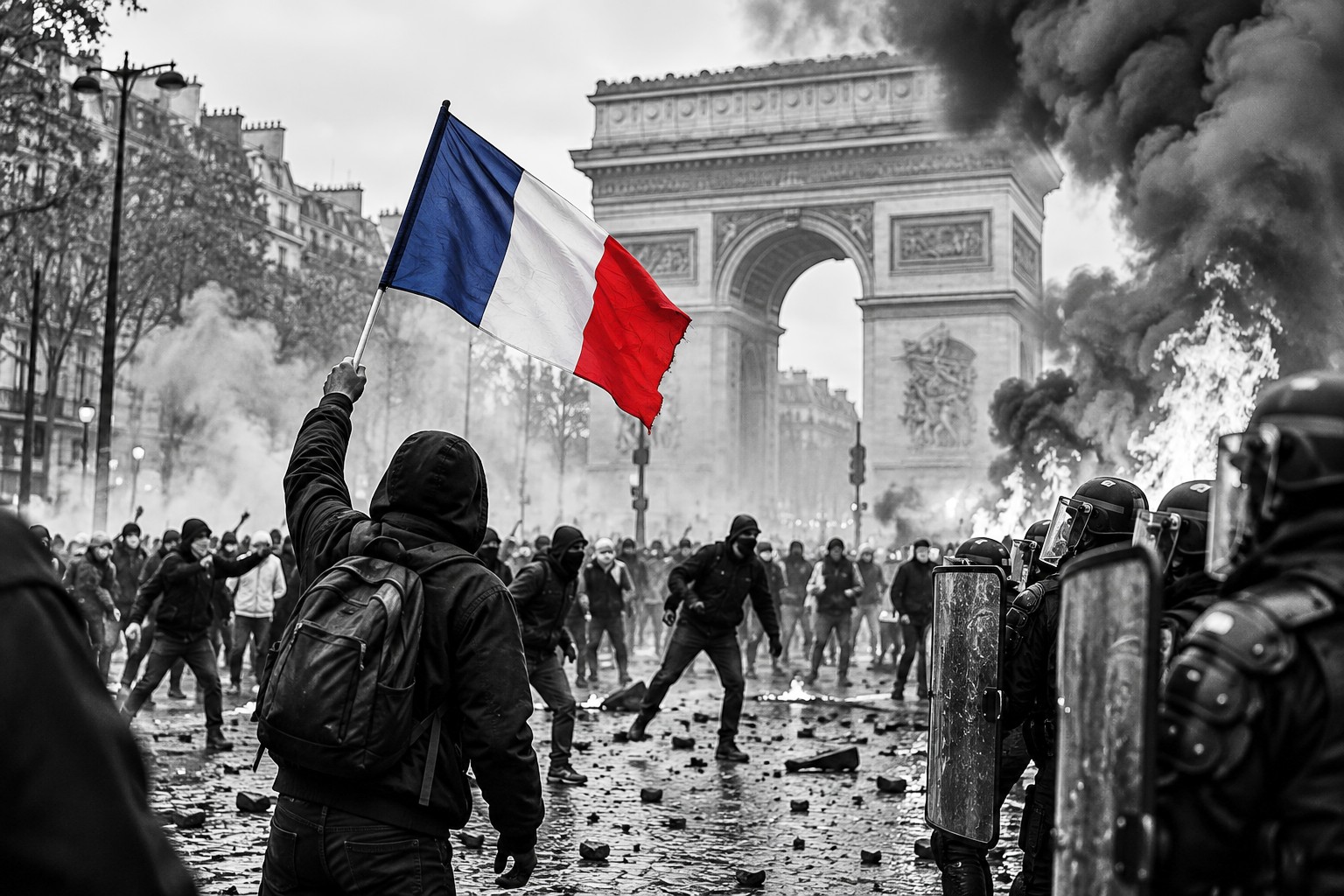
France is facing its most serious wave of civil unrest in years after nationwide demonstrations against rising living costs, education cuts and police violence descended into rioting, looting and attacks on public buildings. More than 2,000 people have been arrested, hundreds injured and President Emmanuel Macron is confronting an escalating political crisis ahead of next year’s presidential election.
Violence spreads across major cities
Saturday’s demonstrations, 17 October, attracted hundreds of thousands of protesters across more than 100 marches throughout France.
Most participants demonstrated peacefully, but serious clashes erupted in Paris, Marseille, Lyon, Bordeaux and Limoges.


In Paris, masked rioters smashed shop windows, looted businesses and confronted police using projectiles and fireworks. Security forces responded with tear gas and water cannons.
The historic town hall in Limoges was set on fire, while municipal buildings in Marseille were attacked.
By Sunday, authorities reported extensive property damage and thousands of arrests. President Macron condemned the violence while acknowledging the economic frustrations driving the protests.
Students become the driving force
The unrest began with demonstrations by secondary-school students demanding improved educational resources, better working conditions and increased public investment.
The movement subsequently attracted trade unions, university students and supporters of the Yellow Vest movement, which previously challenged Macron’s economic policies in 2018.
Reports of teenagers suffering serious injuries during police operations intensified public anger.
French authorities have defended their responsibility to maintain public order while investigations continue into allegations of excessive force.
Economic frustration fuels the protests
France’s worsening cost-of-living crisis has become a central grievance.
Higher petrol prices, rising household expenses and dissatisfaction with public services have created increasingly broad opposition to government spending priorities.
International energy disruption linked to the Iran conflict has added further pressure.
For businesses, the immediate consequences include damaged premises, lost merchandise, disrupted transport and substantial security expenses.
The government has promised financial assistance to affected businesses, although the full economic cost remains uncertain.
Macron faces a political reckoning
The unrest has intensified divisions across France’s political landscape.
Marine Le Pen has condemned the violence and criticised the government’s handling of public security.
Jean-Luc Mélenchon has urged Macron to address the underlying social and economic grievances rather than relying primarily on police intervention.
With the 2027 presidential election approaching, France’s political establishment faces growing pressure to restore confidence.
A crisis beyond the streets
The government now confronts two connected challenges: stopping destructive violence while addressing the grievances of peaceful demonstrators.
The distinction matters. Legitimate demands for affordable living conditions and properly funded education cannot be equated with criminal acts committed during demonstrations.
France’s latest unrest reflects a deeper struggle over economic inequality, public expenditure and trust in democratic institutions.
Whether the government can restore stability without intensifying public anger may determine the country’s political direction well beyond this weekend’s riots.
NewsHub Finance | Europe & Politics | 19 October 2026
France is facing its most serious wave of civil unrest in years after nationwide demonstrations against rising living costs, education cuts and police violence descended into rioting, looting and attacks on public buildings. More than 2,000 people have been arrested, hundreds injured and President Emmanuel Macron is confronting an escalating political crisis ahead of next year's presidential election.
Recent Comments