
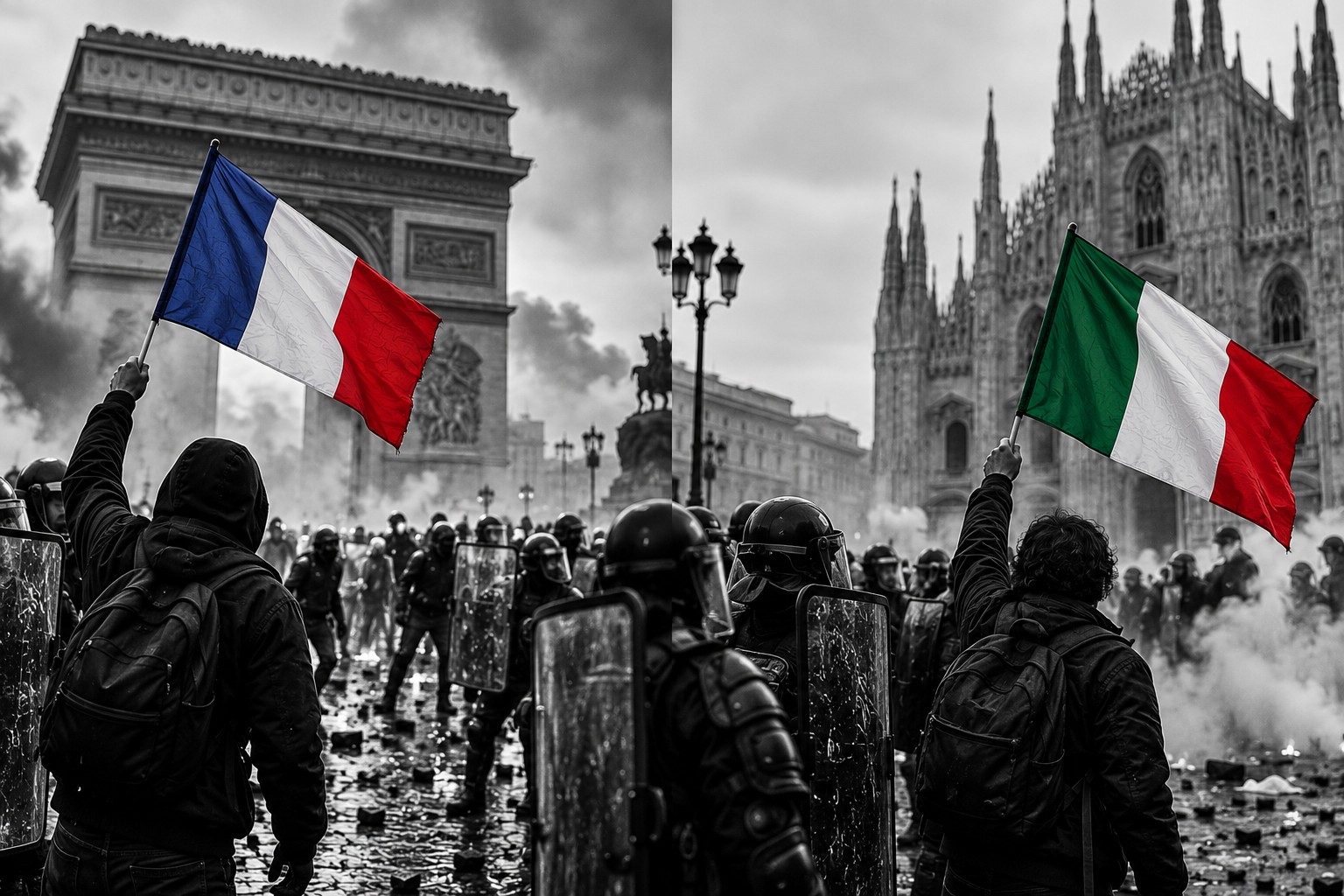
France and Italy have witnessed widespread demonstrations that have escalated into violent confrontations with police. Although the scenes appear similar, the evidence points to separate movements driven by distinct grievances. The unrest highlights growing economic frustration across Europe, but also the importance of distinguishing peaceful mass demonstrations from criminal violence.
France: Students ignite nationwide protests
In France, demonstrations initially organised by students demanding better school conditions expanded into a nationwide movement against rising living costs, fuel prices and deteriorating public services.
Hundreds of thousands joined protests across the country. The French Interior Ministry estimated participation at 550,000, while the CGT trade union reported approximately 800,000.


Reuters reported that most demonstrators marched peacefully. However, smaller groups engaged in looting, arson and violent confrontations with police.
French authorities reported nearly 2,400 arrests and almost 1,000 injured police officers during Saturday’s unrest.
Italy: Separate protests, similar frustrations
Italy experienced its own demonstrations, particularly in Milan and other northern cities.
A march opposing wars and rising living costs began peacefully before masked demonstrators attacked police, set fires and damaged commercial premises.
By Monday, Euronews, citing Italian news agency ANSA, reported more than 200 arrests in Milan since Saturday.
Although economic frustration featured prominently in both countries, the Italian protests developed independently of events in France.
Police conduct under scrutiny
The violence has raised serious questions about policing tactics and the proportionality of crowd-control measures.
AFP reported that a 17-year-old boy in France lost his hand after a crowd-control grenade exploded, while a 17-year-old girl lost an eye.
Reuters reported that allegations of excessive police force were under investigation.
These cases require independent examination. However, available evidence does not establish that every reported injury or arrest resulted from police misconduct.
Equally, violent actions by some participants should not be attributed to the hundreds of thousands who demonstrated peacefully.
Not one European uprising
The simultaneous demonstrations have encouraged comparisons suggesting a single protest movement spreading across Europe.
However, reporting cited by Al Jazeera, including assessments from news agencies and experts, characterised the French and Italian demonstrations as separate and uncoordinated.
Both reflect concerns about household finances, public services and political priorities, but their origins and local circumstances differ.
The NHX assessment
Europe is experiencing overlapping social and economic pressures, not necessarily a coordinated continental uprising.
The distinction matters.
Mass demonstrations reveal genuine public grievances. Rioting and destruction represent separate acts requiring independent assessment. Police responses must likewise be evaluated against established legal standards.
The emerging European protest wave is therefore not one story, but several national stories unfolding against a shared backdrop of economic uncertainty.
Understanding those differences is essential to understanding what is happening on Europe’s streets.
NewsHub Finance | NHX Investigations & European Affairs | 19 October 2026
France and Italy have witnessed widespread demonstrations that have escalated into violent confrontations with police. Although the scenes appear similar, the evidence points to separate movements driven by distinct grievances. The unrest highlights growing economic frustration across Europe, but also the importance of distinguishing peaceful mass demonstrations from criminal violence.
Recent Comments