
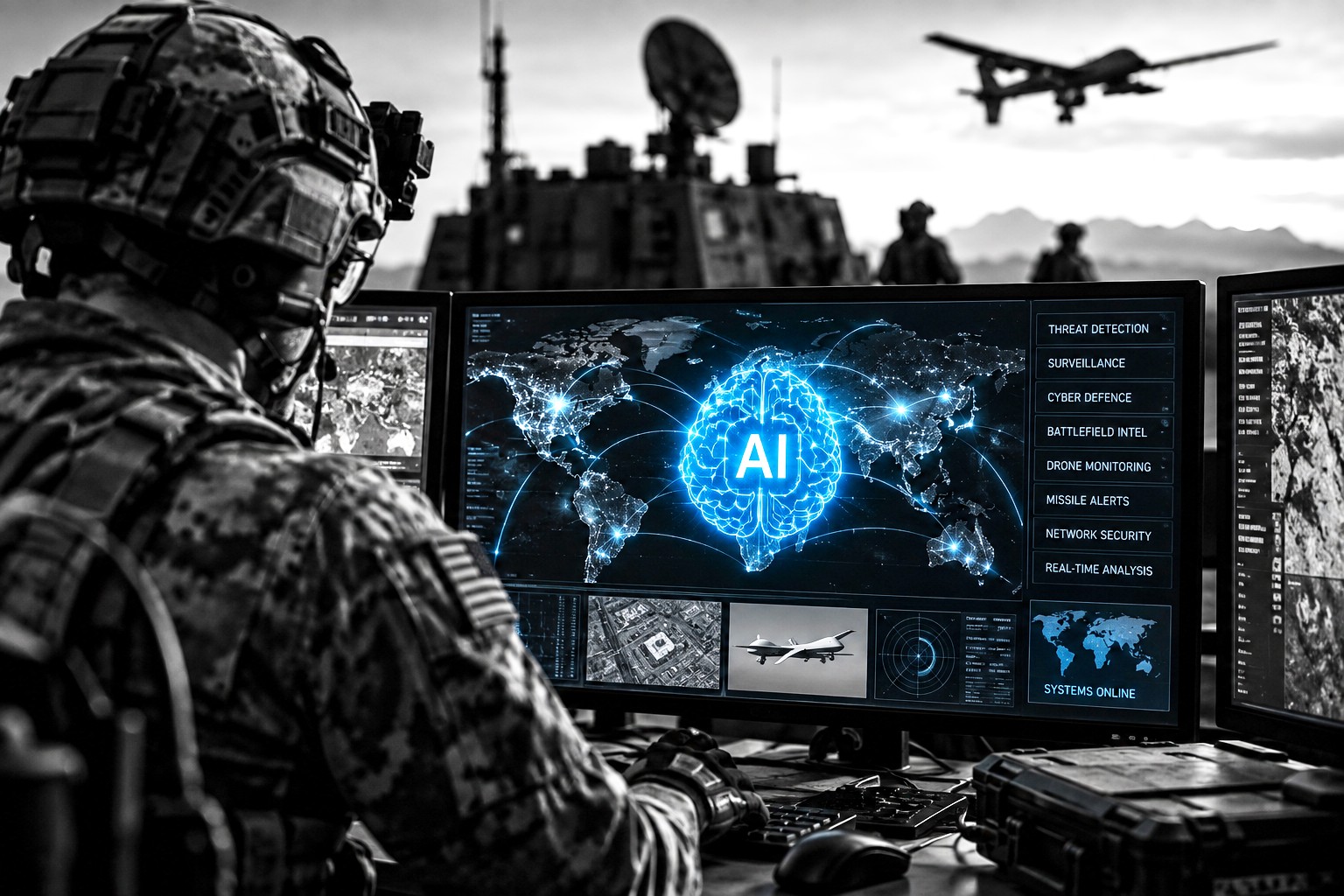
Artificial intelligence is rapidly becoming part of modern military infrastructure, helping analyse intelligence, identify threats, defend computer networks and support battlefield decisions. But the same technology is creating a new security problem: what happens when an enemy attacks the AI rather than the weapon?
The question is moving from theory towards operational reality. Military organisations are integrating AI into cyber defence, logistics, intelligence analysis, drone detection and command systems, while researchers warn that increasingly autonomous AI agents could also accelerate offensive cyber operations.
The computer becomes part of the battlefield
Traditional cyber warfare attempts to penetrate networks, steal information, disable systems or manipulate data. AI potentially changes both the speed and scale of that contest.

An AI system can analyse enormous quantities of network activity and identify suspicious behaviour far faster than a human team. NATO says AI can help cyber analysts triage alerts, analyse malware and accelerate responses to attacks.
But an adversary can use similar capabilities offensively.
AI agents could search for vulnerabilities, analyse software and automate parts of cyber operations. A 2026 US Army Cyber Institute-linked research paper argues that agentic AI is already reshaping cyber operations and identifies technical vulnerabilities, insufficient governance and escalation risks as major unresolved problems.
What if the AI itself is attacked?
The vulnerability does not stop with conventional hacking.
Military AI depends on data. Manipulating sensor information, corrupting training data or exploiting weaknesses in an AI model could potentially cause a system to classify something incorrectly or provide misleading information to operators.
NATO has explicitly recognised the danger of adversaries exploiting defects in military AI through interference, manipulation or sabotage.
NIST has meanwhile warned that no fixed collection of AI guardrails can be assumed to withstand every adaptive adversarial attack. Its recommended approach is continuous testing, red-teaming, updating and operational resilience rather than assuming a system can be permanently secured.
Defence and attack are getting faster
This creates a potentially dangerous military equation.
AI can shorten the time between detecting a threat and responding to it. That can strengthen defence, particularly against cyberattacks, missiles and drones. NATO is already investigating AI systems capable of combining radar, radio, camera and acoustic information to identify small drones.
But greater speed also creates risk.
The International Committee of the Red Cross warns that military AI decision-support systems can amplify errors and contribute to unintended escalation, particularly when humans place excessive trust in machine-generated recommendations.
Humans may become the critical safeguard
One of the most important questions is therefore not whether militaries will use AI. They already are.
The question is how much authority AI should receive.
US and Chinese security experts this week proposed safeguards intended to prevent AI from independently controlling critical cyber operations or interfering with nuclear command-and-control systems. Their proposals emphasise meaningful human control and mechanisms to prevent automated responses from escalating faster than governments can intervene.
AI could make military computers significantly better at seeing threats and defending themselves.
It could also make cyber conflict faster, more automated and considerably harder for humans to stop once it begins.
Newshub Editorial in Global Affairs – 18 September 2026

Ask NF GPT
If you have an account with ChatGPT you get deeper explanations,
background and context related to what you are reading.
Recent Comments