
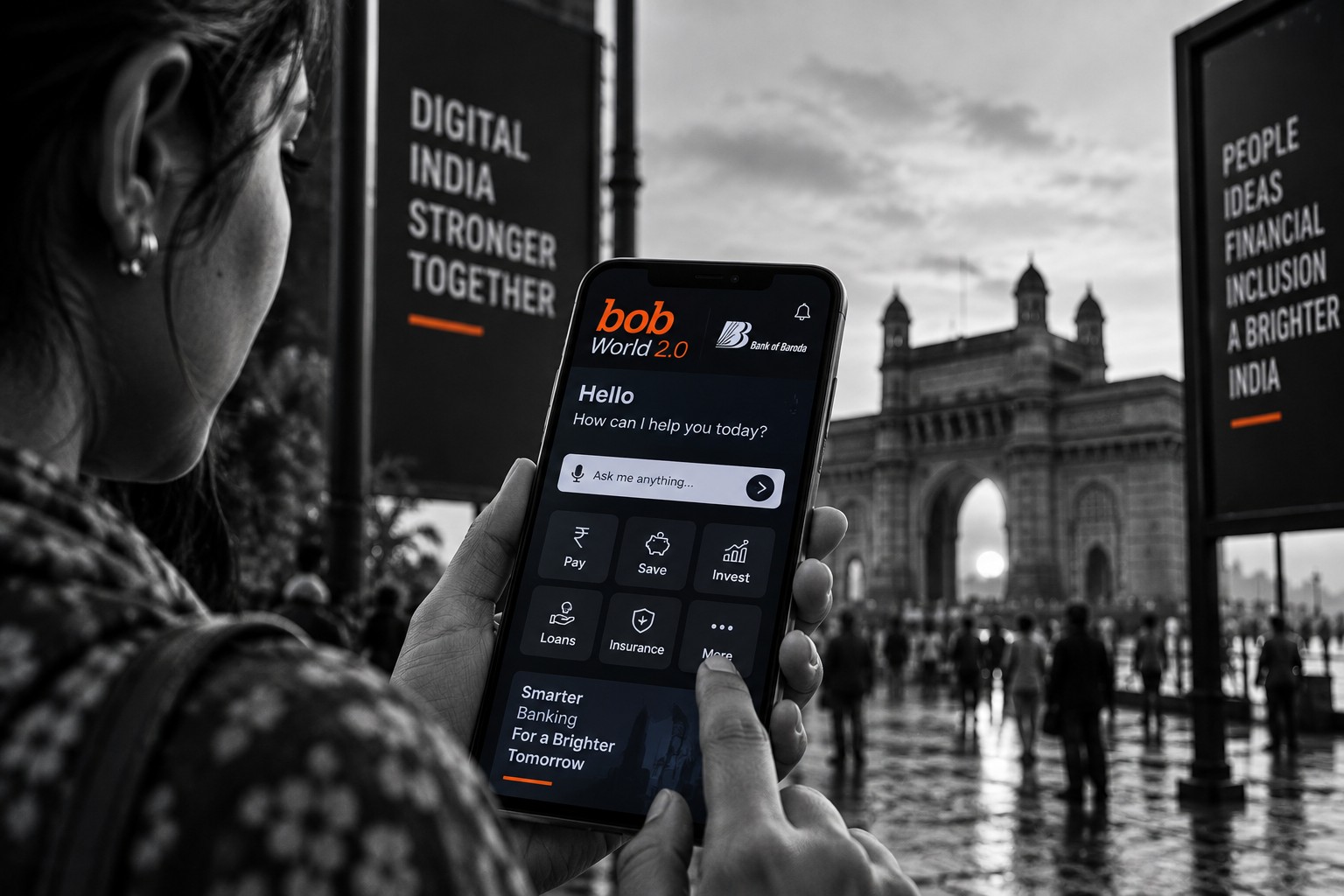
One of India’s largest banks is moving artificial intelligence directly into everyday banking, launching a new mobile platform designed to make the bank account conversational, personalised and increasingly intelligent.
Bank of Baroda has unveiled bob World 2.0, a new generation of its mobile banking platform built around artificial intelligence and a redesigned digital architecture.
The platform was presented at Global FinTech Fest 2026 in Mumbai and represents another step in India’s rapid transition from conventional online banking towards financial services built around the smartphone.


Banking becomes conversational
One of the most significant additions is AI-powered, voice-enabled conversational banking.
Instead of navigating traditional menus, customers can interact more naturally with the banking platform while accessing financial services and information.
The system also introduces personal financial management tools designed to give customers a broader view of their finances and provide insights based on their individual financial activity.
One bank, different experiences
The technology is designed around hyper-personalisation.
Rather than presenting every customer with essentially the same digital bank, bob World 2.0 can adapt the experience for different customer groups, including senior citizens, women, non-resident Indians and millennials.
Behind the interface is a microservices-based architecture connecting mobile and internet banking into a wider omnichannel ecosystem.
Bank of Baroda says the platform also incorporates multiple layers of security intended to protect increasingly complex digital interactions.
India pushes digital banking further
The launch comes as Indian banks are investing heavily in digital infrastructure.
Bank of India separately unveiled 12 digital banking initiatives at the same Mumbai fintech event, covering mobile banking, digital currency, cards, self-service banking, compliance and fintech collaboration.
India already has one of the world’s most developed digital payment environments. The next competition may therefore be less about moving payments onto phones and more about what intelligence can be built around the financial relationship.
The smartphone becomes the bank
That represents an important shift in digital banking.
The first generation digitised the branch. The next placed banking inside an app.
AI potentially changes the model again.
The mobile bank can increasingly analyse, communicate, personalise and respond — turning the smartphone from a channel for accessing a bank into the primary environment in which the financial relationship exists.
India is now providing an early glimpse of what that transition could look like at scale.
Newshub Editorial in Asia – 18 September 2026

Ask NF GPT
If you have an account with ChatGPT you get deeper explanations,
background and context related to what you are reading.
One of India’s largest banks is moving artificial intelligence directly into everyday banking, launching a new mobile platform designed to make the bank account conversational, personalised and increasingly intelligent.
Recent Comments