
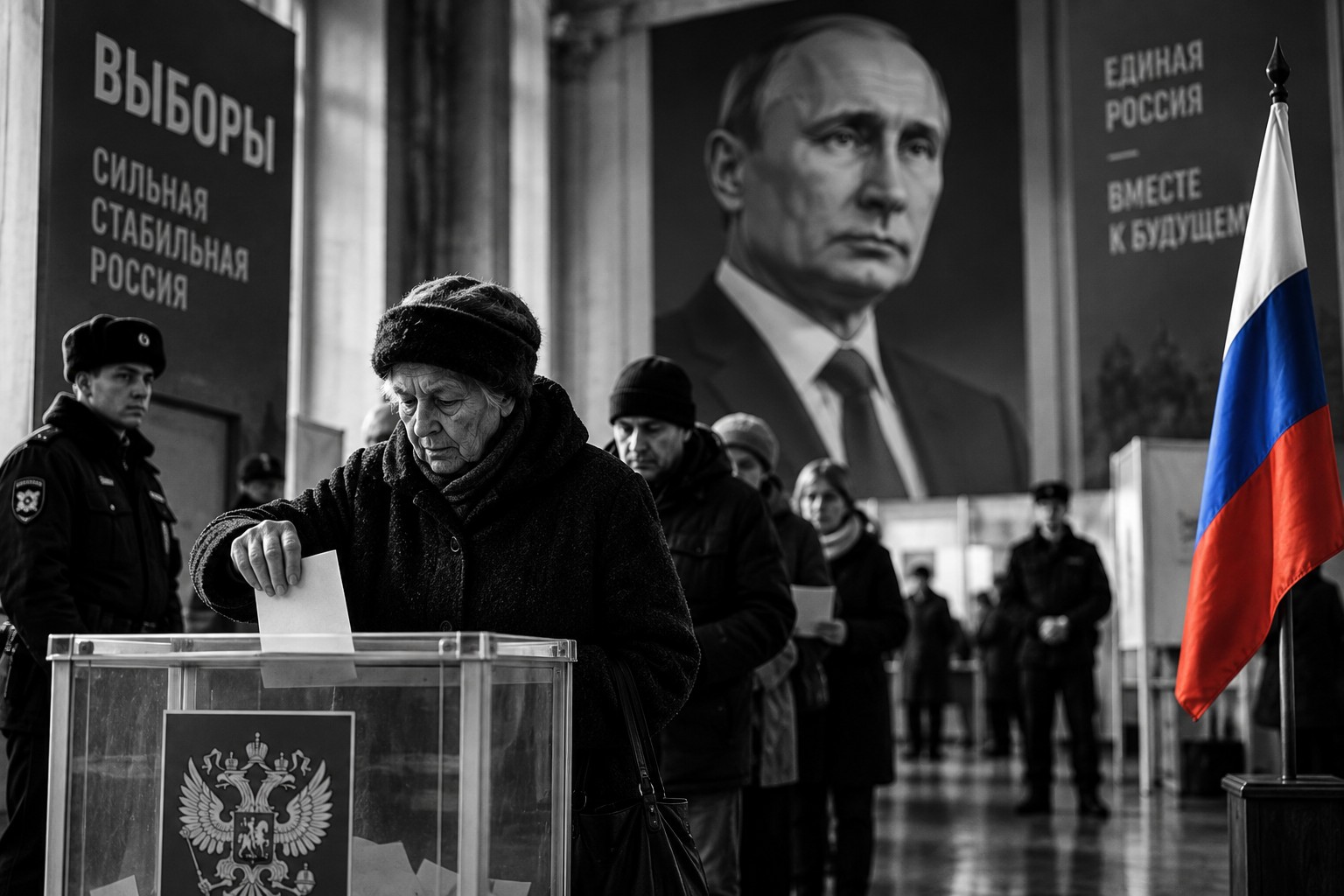
Russians began voting on Friday in the country’s first parliamentary election since the full-scale invasion of Ukraine, with President Vladimir Putin’s United Russia dominating a political landscape in which the only openly anti-war party has been excluded from the ballot.
Voting for the 450-seat State Duma takes place over three days, from 18 to 20 September.
United Russia currently controls two-thirds of the lower house of parliament. Nine other parties are participating, but the Associated Press reports that all support Putin’s principal policies, leaving voters without a major parliamentary party openly opposing the war.


The anti-war option disappears
The liberal Yabloko party had called for an end to Russia’s war against Ukraine.
In August, Russia’s Supreme Court barred Yabloko’s federal candidate list from participating in the election. The decision removed what had been the country’s only registered political party openly campaigning against the war.
The exclusion comes after years of increasing pressure on opposition politicians and anti-war activists following Russia’s invasion of Ukraine in February 2022.
Several Yabloko politicians have also faced criminal prosecution. Party vice-president Lev Shlosberg was sentenced in August to more than 11 years in prison after being convicted of offences including spreading what Russian authorities classified as false information about the armed forces.
War moves closer to everyday Russia
The election is taking place as the effects of the war become increasingly visible inside Russia itself.
Ukrainian drone attacks have struck oil refineries and other economic infrastructure, while businesses are dealing with labour shortages, high borrowing costs and inflation above 6 per cent. Russia’s government forecasts economic growth of only 0.6 per cent this year after growth slowed sharply in 2025.
The war has therefore moved beyond something experienced primarily through television, military recruitment and government spending.
For some Russians, it is increasingly affecting fuel supplies, prices, employment and physical infrastructure.
A parliament built around the Kremlin
The Communist Party, Liberal Democratic Party and other parties represented in the Duma remain formally separate from United Russia. However, they have supported many of the Kremlin’s central policies, including the war.
The election is also being conducted in Ukrainian territories that Moscow claims to have annexed, although those annexations are not internationally recognised by most countries.
Independent analysts quoted by international media describe the political environment as highly controlled and the scope for genuine electoral competition as severely restricted.
The question after the election
Attention is also turning towards what happens when voting ends.
Reports of concern about another mobilisation have circulated inside Russia, particularly among younger men. Putin has publicly rejected suggestions that another large-scale mobilisation is imminent.
The election will formally determine who occupies Russia’s parliament for the coming term.
But with the anti-war party removed from the ballot and the parliamentary parties broadly aligned with the Kremlin on the conflict, Russian voters are entering polling stations with sharply constrained choices over the issue that has transformed their country more than any other during the past four years.
Newshub Editorial in Europe – 18 September 2026

Ask NF GPT
If you have an account with ChatGPT you get deeper explanations,
background and context related to what you are reading.
Russians began voting on Friday in the country’s first parliamentary election since the full-scale invasion of Ukraine, with President Vladimir Putin’s United Russia dominating a political landscape in which the only openly anti-war party has been excluded from the ballot.
Recent Comments