
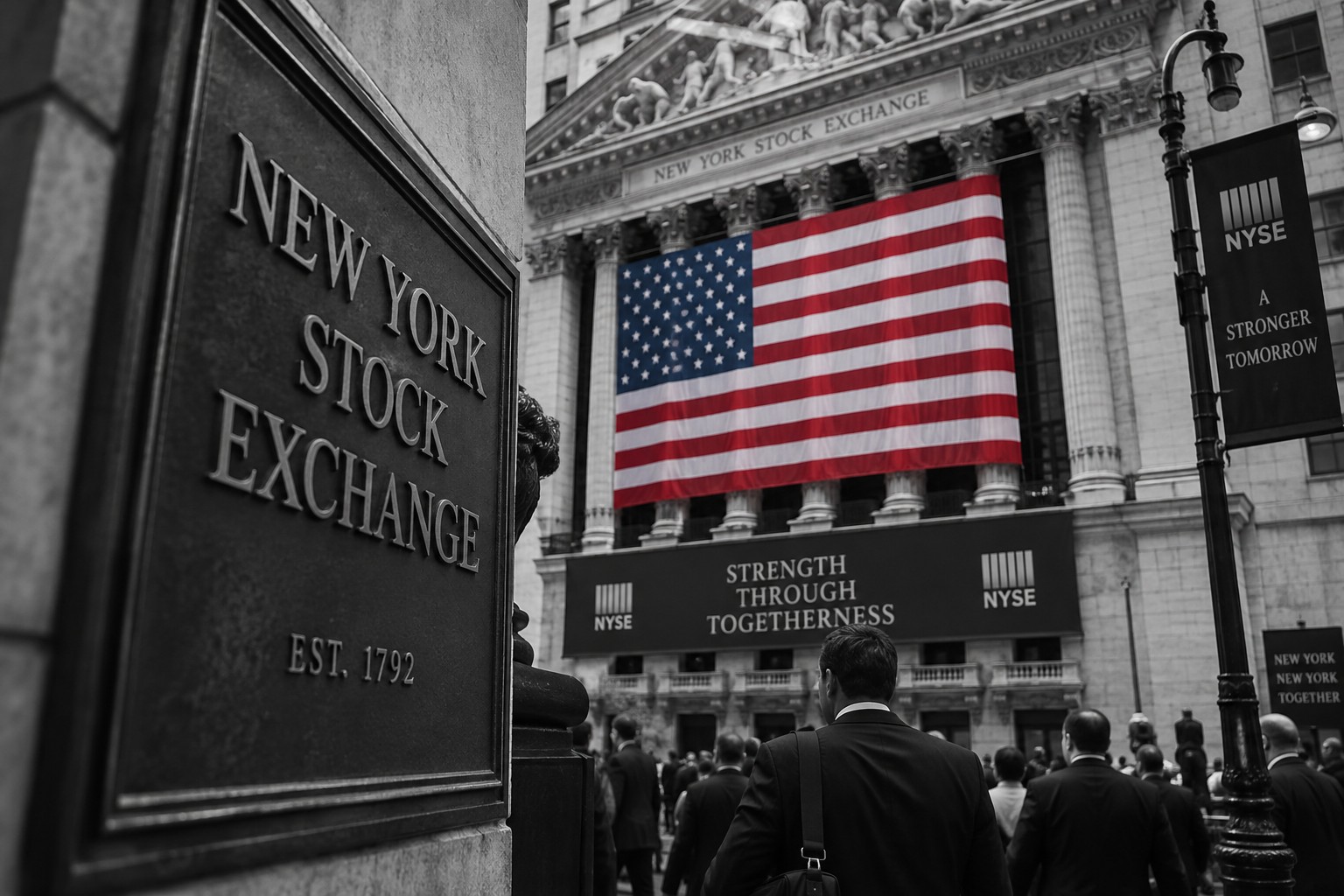
On September 17, 2001, the New York Stock Exchange reopened for trading for the first time since the September 11 terrorist attacks. The opening bell marked far more than the return of buying and selling: it became a test of whether the financial system at the heart of Lower Manhattan could function after an unprecedented attack.
NEW YORK — September 17, 2001
Six days earlier, hijacked aircraft had struck the World Trade Center, destroying the Twin Towers and devastating part of Lower Manhattan. Nearly 3,000 people were killed in the September 11 attacks.

The New York Stock Exchange did not open that morning. The closure continued as authorities, financial institutions and infrastructure providers dealt with damaged communications, disrupted transport and severe restrictions on access to the financial district.
Equity and options markets remained closed until Monday, September 17. The shutdown became the NYSE’s most significant prolonged interruption since 1914.
Preparing Wall Street to reopen
The decision to wait until September 17 was partly practical. Financial institutions had to establish whether trading, communications, clearing and settlement systems could operate reliably.
During the weekend before reopening, exchanges and market participants conducted extensive systems tests monitored by the Securities and Exchange Commission. The SEC announced on September 16 that the tests had confirmed that systems were operational and that US equity markets would reopen the following morning.
The SEC also temporarily relaxed some regulatory restrictions. Among other measures, companies were given greater flexibility to repurchase their own shares as regulators attempted to reduce the risk of disorderly market conditions.
The Federal Reserve provides liquidity
Behind the reopening was an extraordinary effort to keep America’s financial plumbing operating.
Immediately after the attacks, the Federal Reserve announced that it remained open and that its discount window was available to meet liquidity needs. In the following days, the central bank injected enormous amounts of liquidity into the financial system as disrupted communications and settlement networks made normal funding difficult.
Before equity trading resumed on September 17, the Federal Reserve also cut its target federal funds rate by 50 basis points amid concerns that the attacks could deepen an already weakening economic environment.
The opening bell rings again
When the NYSE finally reopened, the symbolism was unmistakable.
Wall Street was operating only a short distance from Ground Zero. Rescue and recovery operations continued nearby, while much of Lower Manhattan remained profoundly changed.
The market itself worked. The SEC later reported that all US securities markets resumed trading without major operational incident and that trading volumes were exceptionally heavy.
But investors immediately began pricing the economic consequences of the attacks.
The Dow Jones Industrial Average fell about 684 points, or 7.1 per cent, during the first session back.
The decline reflected concerns extending far beyond New York. Airlines, tourism, insurance, consumer confidence and the wider US economy faced enormous uncertainty.
A financial system under pressure
The reopening demonstrated something important about modern financial infrastructure.
The attacks had exposed vulnerabilities created by the geographic concentration of financial institutions, telecommunications systems and critical infrastructure in Lower Manhattan. Some backup facilities were themselves inaccessible or affected, while communications failures disrupted institutions far beyond the immediate disaster area.
Those lessons would influence financial-sector disaster recovery and business-continuity planning for years afterwards.
But September 17 also demonstrated the resilience of the system.
Six days after one of the most devastating attacks in American history, traders returned to the floor, computers were switched back into full operation and capital began moving again.
The market fell sharply.
The market nevertheless functioned.
Twenty-five years later, the reopening of the New York Stock Exchange remains one of the defining moments in Wall Street history: a day when the opening bell represented not optimism about share prices, but the restoration of a fundamental part of the global financial system.
Newshub Editorial in North America – 17 September 2026

Ask NF GPT
If you have an account with ChatGPT you get deeper explanations,
background and context related to what you are reading.
Recent Comments