
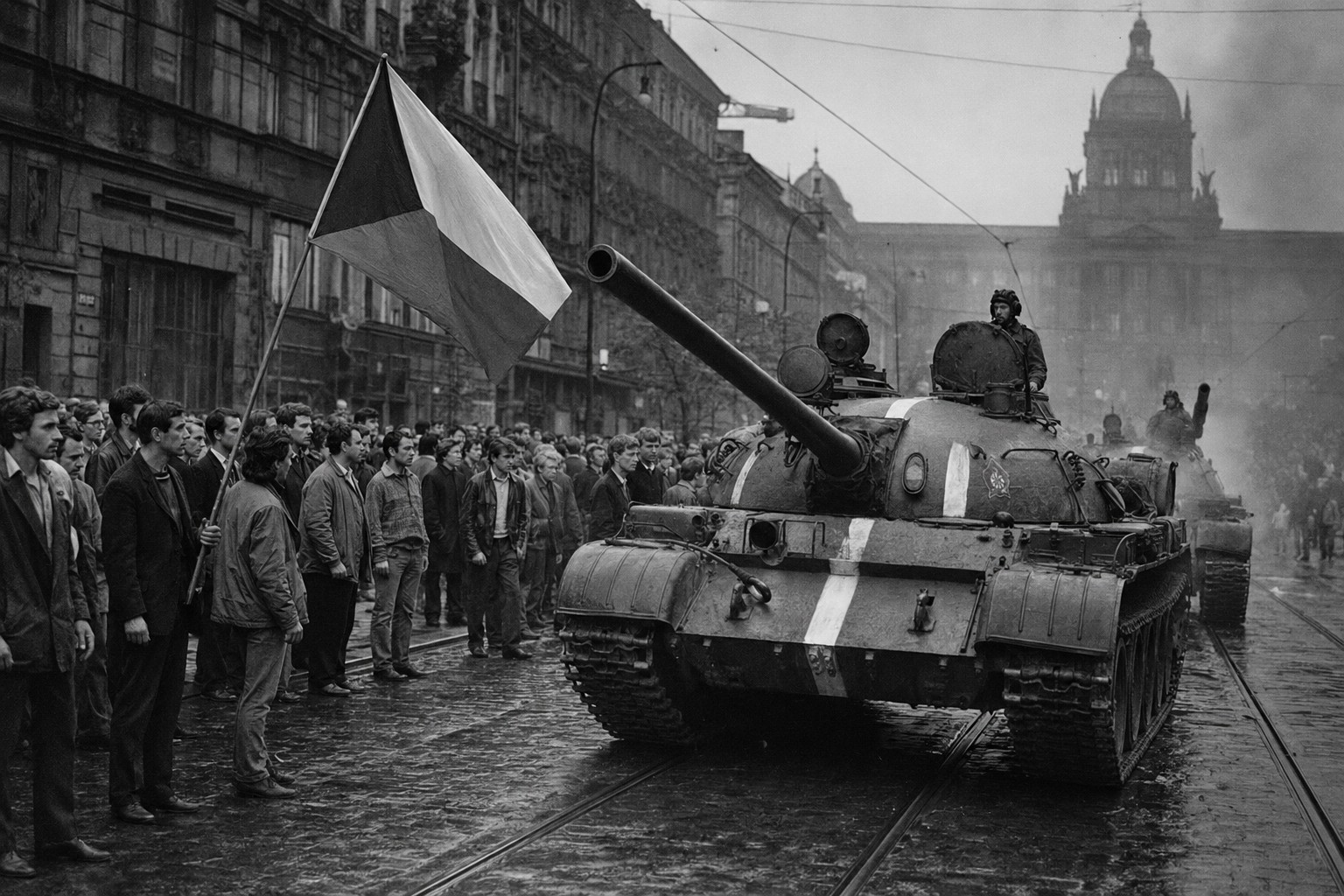
On the night of 20 August 1968, Soviet-led Warsaw Pact forces invaded Czechoslovakia, bringing an abrupt end to the Prague Spring and its attempt to create “socialism with a human face”. Romania refused to participate, while Albania—already estranged from Moscow—also stayed out of the operation.
A reform movement alarms Moscow
The crisis began after Alexander Dubček became leader of the Communist Party of Czechoslovakia in January 1968. He introduced reforms intended to make the country’s socialist system more open, accountable and responsive to its citizens.
Censorship was relaxed, public debate expanded and restrictions on travel and political expression were eased. Economic reforms were also proposed. Dubček insisted that Czechoslovakia would remain communist and stay within the Warsaw Pact, but the changes created deep concern in Moscow.

Soviet leader Leonid Brezhnev feared that the Prague Spring could inspire similar reform movements across Eastern Europe and weaken Soviet control over the communist bloc.
Operation Danube begins
After negotiations and political pressure failed to halt the reforms, Moscow approved a military intervention known as Operation Danube.
During the night of 20–21 August, Soviet, Polish, Hungarian and Bulgarian troops crossed into Czechoslovakia. East Germany supported the operation, although most of its military units were kept outside the country. Romania openly opposed the invasion, while Albania’s refusal to participate contributed to its formal withdrawal from the Warsaw Pact the following month.
Hundreds of thousands of soldiers, supported by tanks and aircraft, rapidly seized airports, government buildings, communication centres and major cities, including Prague.
Resistance without a conventional battle
The Czechoslovak government ordered its armed forces not to fight, recognising that organised military resistance against the overwhelming invasion force would probably lead to enormous casualties.
Civilian resistance nevertheless spread across the country. Residents removed street signs, confronted soldiers, painted slogans on tanks and attempted to confuse invading units. Czechoslovak Radio continued broadcasting despite efforts to silence it, becoming a focal point for resistance in Prague.
Historians have identified 137 Czechs and Slovaks who died as a result of the 1968 invasion. Around 500 people were seriously injured.
Reform leaders taken to Moscow
Dubček and other senior officials were arrested and transported to Moscow. Under intense pressure, most of the Czechoslovak delegation signed the Moscow Protocol, accepting the presence of foreign troops and the gradual reversal of the reforms.
Dubček temporarily remained in office but was removed in April 1969 and replaced by Gustáv Husák. A period known as “normalisation” followed, restoring censorship, political control and loyalty to Moscow.
The Brezhnev Doctrine
The invasion became the clearest expression of what became known as the Brezhnev Doctrine: the Soviet claim that it could intervene whenever communist rule in another socialist country appeared threatened.
The intervention damaged the Soviet Union’s international standing and divided communist parties around the world. It also demonstrated that Moscow was prepared to use military force to preserve its dominance in Eastern Europe.
Soviet troops remained in Czechoslovakia until 1991. The Prague Spring was defeated, but its demand for political freedom survived—and resurfaced during the peaceful Velvet Revolution of 1989.
REFH – Newshub, 20 August 2026

Ask NF GPT
If you have an account with ChatGPT you get deeper explanations,
background and context related to what you are reading.
Recent Comments