
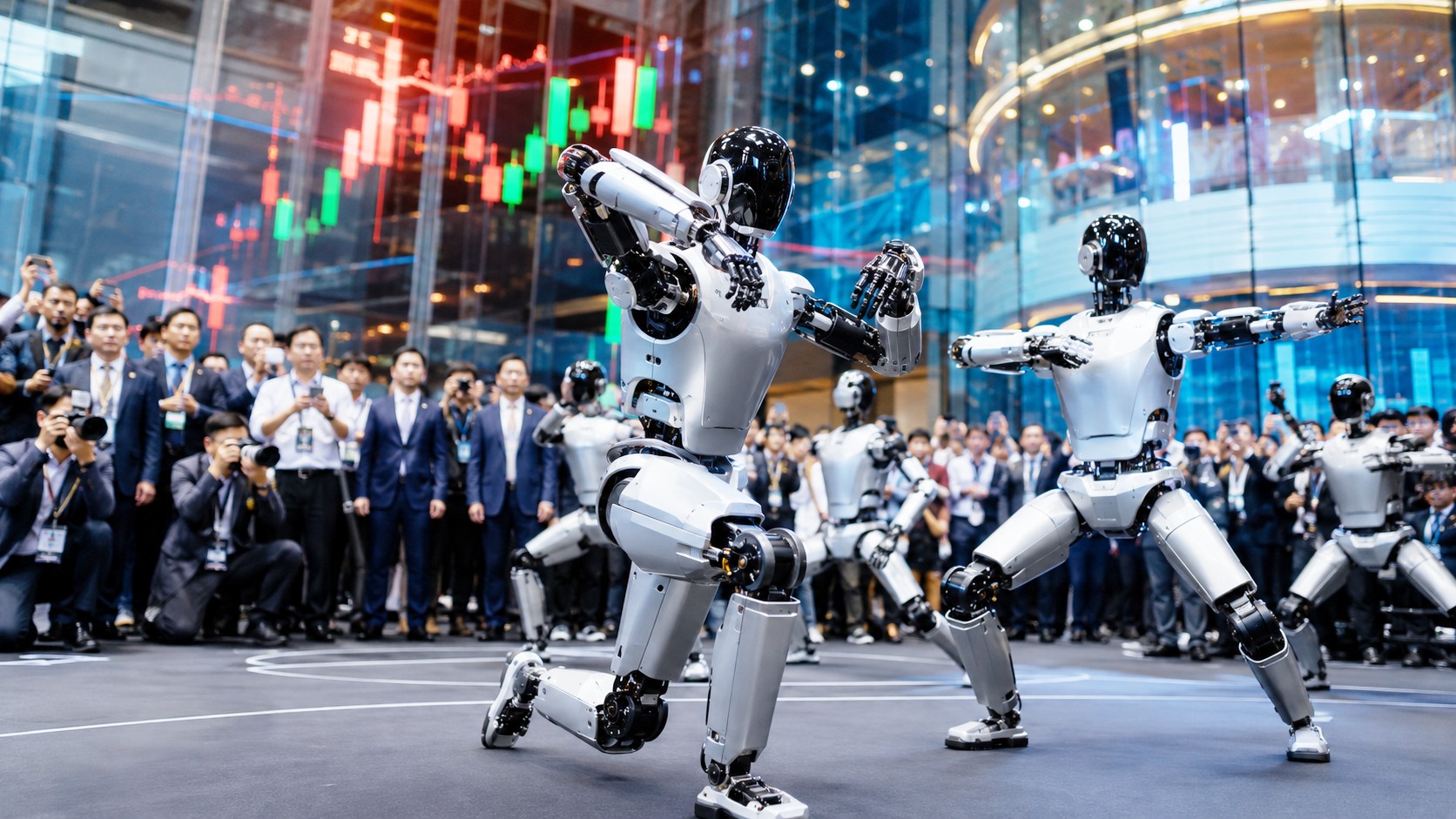
Unitree shares surged by as much as 620 per cent during their Shanghai debut, reflecting intense investor enthusiasm for the rapidly developing market for human-like robots.
Shares in Chinese robotics manufacturer Unitree soared during their first day of trading on Shanghai’s technology-focused STAR Market, delivering one of the most dramatic market debuts of the year.
The Hangzhou-based company, which manufactures humanoid and four-legged robots, has become a prominent symbol of China’s ambitions in robotics and artificial intelligence. Its machines have attracted global attention through demonstrations involving running, dancing and martial arts.

A spectacular first day
Unitree’s shares were issued at 150.80 yuan but opened as high as 1,100 yuan, representing an increase of more than 600 per cent. The stock later surrendered some of those gains and closed at 845 yuan, still 460 per cent above its initial public offering price.
The closing price gave Unitree a market capitalisation of approximately $50 billion. The performance was particularly striking because China’s CSI 300 benchmark fell about 3 per cent during the same session as technology shares weakened globally.
Unitree raised around 6.1 billion yuan, equivalent to approximately $900 million, by selling about 10 per cent of the company. Retail demand was more than 8,000 times greater than the number of shares available.
Founder and chief executive Wang Xingxing retains approximately one-fifth of the company, giving him a paper fortune of more than $11 billion following the listing.
Profitability separates Unitree from rivals
Founded in 2016, Unitree initially became known for relatively affordable quadruped robots before expanding into humanoid models such as the G1, H1 and R1.
Revenue increased more than fourfold to almost 1.7 billion yuan in 2025. The company reported adjusted net profit of around 600 million yuan, making it unusual in a robotics industry where many competitors continue to record substantial losses.
However, commercial adoption remains limited. Many Unitree robots have been purchased by universities and research institutions, while a significant proportion of sales have involved individual orders rather than large-scale industrial deployments.
China accelerates its physical AI strategy
Beijing regards humanoid robotics, sometimes described as physical or embodied AI, as an important future industry. The technology could eventually be used in manufacturing, logistics, healthcare and domestic services, while also helping China manage labour shortages caused by its ageing population.
Global humanoid robot shipments nearly quadrupled during the first half of 2026 to approximately 19,100 units, with Chinese manufacturers accounting for a dominant share.
Unitree is backed by prominent Chinese companies including Tencent, Alibaba, Meituan, Ant Group, China Mobile, Geely and AI developer DeepSeek. Its successful flotation could encourage further listings from companies including Deep Robotics, Leju Robotics, Mech-Mind Robotics and AgiBot.
Valuation and geopolitical risks remain
The enthusiasm has produced an exceptionally demanding valuation. At the IPO price, Unitree was already valued at approximately 219 times its 2025 earnings and 36 times annual sales. The first-day surge pushed those multiples considerably higher.
The company also faces geopolitical restrictions. The US Federal Communications Commission has prohibited imports of future foreign-made humanoid and quadruped robot models, including those produced by Unitree, citing national-security concerns. The Pentagon has separately added Unitree to a list of companies associated with China’s military-industrial sector. Unitree maintains that its robots are intended for civilian purposes.
Despite those risks, the market debut demonstrates the strength of investor expectations surrounding humanoid robotics. The challenge will now be turning technological spectacle into widespread, profitable commercial use.
REFH – Newshub, China, 20 August 2026

Ask NF GPT
If you have an account with ChatGPT you get deeper explanations,
background and context related to what you are reading.
Recent Comments