
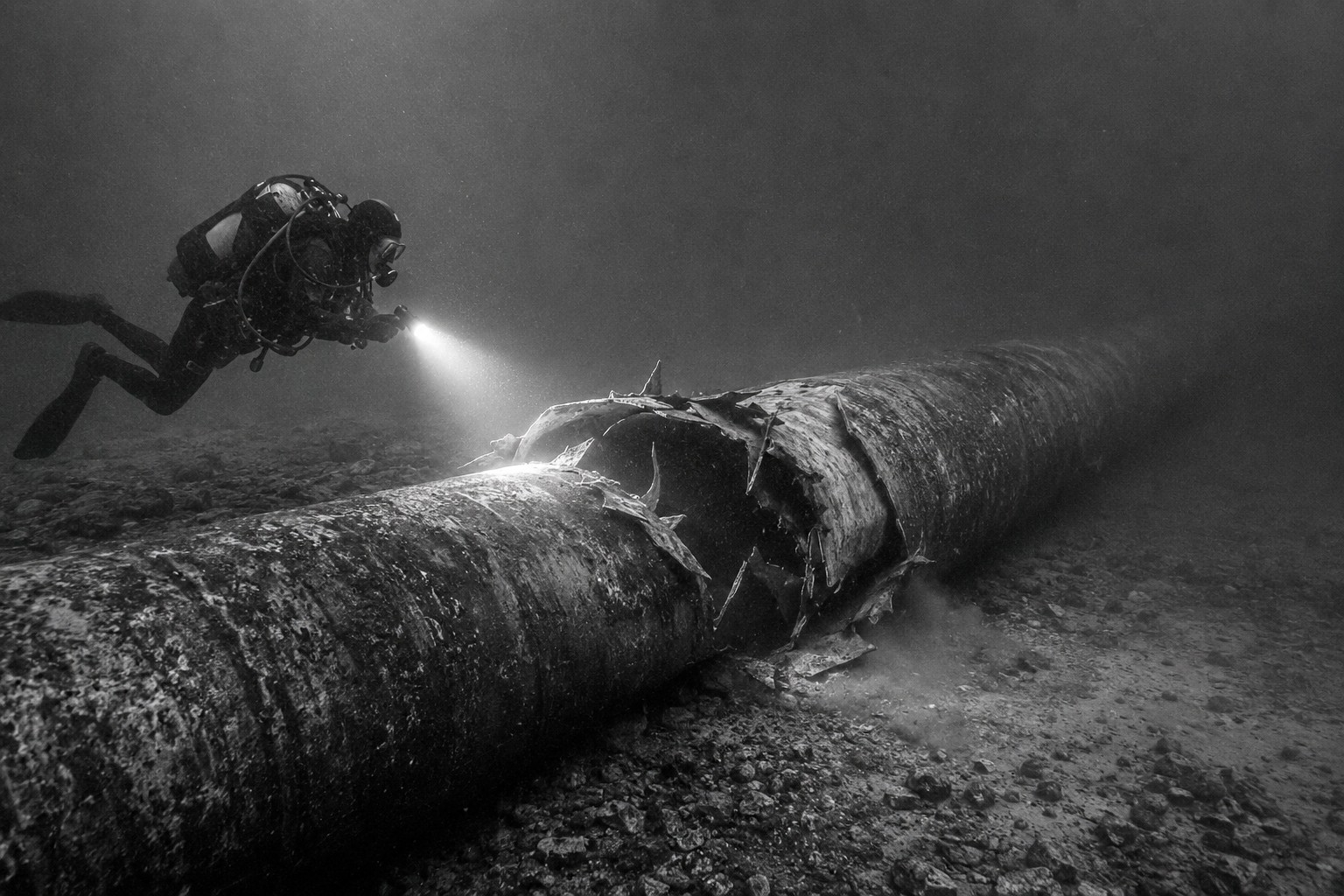
A Ukrainian scuba diver suspected of helping to plant explosives on the Nord Stream gas pipelines has been arrested in Croatia. German prosecutors will seek his extradition over the September 2022 explosions that damaged three of the four underwater pipelines built to transport Russian gas to Germany.
Arrested under a European warrant
Croatian police detained the suspect in the Adriatic coastal city of Pula on Wednesday after acting on a European arrest warrant issued by Germany.
German federal prosecutors identified him only as Vladimir Z., in accordance with German privacy rules. He is understood to be Volodymyr Zhuravlev, the Ukrainian diving instructor previously arrested in Poland in connection with the same investigation.

The Croatian justice ministry said the extradition question would be handled directly by the relevant judicial authorities under European Union procedures. A court in Pula is expected to decide whether he should be surrendered to Germany.
Prosecutors allege a direct role
German investigators describe the suspect as a trained scuba diver who belonged to a group accused of placing explosives on Nord Stream 1 and Nord Stream 2 near the Danish island of Bornholm.
Prosecutors allege that Vladimir Z. participated in the underwater dives required to attach the explosive devices. He is suspected of jointly causing an explosion, anti-constitutional sabotage and damaging important infrastructure.
Reuters was unable to reach the suspect or a legal representative for comment following the Croatian arrest. The allegations have not been tested in court, and he must be regarded as innocent unless convicted.
A disputed extradition returns
The arrest reopens a politically sensitive dispute between Germany and Poland.
The same suspect was detained in Poland in 2025, but a Polish court rejected Germany’s extradition request and ordered his release. The court questioned whether Germany had jurisdiction over explosions in international waters and argued that the destruction of infrastructure used to generate Russian revenue could potentially be regarded as an act connected to Ukraine’s defensive war.
The ruling caused friction with Berlin. Poland had strongly opposed the Nord Stream project, viewing it as a strategic mistake that increased Germany’s dependence on Russian energy while bypassing Central and Eastern European countries.
Explosions transformed Europe’s energy landscape
The Nord Stream pipelines were struck on 26 September 2022, seven months after Russia launched its full-scale invasion of Ukraine. Powerful underwater explosions ruptured three pipeline sections and released large quantities of methane into the Baltic Sea.
Nord Stream 1 had been an important route for Russian gas exports to Europe, although Moscow had already suspended deliveries before the attack. Nord Stream 2 had been completed but never entered commercial operation after Germany halted its certification following the invasion of Ukraine.
German prosecutors believe the attack was intended to prevent future Russian gas deliveries and deny Moscow revenue that could be used to finance the war.
Second suspect already in Germany
Another Ukrainian suspect, former army officer Serhii K., was arrested in Italy in August 2025 and extradited to Germany three months later. German prosecutors charged him in July with coordinating the operation while allegedly acting on behalf of Ukrainian state entities. He denies any involvement.
Ukraine has denied responsibility for the Nord Stream explosions. No government or organisation has publicly claimed the attack.
German courts maintain jurisdiction because the pipelines terminate in Mecklenburg-Vorpommern and their destruction directly affected Germany’s energy security. If Croatia approves the extradition, Vladimir Z. will be brought before a federal judge in Karlsruhe as Germany moves closer to putting its account of one of Europe’s most consequential acts of infrastructure sabotage before a court.
REFH – Newshub, Europe, 20 August 2026

Ask NF GPT
If you have an account with ChatGPT you get deeper explanations,
background and context related to what you are reading.
Recent Comments