
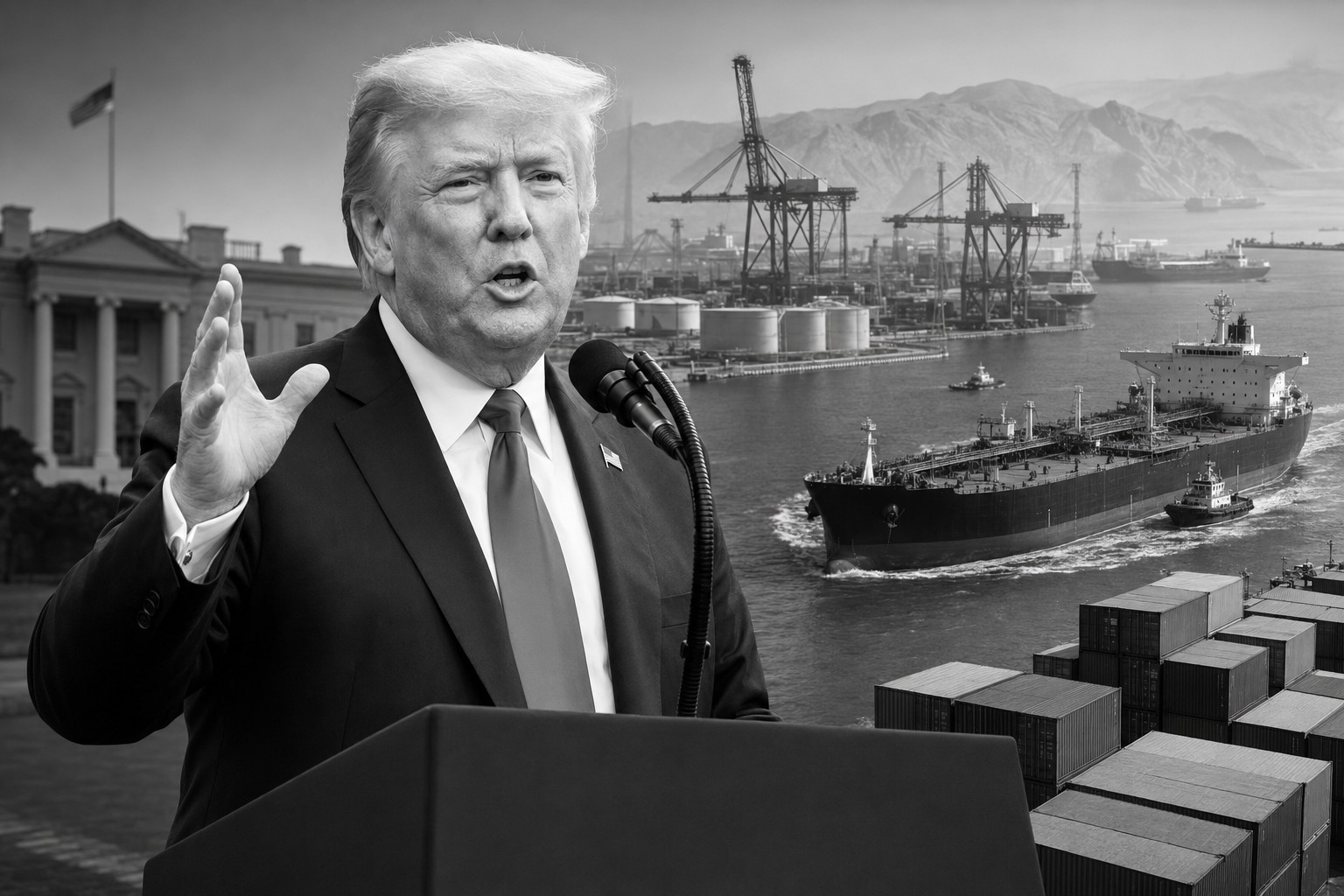
US President Donald Trump has threatened severe penalties against countries and companies that continue supporting Iran’s economy, signalling a shift towards what he called an unprecedented campaign of economic warfare. The move follows months of military strikes and blockades that have damaged Iran’s armed forces but failed to force Tehran into accepting Washington’s terms.
Trump declares an ‘Economic D-Day’
Trump announced the new campaign in a social media post, promising “Economic Warfare and Isolation on an unprecedented scale” against Iran.
He warned that any country allowing its financial institutions, businesses, airports or government bodies to provide Iran with an economic lifeline would face “tremendous economic consequences”.


The president did not identify individual countries or specify whether Washington would use tariffs, secondary sanctions, restrictions on dollar transactions or exclusion from the US market.
Trump said the operation would target the financial and commercial networks that allow Iran to evade existing sanctions. These include currency exchanges, cash transfers, swap arrangements, ship registries, front companies and oil-smuggling operations.
China emerges as the principal target
Although no country was named, the warning immediately placed attention on China. Data from analytics company Kpler indicates that China purchased more than 80% of Iran’s shipped oil during 2025.
Punishing Chinese companies, banks or government entities could reopen the trade conflict between Washington and Beijing. China remains a major supplier of manufactured products and strategically important rare-earth materials to the United States.
Further economic action could also complicate Trump’s attempt to extend a tariff truce with President Xi Jinping, who is expected to visit the United States in September.
UAE cuts economic ties with Tehran
Trump’s campaign received support from the United Arab Emirates, which suspended all trade, commercial exchanges and financial transactions with Iran.
The UAE said the decision followed the detection of two ballistic missiles allegedly launched from Iran towards maritime traffic. Both missiles reportedly fell into the sea. Tehran rejected the allegation as baseless.
Dubai has long been one of Iran’s most important commercial and financial gateways, providing access to imported goods, foreign currency and international payment networks. Closing that route could make it considerably harder for Iranian companies to bypass sanctions.
Military campaign fails to produce agreement
The economic escalation comes as the US-Israel conflict with Iran approaches its sixth month. Thousands of people have been killed, while attacks and counterattacks have spread across the Gulf.
Ceasefire arrangements announced in April and June collapsed before producing a permanent agreement. Israel has largely withdrawn from active fighting, while the United States has reduced parts of its military campaign amid rising costs, pressure on weapons inventories and concerns about an overstretched force.
Military strikes have damaged Iranian infrastructure and eliminated senior officials but have not forced Tehran to surrender its nuclear programme or loosen its control over shipping through the Strait of Hormuz.
Pressure on global energy markets
Before the conflict, approximately one-fifth of the world’s internationally traded oil passed through the Strait of Hormuz. Iranian threats against commercial vessels and a US counter-blockade have severely restricted traffic through the route.
Brent crude remains close to $92 per barrel, while US West Texas Intermediate has traded above $84. Prolonged disruption risks raising fuel prices, inflation and transport costs across the global economy.
Iranian officials say the country remains open to negotiations but will not accept talks as a form of surrender. Trump has said no discussions are taking place, while his special envoy Jared Kushner recently described contacts as more active than ever.
The contradictions underline the uncertainty surrounding Washington’s strategy. Economic pressure may further weaken Iran, but it could also deepen the confrontation with China, increase global energy costs and leave the conflict without a clear diplomatic exit.
REFH – Newshub, Middle East, 20 August 2026

Ask NF GPT
If you have an account with ChatGPT you get deeper explanations,
background and context related to what you are reading.
US President Donald Trump has threatened severe penalties against countries and companies that continue supporting Iran’s economy, signalling a shift towards what he called an unprecedented campaign of economic warfare. The move follows months of military strikes and blockades that have damaged Iran’s armed forces but failed to force Tehran into accepting Washington’s terms.
Recent Comments