
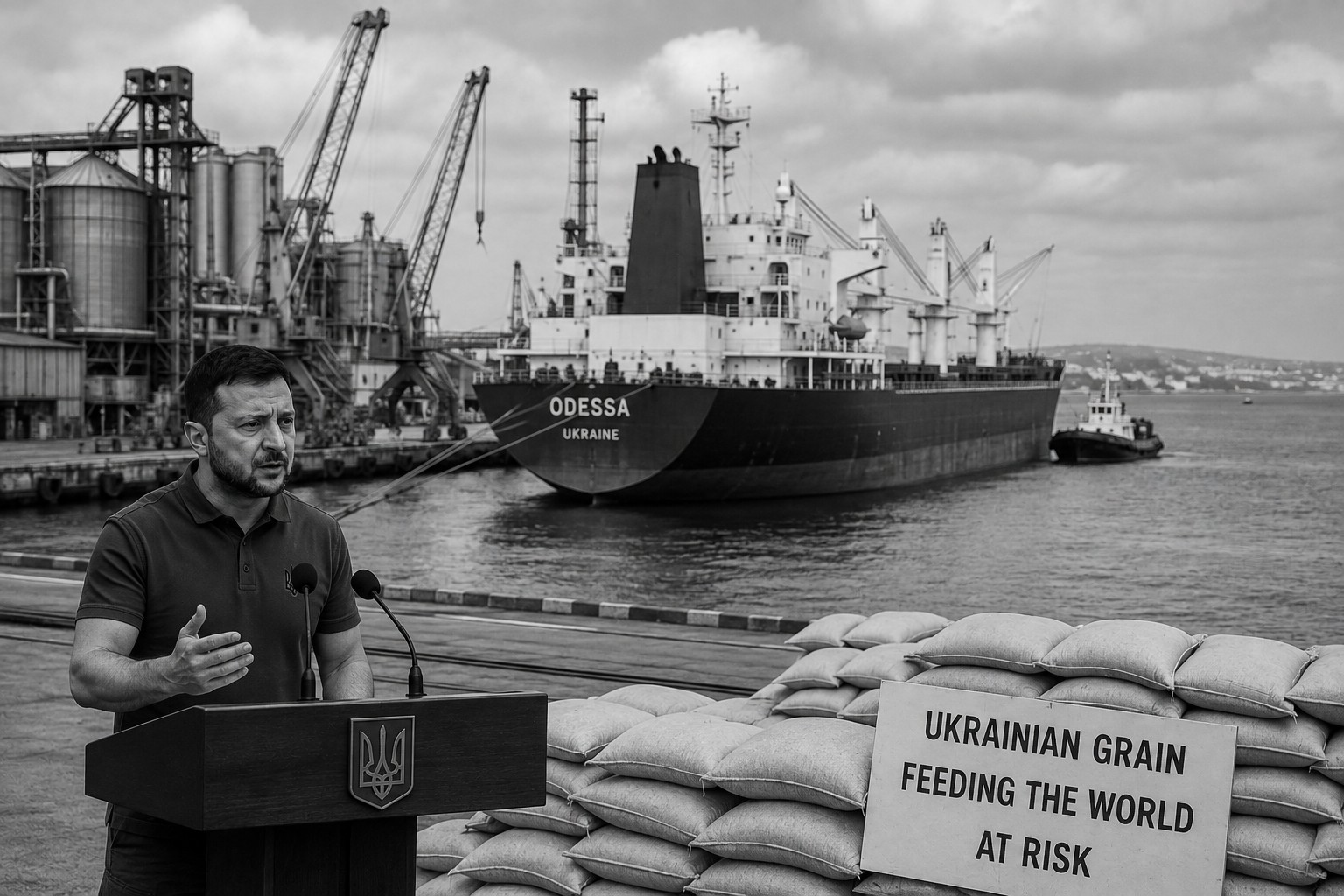
Ukrainian President Volodymyr Zelenskyy has warned Egyptian President Abdel Fattah al-Sisi that escalating Russian attacks on cargo vessels and Ukrainian ports in the Black Sea are threatening food supplies to Egypt and other countries across Africa and the Middle East. The warning comes as renewed disruption to one of the world’s most important grain-export corridors raises fears of higher wheat prices and increasing pressure on food-importing emerging economies.
Egypt depends on Ukrainian supplies
Ukraine is an important agricultural supplier to Egypt, whose population of more than 100 million makes the country one of the world’s major wheat importers. Zelenskyy said after speaking with al-Sisi on Friday that Ukrainian food exports to Egypt and numerous other African and Middle Eastern countries were under serious threat because of the war.
The issue extends far beyond bilateral trade. Bread is a politically and economically sensitive staple in Egypt, where the government maintains an extensive subsidised bread programme. Disruption to international grain markets can therefore translate into higher government expenditure as well as increased pressure on household budgets.

Black Sea trade comes under renewed pressure
The immediate concern is a sharp deterioration in security around Black Sea shipping and port infrastructure.
Russian strikes have damaged Ukrainian facilities including the strategically important ports of Odesa and Izmail. Ukraine, meanwhile, has attacked Russian military and commercial infrastructure around Novorossiysk, temporarily disrupting major Russian grain terminals.
The consequences are already visible in Ukraine’s export figures. Ukrainian grain exports were reported to have fallen 76% year-on-year in August amid severe disruption to Black Sea shipping. Alternative routes through the Danube and European rail networks provide some capacity, but cannot easily replace Ukraine’s major seaports.
Kyiv proposes maritime ceasefire
Ukraine has proposed a mutual halt to attacks on civilian targets in the Black Sea, according to Reuters, in an attempt to protect commercial shipping and reduce the growing threat to international food supplies.
Russia has said it has received no formal proposal, leaving the future of any maritime arrangement uncertain.
The situation recalls the importance of the Black Sea Grain Initiative established after Russia’s full-scale invasion in 2022. That agreement, brokered by the United Nations and Turkey, enabled Ukrainian agricultural exports to continue through protected maritime routes before Russia withdrew from the arrangement in 2023.
Africa faces consequences beyond Egypt
For African economies, renewed disruption could be particularly damaging. Many countries remain heavily dependent on imported wheat and are more vulnerable than wealthier economies to sudden increases in commodity prices, freight costs and insurance premiums.
The economic effects can spread rapidly. Higher grain prices increase the cost of bread and other basic foods, place pressure on foreign-currency reserves and force governments to spend more on subsidies.
For countries already dealing with inflation, currency weakness or high sovereign debt, another international food-price shock would be particularly unwelcome.
Food security again becomes part of the war
The latest warning demonstrates how events around Ukrainian ports can have consequences thousands of kilometres from the battlefield.
Ukraine and Russia are both major agricultural exporters, making the Black Sea a strategic artery for international food markets. Continued attacks affecting ports and commercial shipping therefore risk transforming a military confrontation into a wider economic and humanitarian problem.
For Egypt, securing reliable grain supplies is a matter of national economic stability. For Ukraine, maintaining its export corridors is essential both to its wartime economy and its position as a major global agricultural producer.
The danger is that the longer Black Sea shipping remains exposed to attack, the greater the possibility that countries far beyond Europe will ultimately pay part of the price through more expensive and less secure food supplies.
Newshub Editorial in Africa – 15 August 2026

Ask NF GPT
If you have an account with ChatGPT you get deeper explanations,
background and context related to what you are reading.
Open article chat
Recent Comments