
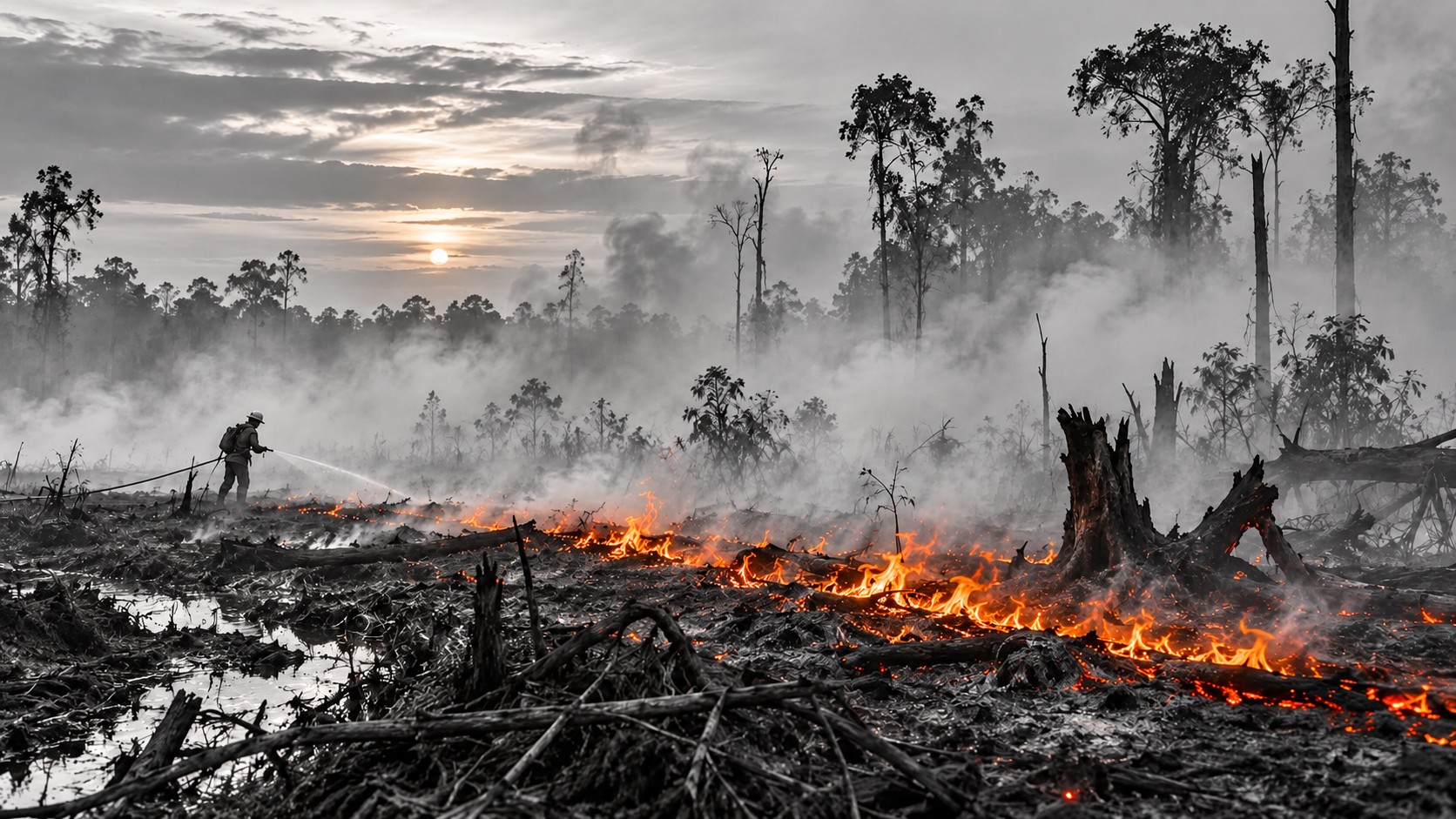
Rain has brought temporary relief to Indonesia after months of devastating wildfires and hazardous smoke, but the environmental emergency is far from finished. Satellite analysis suggests the 2026 fire season has affected more land than the corresponding period in 2019, while health authorities report hundreds of thousands of respiratory infections and investigators pursue companies and individuals suspected of violating environmental laws.
Satellite data reveals extensive damage
Independent satellite analysis by Nusantara Atlas estimates that approximately 1.92 million hectares were affected by fire between January and September, around 38% more than during the same period in 2019.
The estimate differs from government figures because of variations in methodology and reporting periods.


Swamp vegetation, agricultural land and grassland account for much of the affected territory, although tens of thousands of hectares of natural forest have also been impacted.
Environmental concerns extend to protected ecosystems, including areas around Gunung Palung National Park.
El Niño intensifies an existing problem
Indonesia’s meteorological agency has warned that exceptionally dry conditions, strengthened by El Niño and a positive Indian Ocean Dipole, delayed the arrival of seasonal rainfall across much of the country.
However, drought alone does not explain the fires.
Land clearing and the drainage of carbon-rich peatlands have created landscapes particularly vulnerable to ignition. Once burning underground, peat fires can continue smouldering despite surface rainfall.
Hundreds of thousands affected by smoke
Indonesia’s Health Ministry reported more than 333,000 acute respiratory infection cases by 22 October, with subsequent estimates approaching 350,000.
Children, older residents and people with existing respiratory conditions face particular risks.
Smoke has also crossed international borders, affecting air quality in neighbouring Malaysia and Singapore.
Government increases enforcement
Indonesian authorities have intensified investigations into suspected illegal burning.
The Forestry Ministry reported administrative sanctions against 32 companies, while police identified hundreds of individual suspects and several corporate suspects in ongoing investigations.
However, administrative penalties and criminal investigations should not be confused with convictions.
The effectiveness of enforcement will depend on successful prosecutions, verified environmental restoration and measures preventing further fires.
The challenge beyond the rainy season
International assistance has been offered, while Indonesian emergency teams continue battling fires across Sumatra and Kalimantan.
Yet experts warn that firefighting alone cannot solve a crisis rooted partly in land management and peatland degradation.
Indonesia’s greatest challenge is no longer simply extinguishing the flames. It is preventing the conditions that allow them to return.
With rainfall providing only temporary relief, lasting progress will require peatland restoration, stronger environmental oversight and earlier intervention before fires spread beyond control.
NewsHub Finance | Environment | 29 October 2026
Rain has brought temporary relief to Indonesia after months of devastating wildfires and hazardous smoke, but the environmental emergency is far from finished. Satellite analysis suggests the 2026 fire season has affected more land than the corresponding period in 2019, while health authorities report hundreds of thousands of respiratory infections and investigators pursue companies and individuals suspected of violating environmental laws.
Recent Comments