
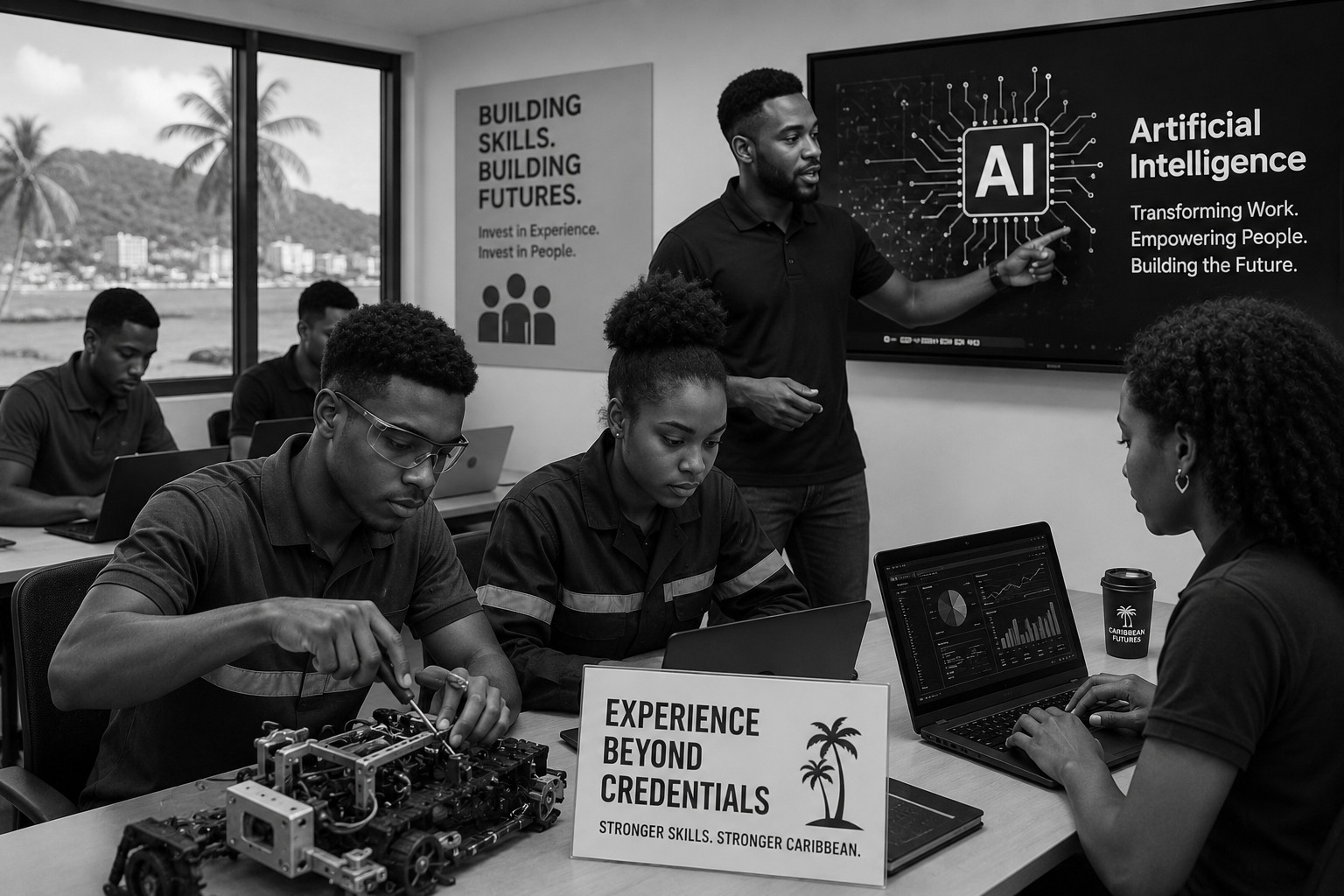
Artificial intelligence is rapidly changing labour markets across Caribbean and Latin America, increasing the value of practical experience while reducing the relative importance of traditional credentials alone. As AI systems make codified knowledge more accessible and automatable, economists and policymakers are warning that tacit knowledge — the expertise acquired through real-world work experience — may become one of the most valuable assets in the future economy. The shift is creating both risks and opportunities for Caribbean labour markets already facing youth unemployment, migration pressure and educational inequality.
Experience becoming harder to replace
AI systems are increasingly capable of performing tasks based on structured information, including administrative work, data analysis, translation and customer support. This means that knowledge traditionally obtained through formal education can now often be accessed instantly through digital tools.
However, many forms of practical expertise remain difficult to automate. Skills involving judgement, interpersonal communication, negotiation, technical adaptation and situational problem-solving continue to rely heavily on direct human experience.

Economists argue that this creates a growing divide between theoretical qualifications and experiential competence. Workers who have accumulated hands-on operational knowledge may become increasingly valuable as AI expands into white-collar sectors.
Entry-level jobs face growing pressure
One of the greatest concerns for Latin America and the Caribbean is that entry-level positions — where younger workers traditionally gain practical experience — are among the roles most exposed to automation.
Administrative assistants, junior analysts, call-centre employees and routine office staff are increasingly encountering AI-driven productivity tools capable of replacing or reducing human tasks. This creates the risk that younger workers may struggle to acquire the practical workplace experience historically required for career progression.
The concern extends beyond technology companies. Tourism, financial services, logistics and public administration sectors throughout the Caribbean are all beginning to integrate AI-based systems into daily operations.
Without sufficient entry-level exposure, analysts warn that future generations could face weaker long-term skill development despite having higher formal educational attainment.
Governments encouraged to rethink labour policy
Regional organisations including the Inter-American Development Bank have increasingly advocated for apprenticeship systems, dual-training programmes and portable employment records to address the changing labour market.
The argument is that governments must actively protect opportunities for experiential learning as AI adoption accelerates. Apprenticeships and work-integrated education models may become essential tools for maintaining skill formation within younger populations.
Several policymakers are also discussing portable digital employment records that allow workers to document practical competencies and project-based experience across multiple employers and sectors.
Analysts believe such systems could become particularly important in Caribbean economies characterised by seasonal employment, migration and informal labour patterns.
Tourism and services sector entering transition period
The Caribbean’s dependence on tourism and service industries makes the region especially sensitive to labour market transformation. Hotels, airlines, banking services and customer-support operations are increasingly introducing AI-driven automation to improve efficiency and reduce operational costs.
At the same time, many customer-facing roles still require human adaptability, cultural understanding and emotional intelligence — qualities that remain difficult for AI systems to fully replicate.
This could ultimately increase the value of experienced workers capable of combining digital literacy with practical interpersonal skills.
Balancing technology with human capital
AI is unlikely to eliminate the need for human workers across the Caribbean economy. Instead, it is changing which forms of knowledge hold the greatest economic value.
The challenge for governments, educators and employers will be ensuring that AI adoption strengthens productivity without removing the pathways through which younger generations acquire practical expertise.
For the Caribbean, the future labour market may increasingly reward not only what workers know, but what they have actually done.
Newshub Editorial in North America – 17 May 2026

If you have an account with ChatGPT you get deeper explanations,
background and context related to what you are reading.
Open an account:
Open an account
Recent Comments