
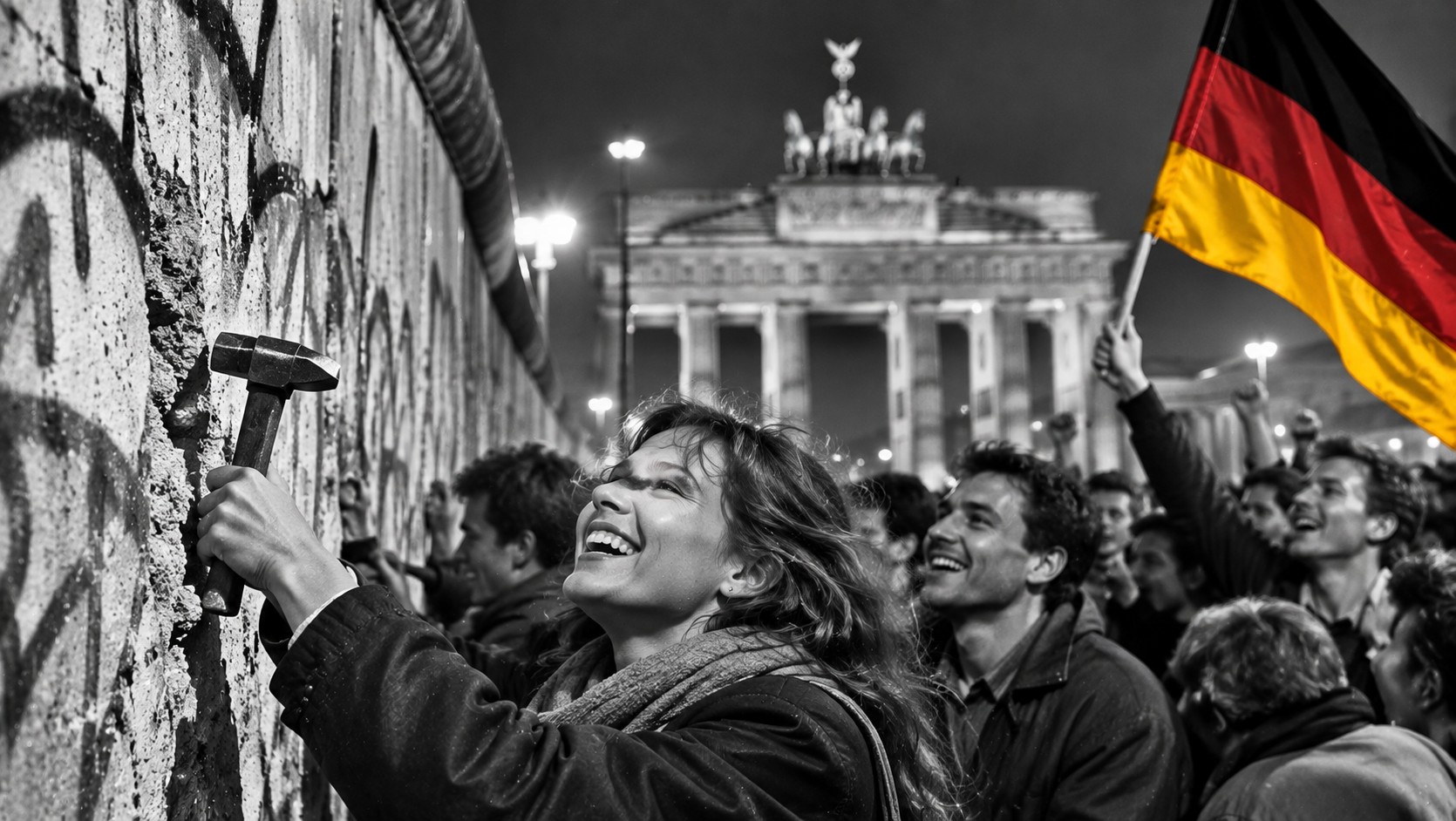
On 9 November 1989, one of the most significant events of the twentieth century unfolded as thousands of East Germans crossed into West Berlin following the unexpected opening of the Berlin Wall. After 28 years of division, the concrete barrier separating families, communities and political systems began to collapse. The historic breakthrough symbolised the approaching end of the Cold War and paved the way for German reunification and a fundamental transformation of Europe’s political and economic landscape.
A city divided for nearly three decades
The Berlin Wall was constructed on 13 August 1961 by the communist German Democratic Republic (East Germany), with Soviet support, to prevent its citizens from fleeing to West Berlin.


Over the following decades, the fortified border developed into a complex security system featuring concrete walls, watchtowers, armed guards and restricted zones.
Families were separated, businesses lost access to their traditional markets and thousands attempted dangerous escapes across the border.
At least 140 people died at the Berlin Wall between 1961 and 1989, according to research by the Berlin Wall Memorial.
An announcement that changed history
On the evening of 9 November 1989, East German official Günter Schabowski announced new travel regulations during a televised press conference.
When journalists asked when the changes would take effect, Schabowski appeared uncertain and replied that they would apply immediately.
The announcement triggered extraordinary scenes as thousands of East Berliners gathered at border crossings demanding passage into West Berlin.
Overwhelmed border guards eventually opened the checkpoints, allowing people to cross freely.
Celebrations erupted across the divided city as crowds embraced, climbed the wall and began dismantling sections of the barrier.
The economic transformation of Europe
The fall of the Berlin Wall accelerated the collapse of communist governments throughout Central and Eastern Europe.
Germany formally reunified on 3 October 1990, bringing together two economies that had developed under fundamentally different political and financial systems.
Reunification required enormous public investment to modernise infrastructure, restructure industries and integrate eastern Germany into a market economy.
The transformation also created new opportunities for international investment, trade and European economic integration.
A turning point with lasting consequences
The events in Berlin contributed to the end of the Cold War and preceded the dissolution of the Soviet Union in December 1991.
Germany subsequently emerged as Europe’s largest economy and a central force in European integration.
Thirty-seven years after the Wall opened, 9 November remains a powerful reminder of how political decisions, public pressure and demands for freedom can reshape nations.
The fall of the Berlin Wall demonstrated that even the most heavily fortified divisions can disappear when political systems lose public legitimacy.
NewsHub Finance | History | 9 November 2026
On 9 November 1989, one of the most significant events of the twentieth century unfolded as thousands of East Germans crossed into West Berlin following the unexpected opening of the Berlin Wall. After 28 years of division, the concrete barrier separating families, communities and political systems began to collapse. The historic breakthrough symbolised the approaching end of the Cold War and paved the way for German reunification and a fundamental transformation of Europe's political and economic landscape.

Recent Comments