
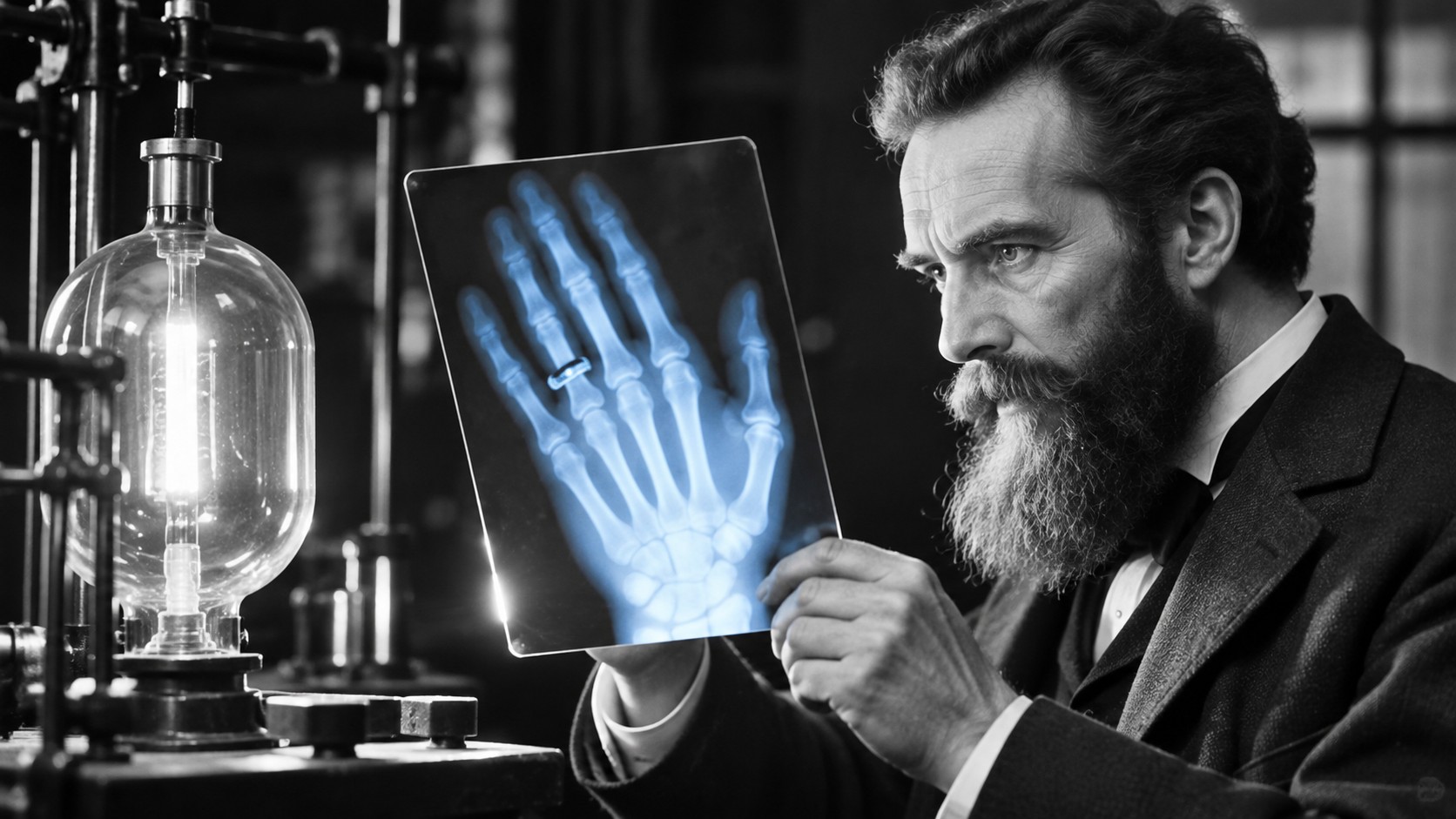
On 8 November 1895, German physicist Wilhelm Conrad Röntgen made one of the most important discoveries in medical and scientific history. Working alone in his laboratory at the University of Würzburg, he detected an unknown form of radiation capable of passing through solid objects and revealing structures hidden inside the human body. His discovery of X-rays transformed medical diagnosis, opened new fields of scientific research and ultimately earned him the first Nobel Prize in Physics.
An unexpected discovery in a German laboratory
Röntgen was investigating electrical discharges in glass vacuum tubes when he noticed something extraordinary.


Although the experimental apparatus was covered with black cardboard to prevent visible light from escaping, a nearby fluorescent screen began to glow.
The phenomenon suggested that an invisible form of radiation was passing through the covering.
Röntgen immediately began investigating the mysterious rays, discovering that they could penetrate paper, wood and human tissue while being absorbed more strongly by dense materials such as bone and metal.
Uncertain about their nature, he named them X-rays, using the mathematical symbol for an unknown quantity.
The first glimpse inside the human body
During subsequent experiments, Röntgen produced one of the most famous images in scientific history: an X-ray photograph of his wife Bertha’s hand.
The image revealed the bones of her fingers and her wedding ring, demonstrating that physicians could potentially examine the human skeleton without surgery.
The implications were revolutionary.
Within months, hospitals and medical researchers began experimenting with the technology to locate fractures, foreign objects and other internal injuries.
For the first time, doctors could examine important structures inside the living human body without making an incision.
A scientific revolution spreads worldwide
Röntgen published his findings in December 1895, triggering international scientific excitement.
The discovery quickly influenced medicine, physics and industrial research.
In 1901, he received the inaugural Nobel Prize in Physics in recognition of his extraordinary contribution.
However, the early enthusiasm came before the dangers of excessive radiation exposure were fully understood. Scientists and medical practitioners later developed protective measures to reduce the risks.
A discovery that continues to save lives
Today, X-ray technology remains fundamental to modern healthcare.
Medical radiography, computed tomography, dental imaging and numerous industrial inspection techniques developed from principles established by Röntgen’s discovery.
His work also helped prepare the scientific foundations for research into atomic structure and radioactivity.
More than a century later, the discovery demonstrates how a seemingly accidental observation can transform civilisation when combined with scientific curiosity and rigorous investigation.
On 8 November, World Radiography Day commemorates the breakthrough that made the invisible visible and permanently changed humanity’s understanding of the physical world.
NewsHub Finance | History | 8 November 2026
On 8 November 1895, German physicist Wilhelm Conrad Röntgen made one of the most important discoveries in medical and scientific history. Working alone in his laboratory at the University of Würzburg, he detected an unknown form of radiation capable of passing through solid objects and revealing structures hidden inside the human body. His discovery of X-rays transformed medical diagnosis, opened new fields of scientific research and ultimately earned him the first Nobel Prize in Physics.

Recent Comments