
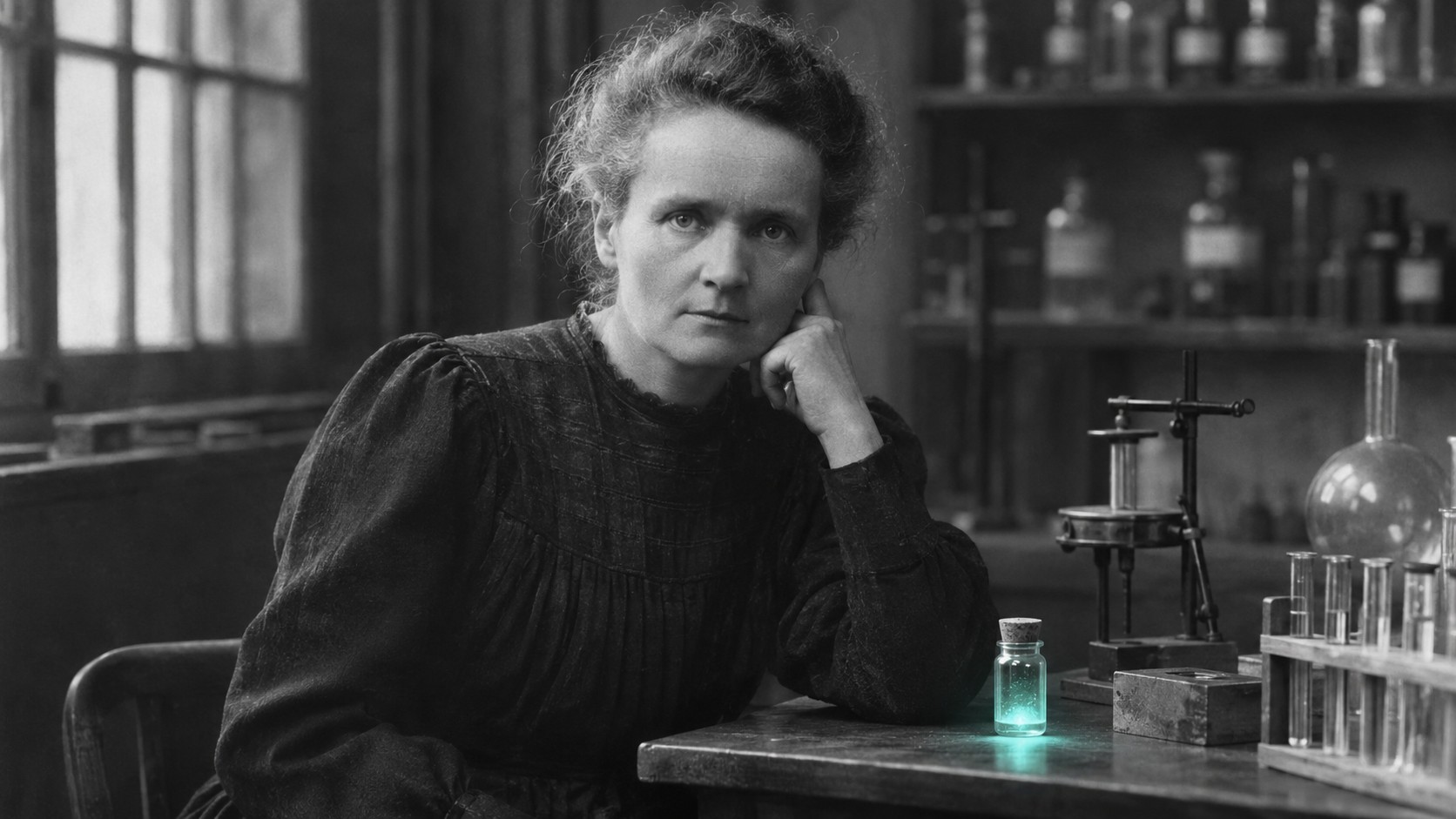
On 7 November 1867, Marie Skłodowska Curie was born in Warsaw, Poland, beginning a life that would fundamentally change humanity’s understanding of radioactivity, atomic science and medicine. Her discoveries helped establish modern nuclear physics and opened the door to revolutionary medical treatments. She would become the first woman to receive a Nobel Prize and remains the only person to have won Nobel Prizes in two different scientific disciplines.
From Warsaw to Paris
Born Maria Salomea Skłodowska when Warsaw was under Russian imperial rule, Curie grew up in a family that valued education despite considerable political and financial difficulties. Women faced significant restrictions in higher education, prompting her to pursue scientific studies through underground educational networks before eventually moving to Paris in 1891.


At the Sorbonne, she studied physics and mathematics, overcoming poverty and considerable social barriers. In 1895, she married French physicist Pierre Curie, beginning one of the most influential scientific partnerships in history.
Discovering the invisible forces of nature
Working together, Marie and Pierre Curie investigated mysterious radiation emitted by uranium compounds. In 1898, they announced the discovery of two previously unknown chemical elements: polonium, named after Marie’s homeland, and radium.
Their research challenged established scientific assumptions and helped reveal that atoms were not necessarily indivisible or unchanging.
In 1903, Marie Curie shared the Nobel Prize in Physics with Pierre Curie and Henri Becquerel for their pioneering investigations into radiation phenomena.
Eight years later, she received the Nobel Prize in Chemistry for her discovery of radium and polonium, the isolation of radium and her study of its compounds.
A legacy extending far beyond laboratories
Curie’s contributions extended into practical medicine. During the First World War, she helped develop mobile X-ray units that enabled battlefield surgeons to locate bullets and fractures, improving medical care for wounded soldiers.
Her prolonged exposure to radioactive materials, at a time when their dangers were poorly understood, contributed to serious health consequences. She died on 4 July 1934, aged 66, from aplastic anaemia.
Today, 159 years after her birth, Marie Curie’s legacy remains visible in cancer treatment, medical imaging, nuclear research and scientific education. Her determination also helped challenge barriers facing women in science, inspiring generations of researchers around the world.
NewsHub Finance | History | 7 November 2026
On 7 November 1867, Marie Skłodowska Curie was born in Warsaw, Poland, beginning a life that would fundamentally change humanity’s understanding of radioactivity, atomic science and medicine. Her discoveries helped establish modern nuclear physics and opened the door to revolutionary medical treatments. She would become the first woman to receive a Nobel Prize and remains the only person to have won Nobel Prizes in two different scientific disciplines.

Recent Comments