
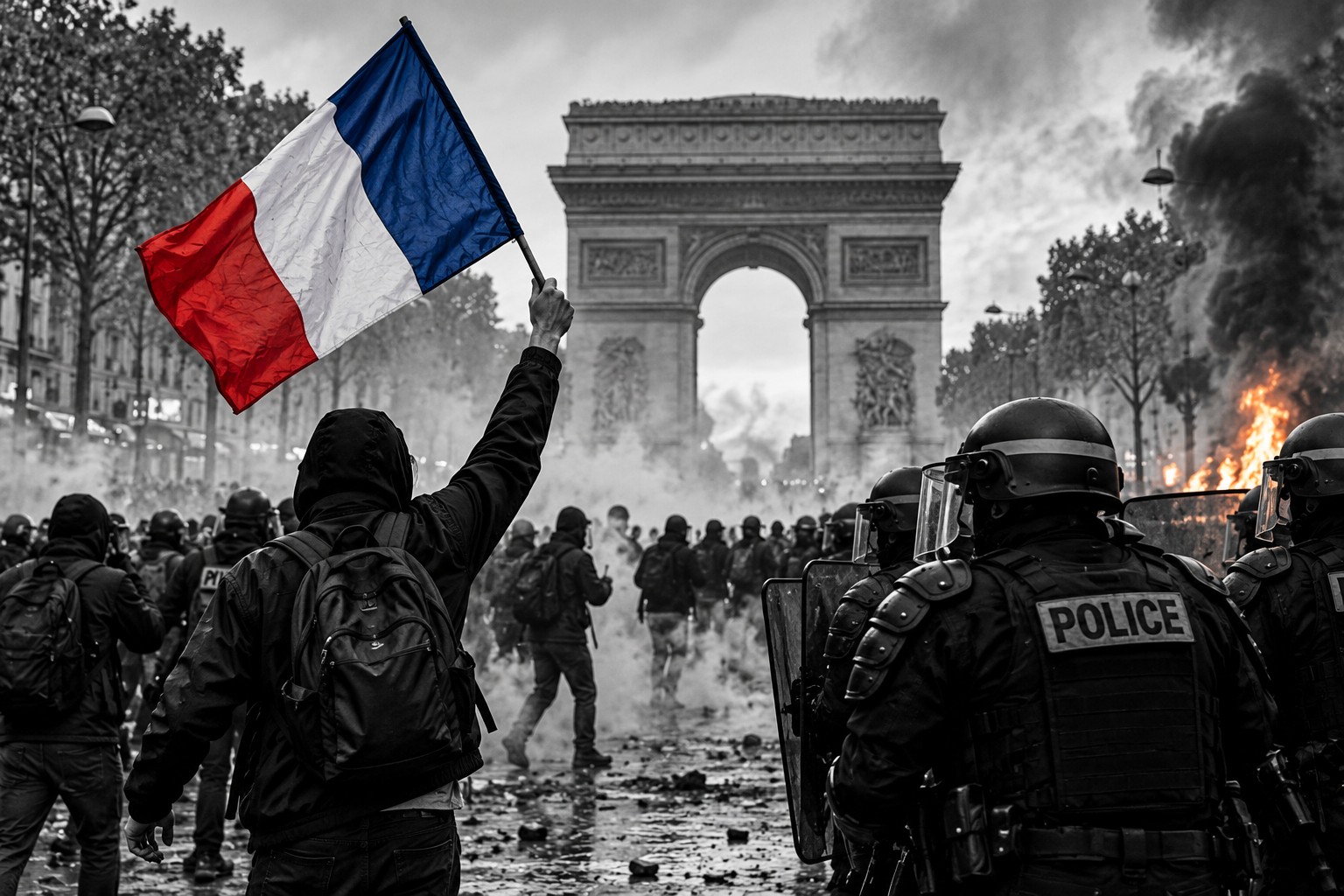
France has introduced partial curfews in Paris and several other cities following a weekend of widespread unrest, looting and violent confrontations with police. Interior Minister Laurent Nuñez has acknowledged that security forces lost control in several locations, while Prime Minister Sébastien Lecornu has pledged to restore public order amid growing political and economic instability.
Paris and other cities face restrictions
Authorities introduced overnight curfews in parts of Paris, including Place de la République and the Les Halles shopping district, from 11 pm on Monday until 6 am on Tuesday.
Similar restrictions were announced in Lille and neighbouring municipalities, while local authorities in Nice and Lyon introduced measures targeting specific areas or age groups.


The government has avoided a nationwide state of emergency but says further intervention remains possible if violence continues.
Thousands arrested after weekend violence
The restrictions follow demonstrations over rising living costs, deteriorating public services and education funding.
What began as student-led protests developed into nationwide demonstrations involving hundreds of thousands of participants.
Although many demonstrators protested peacefully, violent groups attacked businesses, damaged public buildings and clashed with security forces.
More than 2,400 people were arrested over the weekend, while authorities reported injuries to nearly 1,000 police officers and gendarmes.
Retailers suffered extensive damage, with thousands of commercial premises affected by vandalism, looting or disruption.
Interior minister acknowledges police failures
Nuñez admitted that the police response had suffered from inadequate preparation and intelligence failures.
The interior minister offered his resignation to President Emmanuel Macron, who rejected it and instead instructed him to review operational procedures and strengthen security coordination.
Prime Minister Lecornu blamed organised extremists and criminal groups for exploiting legitimate demonstrations, although the precise responsibility for individual incidents remains contested.
Economic uncertainty deepens
The unrest comes at a particularly difficult moment for the French economy.
Investors are already concerned about government debt, weak growth and continuing political instability ahead of the 2027 presidential election.
French financial markets weakened on Monday, with the CAC 40 falling approximately 1.5% and government borrowing costs rising.
Businesses now face additional expenses from damaged property, temporary closures and disrupted commercial activity.
A growing challenge for Macron
The disturbances represent another major test for President Macron, whose administration faces criticism over economic management and public security.
Protest organisers have called for further demonstrations, increasing pressure on authorities to distinguish peaceful political activity from organised violence.
For France, the immediate challenge is restoring security without undermining the democratic right to protest.
The longer-term question is whether the government can address the economic grievances that brought hundreds of thousands of people onto the streets.
NewsHub Finance | Europe & Politics | 20 October 2026
France has introduced partial curfews in Paris and several other cities following a weekend of widespread unrest, looting and violent confrontations with police. Interior Minister Laurent Nuñez has acknowledged that security forces lost control in several locations, while Prime Minister Sébastien Lecornu has pledged to restore public order amid growing political and economic instability.
Recent Comments