
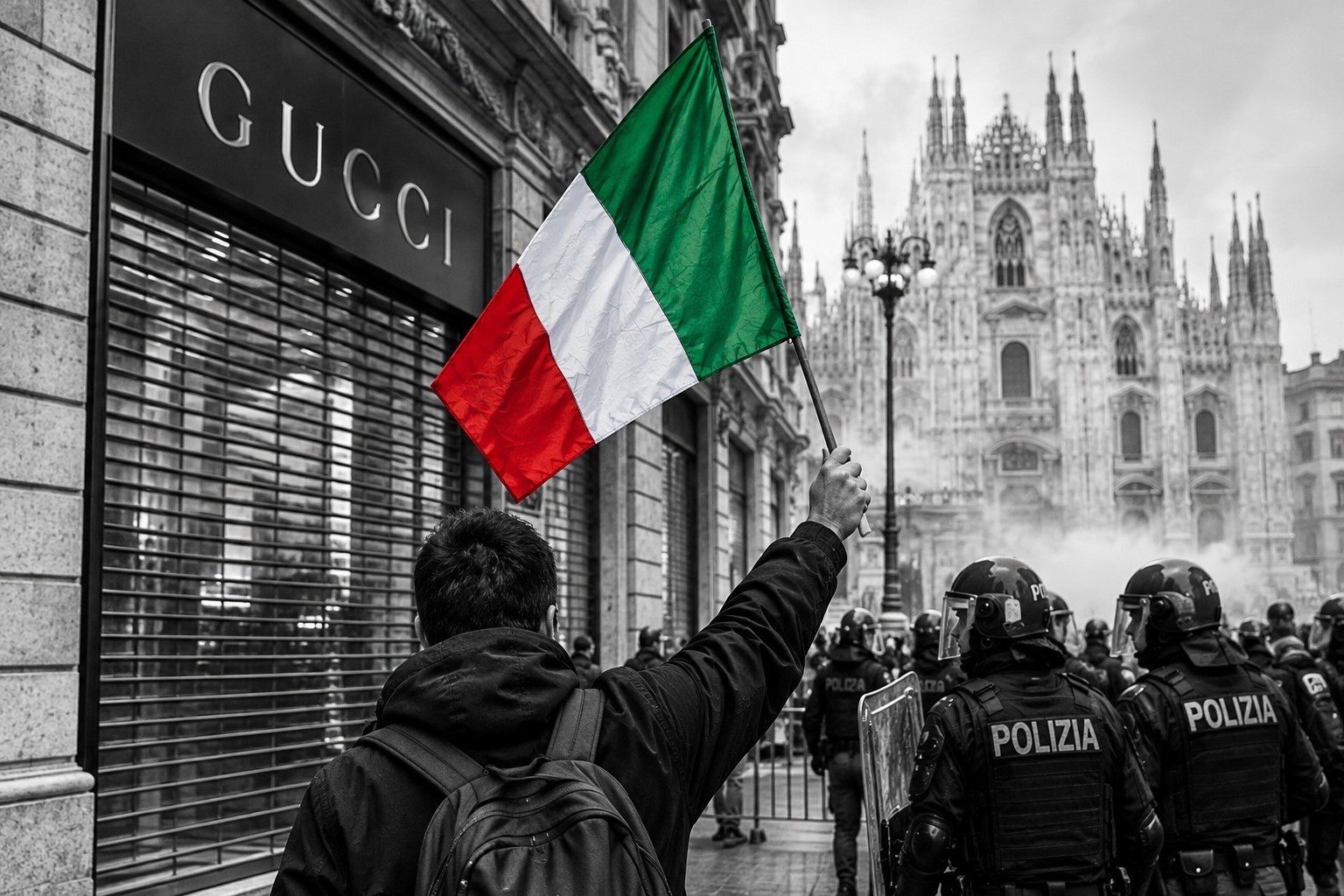
Italy is preparing to deploy 500 additional soldiers to Milan following two days of violent demonstrations that left shops looted, property damaged and police confronting groups of masked protesters. Luxury retailers in the country’s financial and fashion capital have closed their doors as Prime Minister Giorgia Meloni’s government prepares tougher security measures amid growing public anger over living costs and deteriorating public services.
Luxury shopping district shuts down
Milan’s famous Via Montenapoleone, home to some of the world’s most prestigious fashion houses, was unusually quiet on Monday.
Retailers including Chanel, Hermès and Pomellato closed their shops, while others removed expensive merchandise from window displays and installed protective boarding.


The precautions followed attacks on businesses elsewhere in the city, including Decathlon, Arc’teryx and Vodafone.
Police patrols were increased around the luxury district as retailers feared another outbreak of violence.
Peaceful demonstrations turn violent
The unrest began on Saturday, 17 October, with demonstrations against rising living costs, inadequate public services and wider economic pressures.
Although the protests initially proceeded peacefully, several hundred masked individuals subsequently clashed with police, set rubbish bins alight and attacked commercial premises.
Violence continued on Sunday, when police detained 271 people in Milan. Authorities reported 32 arrests, with 23 minors among those taken into custody.
Similar disturbances occurred in Bologna, Brescia, Bergamo and Turin, demonstrating that the unrest extended beyond Milan.
Meloni prepares military response
Deputy Prime Minister Matteo Salvini announced plans to reinforce Milan’s security with 500 additional army personnel.
The proposed deployment forms part of a broader security package scheduled for government consideration on Tuesday.
Meloni convened senior ministers and security officials on Monday to assess the disturbances and prepare the government’s response.
Proposals reportedly under consideration include stronger measures against youth gangs and expanded preventive detention provisions for minors.
Economic concerns extend beyond damaged shops
Milan is Italy’s principal financial centre and a major international destination for luxury shopping, fashion and business tourism.
Temporary retail closures, vandalism and increased security costs threaten commercial activity, although the overall financial impact remains uncertain.
The unrest also highlights broader European economic pressures, with France experiencing separate demonstrations over living standards and public services.
A political challenge for Italy
Meloni’s government now faces the difficult task of restoring public order while addressing the economic grievances behind the demonstrations.
Protest organisers have announced plans for further Saturday mobilisations, suggesting tensions may continue.
For Italy, the immediate priority is protecting residents and businesses. The longer-term challenge is ensuring that public frustration over economic conditions does not develop into a sustained national crisis.
NewsHub Finance | Europe & Economy | 20 October 2026
Italy is preparing to deploy 500 additional soldiers to Milan following two days of violent demonstrations that left shops looted, property damaged and police confronting groups of masked protesters. Luxury retailers in the country's financial and fashion capital have closed their doors as Prime Minister Giorgia Meloni's government prepares tougher security measures amid growing public anger over living costs and deteriorating public services.
Recent Comments