
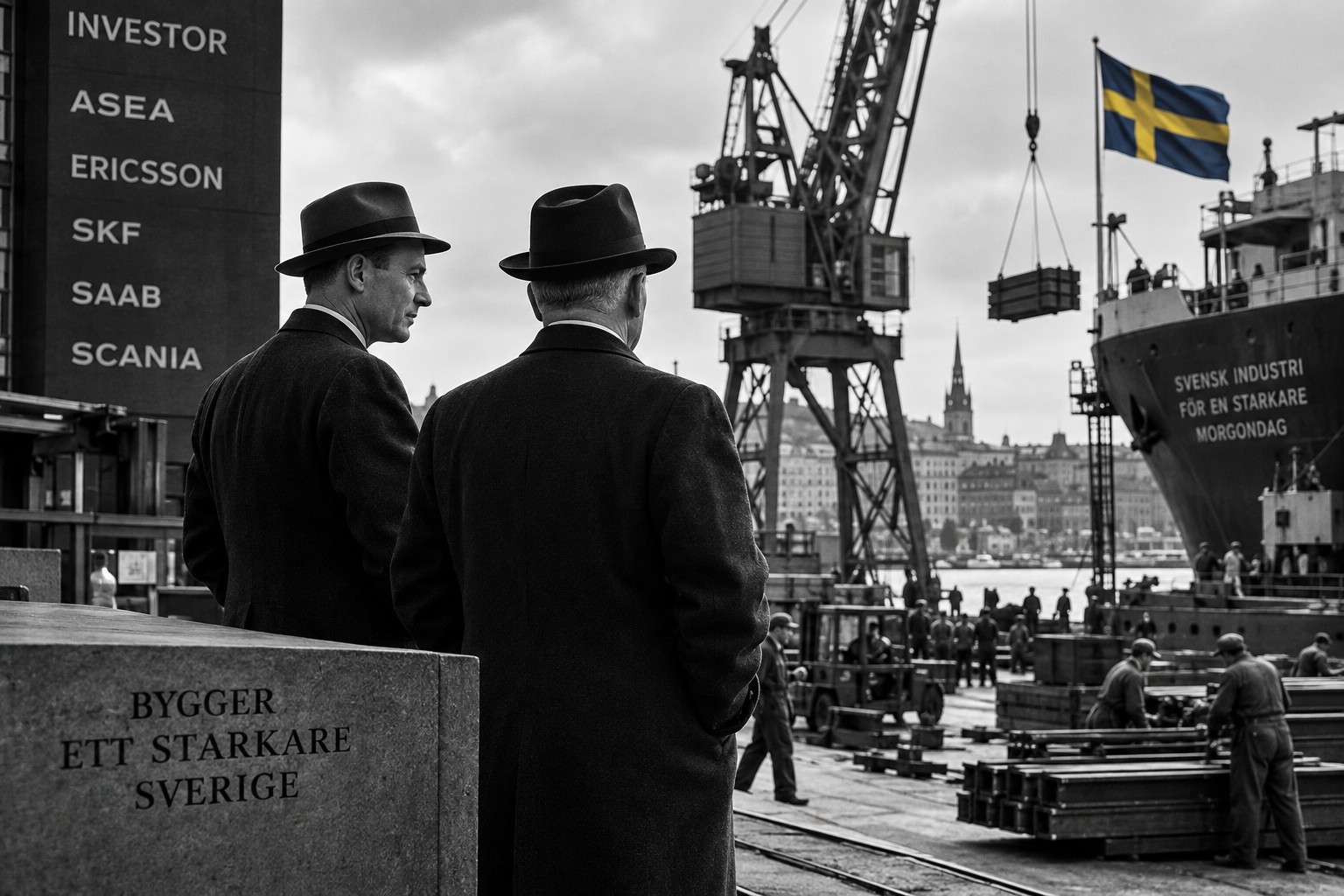
When the Second World War ended in 1945, much of Europe’s industrial infrastructure lay in ruins. Sweden, having remained outside the fighting, emerged with its factories, banks and transport networks largely intact. As Europe began rebuilding, Swedish manufacturers were exceptionally well positioned to meet demand. At the centre of this industrial expansion stood the Wallenberg family, whose financial influence would help shape Sweden’s post-war economy for generations.
A continent in ruins — and Sweden ready to produce
Germany and much of continental Europe faced destroyed factories, damaged railways and severe shortages of industrial equipment. Sweden, by contrast, retained a functioning manufacturing base capable of supplying steel, machinery, electrical equipment and engineering products.
Sweden’s advantage was not neutrality alone. Decades of industrial development, technological innovation and investment in education had already established a competitive export economy. The destruction elsewhere in Europe significantly strengthened its position.


The Wallenberg brothers consolidate their power
Jacob and Marcus Wallenberg occupied central positions in Swedish banking and industry.
Through Stockholms Enskilda Bank, Investor and extensive corporate relationships, the family exercised influence over companies including ASEA, Ericsson, SKF, Saab and Scania-Vabis.
Marcus became managing director of Stockholms Enskilda Bank in 1946, while Jacob increasingly concentrated on the family’s industrial interests.
Their approach combined patient capital, concentrated voting power and long-term corporate governance.
An industrial network expands across Europe
European reconstruction created opportunities for Swedish engineering and manufacturing companies.
ASEA supplied electrical technology, Ericsson expanded telecommunications activities, SKF served international machinery manufacturers, and Saab developed its aerospace and automotive operations.
The Wallenberg sphere benefited from these developments through ownership, financing and board representation.
By the 1960s, its influence extended across a substantial proportion of Sweden’s largest industrial enterprises.
The Swedish state and the industrial establishment
Sweden’s post-war economic model involved extensive cooperation between government, employers and organised labour.
Public infrastructure investment supported industrial production, while defence procurement created important opportunities for companies such as Saab.
The Wallenberg network consequently occupied an influential position at the intersection of private capital, national industrial policy and international commerce.
The foundations of modern Swedish capitalism
Sweden’s industrial success was the product of many forces, including skilled workers, technological development, international demand and political stability.
Nevertheless, the Wallenberg family was exceptionally well positioned to benefit from Europe’s reconstruction.
While much of the continent struggled to restore destroyed industrial capacity, Sweden could expand from an existing manufacturing base.
The result was not merely economic growth. It was the consolidation of a powerful ownership structure that would influence Swedish industry, banking and corporate governance long after the war.
NewsHub Finance | History & Economic Power | 15 October 2026
When the Second World War ended in 1945, much of Europe's industrial infrastructure lay in ruins. Sweden, having remained outside the fighting, emerged with its factories, banks and transport networks largely intact. As Europe began rebuilding, Swedish manufacturers were exceptionally well positioned to meet demand. At the centre of this industrial expansion stood the Wallenberg family, whose financial influence would help shape Sweden's post-war economy for generations.
Recent Comments