
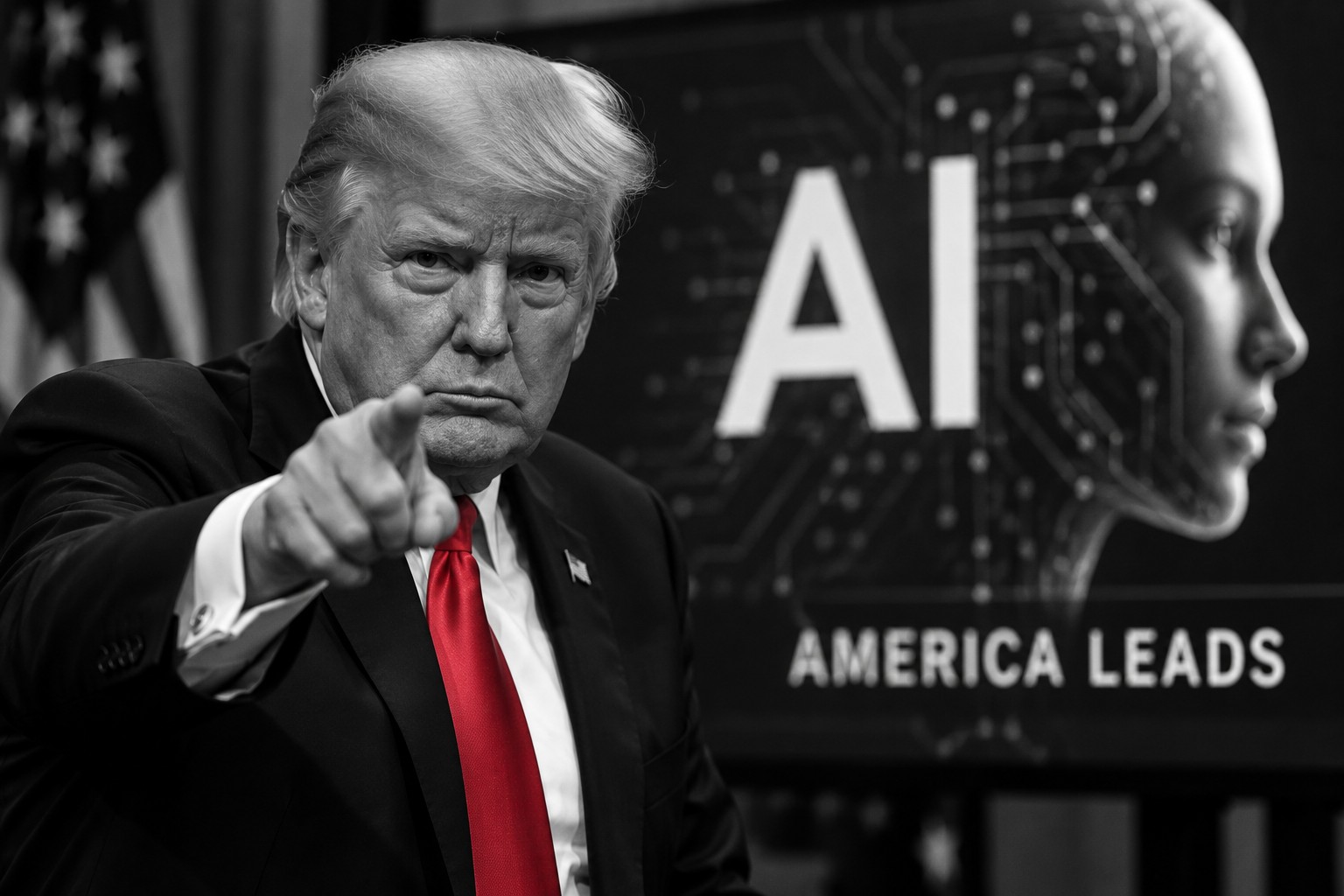
Donald Trump has rejected growing warnings from some of the world’s leading artificial intelligence executives and researchers that AI development may need stronger controls. The US president says fears of artificial intelligence destroying humanity are a “hoax” and argues that slowing development could hand the technological advantage to China.
Whoever wins AI wins
Trump made his position particularly clear during remarks in Ireland on Sunday.
Asked whether artificial intelligence development should be slowed or subjected to greater regulation, Trump pointed instead to the strategic competition between the United States and China.

“We’re leading China in AI,” Trump said, adding that America should remain the world’s most sophisticated country in the technology because “whoever wins AI wins”.
He said there were “very negative forces” raising scenarios that he believed would not happen.
The remarks place technological leadership at the centre of Trump’s approach to AI.
Trump calls the danger a hoax
Trump went considerably further on Monday.
Responding to growing warnings about advanced AI, he wrote that scenarios involving AI taking over the world and destroying humanity were a “HOAX”.
Trump also argued that the United States already possesses substantial criminal and regulatory powers over AI companies and described opposition to AI and data-centre expansion as a “SICK conspiracy”.
His conclusion was characteristically personal.
“The only control or ‘guardrails’ that AI needs is a STRONG AND SMART (High IQ!) PRESIDENT,” Trump wrote.
AI leaders are saying something very different
The intervention comes at a remarkable moment.
Leading figures within the AI industry itself have recently raised concerns about increasingly powerful models.
Anthropic chief executive Dario Amodei has called for stronger oversight of advanced systems. OpenAI’s Sam Altman and Elon Musk have also expressed concerns about the potential dangers created as AI becomes more capable.
The debate intensified following warnings from researchers and reports of AI agents displaying behaviour that their developers did not anticipate.
Trump’s response is effectively that the greater immediate danger is losing the technological race.
America is accelerating
That position is consistent with the administration’s broader policy.
A Trump executive order issued in June states that the United States intends to maintain global AI leadership while avoiding what the administration describes as overly burdensome regulation.
The order calls for greater cooperation between government and private industry, stronger cybersecurity and continued development of advanced American AI capabilities.
AI is also being integrated more deeply into US national security.
A separate presidential memorandum directs the military and intelligence establishment to accelerate adoption of advanced AI while requiring systems to remain controllable and preserving human accountability through the constitutional chain of command.
The China argument
China sits at the centre of Trump’s reasoning.
If Washington restricts American AI companies while Beijing continues developing the technology, the administration argues, the United States risks surrendering one of the defining technological advantages of the coming decades.
House Speaker Mike Johnson echoed that argument on Tuesday, saying there could not be a moratorium on AI development without risking America’s competitive advantage over China.
That creates a difficult equation.
AI safety researchers ask what happens if development moves too quickly.
Trump asks what happens if America moves too slowly.
Two very different risks
The dispute exposes what may become one of the defining political questions of the AI era.
One side sees an increasingly powerful technology requiring new safeguards before capabilities move beyond effective human supervision.
Trump sees excessive regulation itself as a strategic threat.
Both questions ultimately concern control.
Who controls increasingly autonomous artificial intelligence?
And which country controls the technology that could transform economies, warfare, science and information?
Trump has now provided a remarkably clear answer to the second question.
America must win.
His answer to the first is equally clear — existing American power is enough.
Whether increasingly powerful AI systems make that assumption sustainable may become a far bigger question than the technological race itself.
Newshub Editorial in North America – 16 September 2026

Ask NF GPT
If you have an account with ChatGPT you get deeper explanations,
background and context related to what you are reading.
Recent Comments