
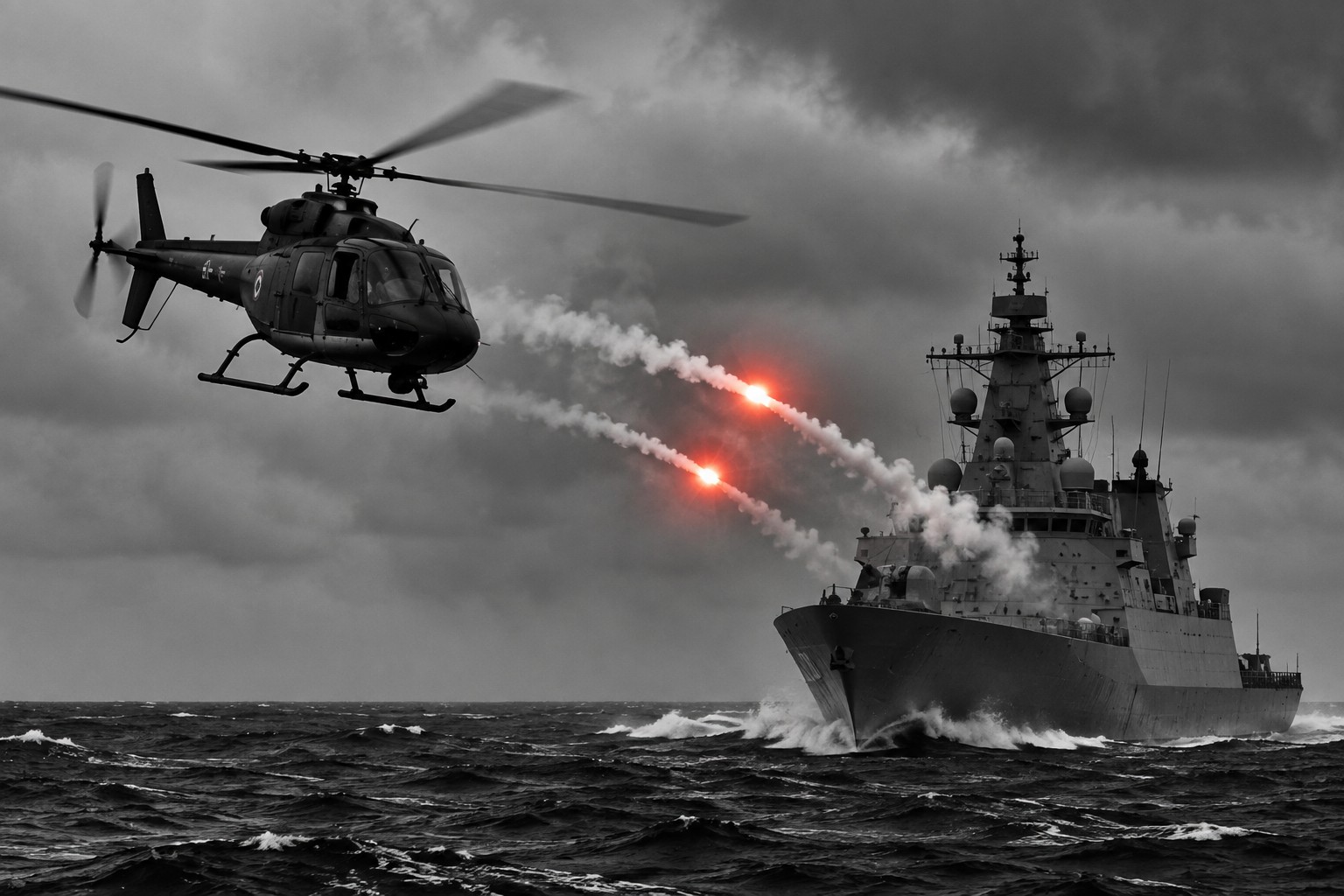
Security tensions across northern Europe intensified on Tuesday after Denmark said a Russian warship fired flares dangerously close to a Danish military helicopter, while NATO fighter jets shot down a drone that entered Lithuanian airspace. European Commission President Ursula von der Leyen described the incidents as part of a broader pattern of Russian aggression and provocation against Europe.
Flares fired towards Danish helicopter
The confrontation in the Baltic Sea occurred on Monday when a Danish Air Force Fennec helicopter was conducting what Danish authorities described as a routine photographic reconnaissance operation involving a Russian frigate sailing in international waters.
According to Denmark’s military, the Russian vessel fired two flares towards the helicopter. One passed within metres of the aircraft. Danish Defence Minister Jeppe Bruus said there had been no warning or radio contact before the flares were launched.


Denmark summoned Russia’s ambassador, Vladimir Barbin, following the incident. Foreign Minister Lars Løkke Rasmussen described the Russian action as unacceptable and said it could have endangered lives.
Russia disputed Denmark’s account of responsibility for the confrontation. Barbin accused Danish helicopters of carrying out dangerous manoeuvres near Russian warships and said Moscow would investigate the incident.
NATO fighter shoots down drone
Hours later, attention shifted east to Lithuania.
NATO fighter jets intercepted and destroyed a drone after it entered Lithuanian airspace, in what Lithuanian officials said was the first interception of its kind over the country. Italian Eurofighter aircraft operating as part of NATO’s Baltic Air Policing mission carried out the interception.
The drone came from the direction of Belarus and remained inside Lithuanian airspace for about 30 minutes before being destroyed near Pratkūnai, west of Vilnius and close to the Kaunas Reservoir.
Lithuanian authorities subsequently said an explosive device had been discovered in the wreckage and neutralised. Officials were investigating the drone’s origin, while Italian Defence Minister Guido Crosetto said it most probably came from Russia.
Europe sees a broader pattern
The two incidents occurred against a background of heightened military activity and security concerns around NATO’s eastern and northern borders.
Poland activated military aircraft on Tuesday in response to Russian drone attacks against Ukraine. Polish authorities had also recovered a suspected Russian drone from the Baltic Sea a day earlier. Germany, meanwhile, was investigating drone debris discovered near the Bundeswehr airbase at Wunstorf.
European Commission President Ursula von der Leyen linked the Danish and Lithuanian incidents, saying they were not isolated events but part of what she described as a broader pattern of Russian aggression and provocation designed to test Europe’s readiness and resolve.
Baltic Sea becomes increasingly sensitive
The Baltic has become one of Europe’s most strategically sensitive regions since Russia’s full-scale invasion of Ukraine in 2022.
Finland and Sweden have joined NATO, leaving Russia facing an alliance that now encompasses almost the entire Baltic coastline outside Russian territory.
The Danish straits are particularly important. They provide the principal maritime route between the Baltic Sea and the North Sea and are used by commercial shipping, military vessels and Russian oil traffic.
Denmark has not sought consultations under NATO’s collective-defence provisions over the helicopter incident. Bruus said such a move would require a more direct attack against Danish territory.
But Tuesday’s events underline the growing risk surrounding military encounters in northern Europe.
Aircraft, drones and warships from Russia and NATO countries are increasingly operating in close proximity. In such an environment, even an incident involving two flares and a reconnaissance helicopter can become part of a much larger security confrontation.
Newshub Editorial in Europe – 16 September 2026

Ask NF GPT
If you have an account with ChatGPT you get deeper explanations,
background and context related to what you are reading.
Security tensions across northern Europe intensified on Tuesday after Denmark said a Russian warship fired flares dangerously close to a Danish military helicopter, while NATO fighter jets shot down a drone that entered Lithuanian airspace. European Commission President Ursula von der Leyen described the incidents as part of a broader pattern of Russian aggression and provocation against Europe.
Recent Comments