
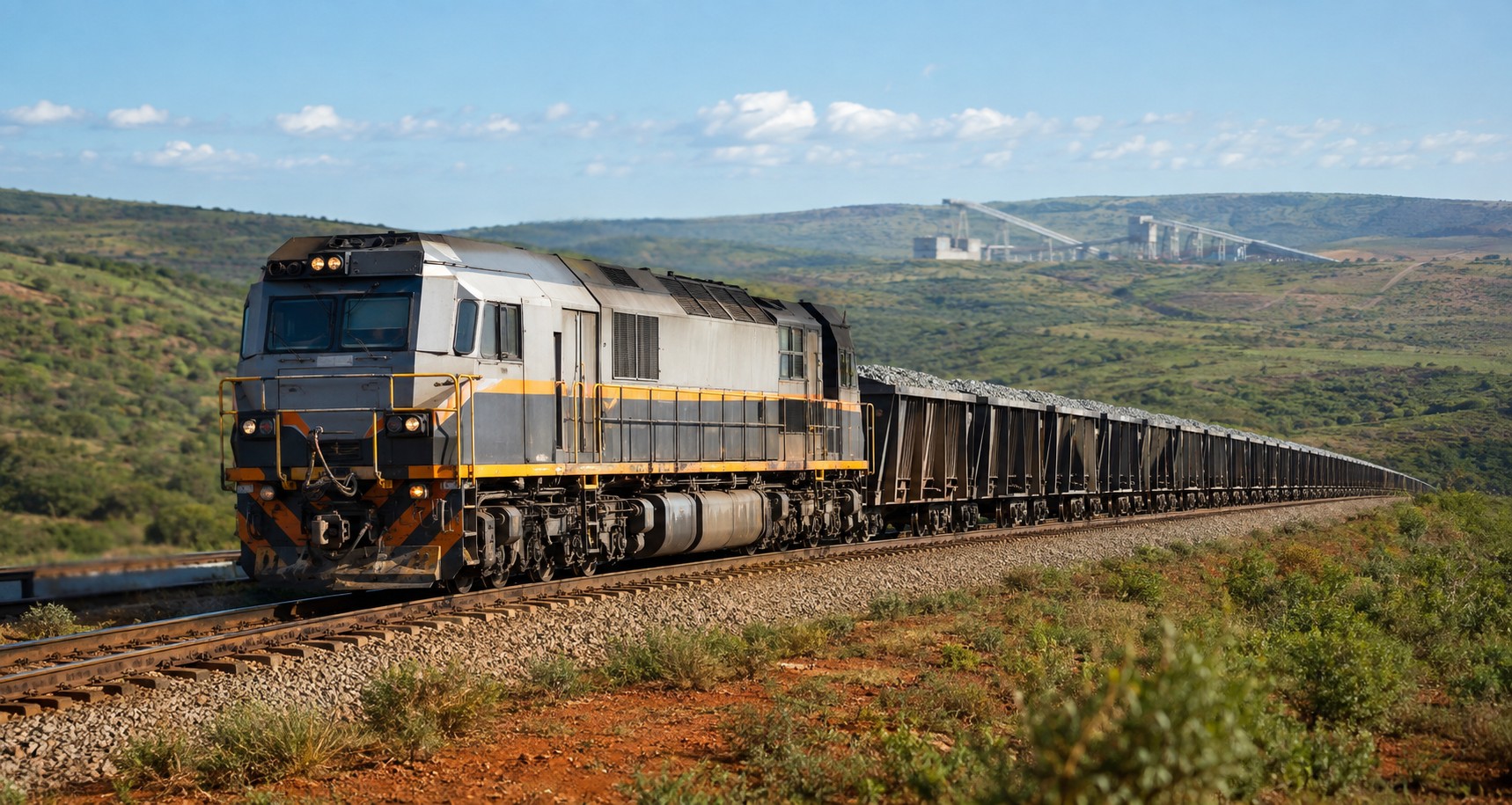
A R3.4 billion ($210 million) investment in locomotives and freight wagons is strengthening confidence in Africa’s rail sector, as several mineral-rich emerging markets open their networks to private operators. The programme could improve regional trade, reduce transport costs and support growing exports of critical minerals.
Major expansion of freight capacity
South African rail services company Traxtion is acquiring 46 locomotives and 920 wagons as part of one of the region’s largest private investments in railway rolling stock. The company is positioning itself for increased demand across southern and central Africa, where governments are reforming freight networks that have often suffered from limited capacity and underinvestment.
The investment reflects growing confidence that open-access policies will allow private companies to operate trains on publicly owned tracks. South Africa is introducing this model to increase freight volumes, improve efficiency and attract private capital without relinquishing state ownership of the underlying infrastructure.

Regional reforms create new opportunities
Similar changes are under way in Angola, the Democratic Republic of Congo, Zambia, Mozambique and Zimbabwe. These countries hold substantial reserves of copper, cobalt, lithium and other minerals required for electric vehicles, renewable energy systems and modern electronics.
Improved rail connections could help African producers move more commodities to international markets while reducing their reliance on costly and congested road transport. Rail freight can carry larger volumes over long distances and generally produces lower emissions per tonne than trucking.
Angola has already awarded a 30-year concession for the Lobito Corridor railway, which connects the Atlantic coast with mining regions in the Democratic Republic of Congo and is expected eventually to reach Zambia. The corridor is attracting billions of dollars in potential financing and has become a central part of efforts to develop more competitive export routes.
Investment spreads across the continent
The Tanzania–Zambia Railway is also undergoing a $1.4 billion Chinese-backed modernisation, while Zimbabwe is pursuing a railway renewal programme worth approximately $533 million. Together, these projects demonstrate a wider shift towards combining public infrastructure with private finance and operational expertise.
For landlocked economies such as Zambia and the Democratic Republic of Congo, reliable regional railways are particularly important. Faster access to ports can lower export costs, improve the competitiveness of local industries and encourage investment in mineral processing and manufacturing.
A foundation for broader growth
Challenges remain, including inconsistent regulations, ageing tracks and the need for better coordination between neighbouring countries. Investors will require predictable access charges and clear operating rules before committing further capital.
Nevertheless, Traxtion’s expansion represents a positive signal for Africa’s emerging markets. If reforms continue, stronger freight networks could unlock mineral exports, support industrial development and create employment in railway operations, maintenance, logistics and related services.
The investment also shows how African companies can participate directly in the continent’s infrastructure transformation, helping build a more connected regional economy rather than relying exclusively on foreign operators.
Newshub Editorial in Africa – 16 August 2026

Ask NF GPT
If you have an account with ChatGPT you get deeper explanations,
background and context related to what you are reading.
Recent Comments