
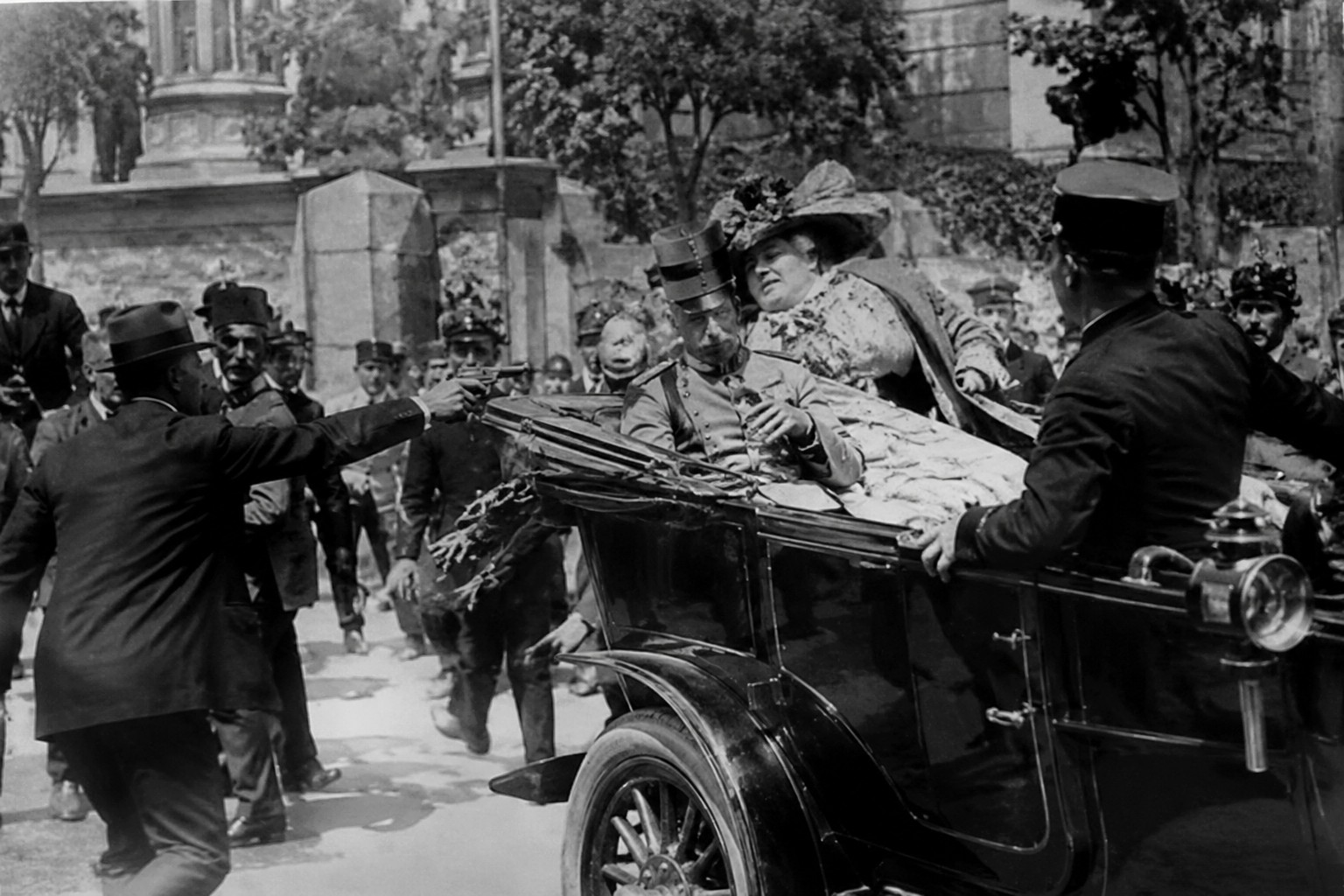
On 28 June 1914, the assassination of Archduke Franz Ferdinand in Sarajevo became the catalyst for one of the deadliest conflicts in human history. Although the murder itself claimed two lives, its political consequences set in motion a chain of events that led directly to the outbreak of the First World War, reshaping the global order for generations.
A Royal Visit Turns Deadly
Archduke Franz Ferdinand, heir presumptive to the Austro-Hungarian throne, travelled to Sarajevo, the capital of Bosnia and Herzegovina, on an official visit. The province had been annexed by Austria-Hungary in 1908, a move fiercely opposed by many Serbian nationalists who believed the territory should belong to a future South Slav state.

The visit took place amid heightened political tensions. A group of young Bosnian Serb conspirators, supported by elements linked to the Serbian nationalist organisation known as the Black Hand, had positioned themselves along the Archduke’s motorcade route with the intention of assassinating him.
A Fatal Twist Of Fate
An initial assassination attempt failed when a bomb thrown at the Archduke’s vehicle missed its target. Believing the danger had passed, Franz Ferdinand continued with his official engagements before deciding to visit those injured by the earlier explosion.
During the journey, the Archduke’s driver made a wrong turn and stopped the car while attempting to reverse. By extraordinary coincidence, the vehicle halted directly in front of Gavrilo Princip, one of the conspirators, who had believed the opportunity was lost.
Princip stepped forward and fired two shots at close range. Franz Ferdinand was struck in the neck, while his wife, Sophie, Duchess of Hohenberg, was fatally wounded in the abdomen. Both died shortly afterwards.
Europe On The Brink
The assassination immediately triggered a diplomatic crisis. Austria-Hungary blamed Serbia for supporting the conspirators and, with Germany’s backing, issued an ultimatum containing demands that Serbia considered unacceptable.
Within weeks, Austria-Hungary declared war on Serbia. A complex network of military alliances rapidly drew Europe’s major powers into the conflict. Russia mobilised in support of Serbia, Germany declared war on Russia and France, and Britain’s entry followed Germany’s invasion of Belgium.
What had begun as a regional dispute quickly escalated into the First World War.
A Turning Point In Modern History
The First World War lasted from 1914 to 1918 and claimed an estimated 20 million lives, with many millions more wounded. The conflict destroyed four great empires—the Austro-Hungarian, German, Russian and Ottoman Empires—and transformed the political map of Europe and the Middle East.
The war also laid many of the foundations for the twentieth century’s major geopolitical developments, including revolutions, economic instability, the rise of extremist ideologies, and ultimately the conditions that contributed to the outbreak of the Second World War.
The assassination of Franz Ferdinand remains one of history’s clearest examples of how a single event, occurring within an already unstable political environment, can unleash consequences far beyond what anyone involved could have imagined.
Newshub Editorial – Europe – 28 June 2026

If you have an account with ChatGPT you get deeper explanations,
background and context related to what you are reading.
Open an account:
Open an account
Recent Comments