
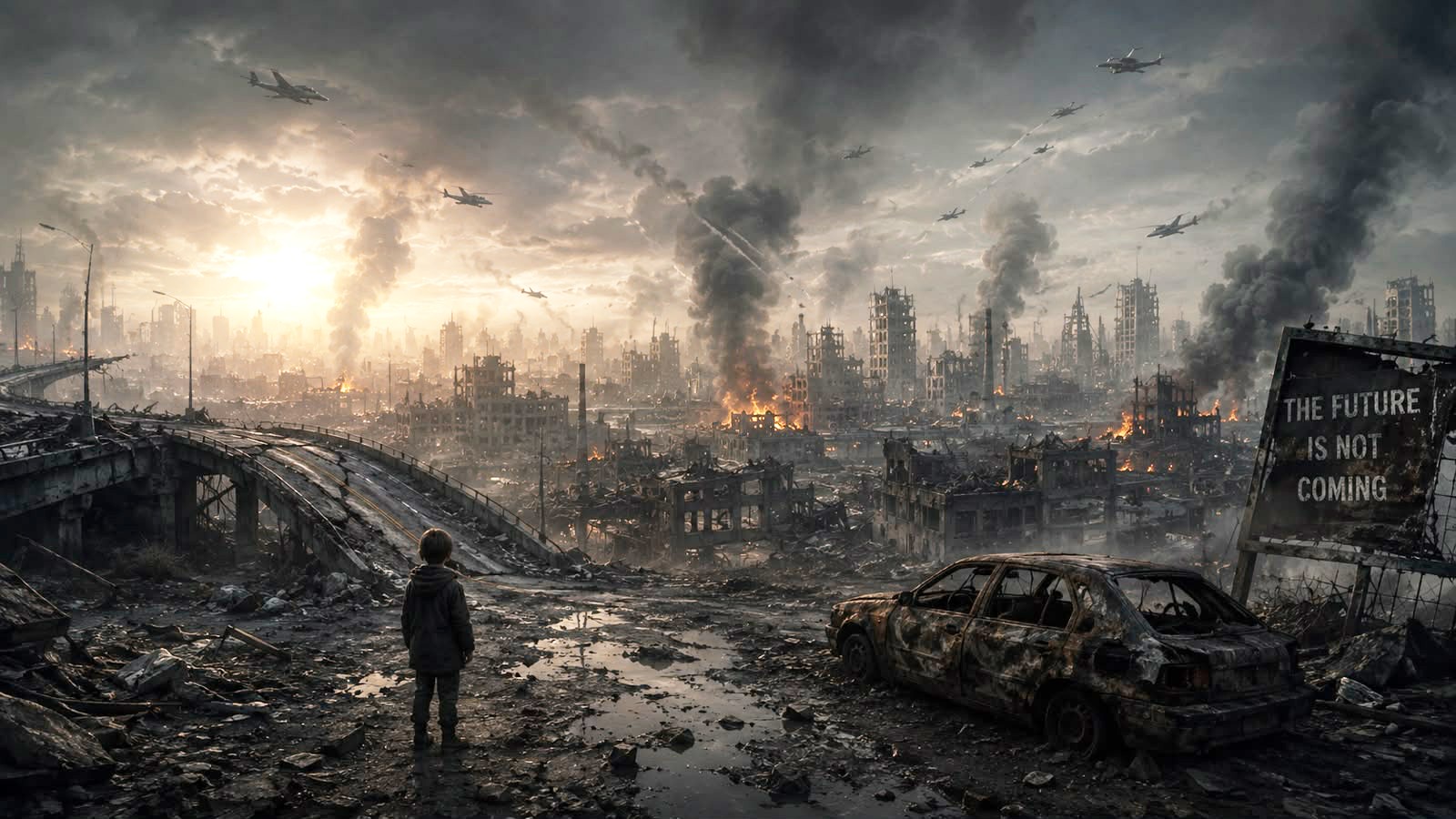
While governments pressure households and businesses to reduce emissions, modern warfare continues to generate greenhouse gases on an almost incomprehensible scale. The war in Ukraine and the first two weeks of the conflict involving Iran together produced an estimated climate impact equivalent to 272 million cars being driven for an entire year.
War’s overlooked environmental cost
The human and economic consequences of war are immediately visible. People are killed or injured, homes are destroyed and communities are displaced. The climate consequences, however, rarely occupy the same place in political debate.
A recent assessment estimated that Russia’s full-scale war against Ukraine generated approximately 311 million tonnes of carbon dioxide equivalent between 24 February 2022 and 23 February 2026.


The calculation includes military fuel consumption, fires, damage to energy infrastructure, diverted aviation, population displacement and the future reconstruction of destroyed buildings and infrastructure.
That is an emissions footprint comparable to the annual output of an industrialised country.
Five million tonnes in just two weeks
No complete climate assessment is yet available for the conflict involving Iran. However, a preliminary analysis estimated that more than five million tonnes of carbon dioxide equivalent were generated during its first 14 days, between 28 February and 14 March 2026.
The emissions came not only from fighter aircraft, naval vessels, missiles and military vehicles. Destroyed buildings, damaged oil facilities, major fires and the future production required to replace infrastructure and military equipment also contributed.
The figure should therefore be treated as an early estimate rather than a final climate total.
Equivalent to 3.27 trillion kilometres
Combining Ukraine’s estimated 311 million tonnes with more than five million tonnes from Iran produces a total of approximately 316 million tonnes of carbon dioxide equivalent.
Preliminary European Environment Agency figures indicate that the average newly registered European passenger car in 2025 emitted approximately 96.7 grams of carbon dioxide per kilometre. The figure includes electric vehicles and represents a standardised comparison rather than the direct emissions of an individual petrol or diesel car.
Using this benchmark, 316 million tonnes corresponds to approximately 3.27 trillion kilometres of driving.
That is equivalent to 272 million cars each travelling 12,000 kilometres in one year, approximately 81.5 million journeys around the Earth, or five million cars travelling 12,000 kilometres annually for more than 54 years.
The Ukraine war alone represents the annual driving emissions of approximately 268 million cars.
The blind spot in climate policy
The comparison exposes a striking contradiction. Citizens are encouraged to drive less, replace vehicles and reduce energy use, while businesses face expanding climate-reporting and efficiency requirements.
Yet military conflicts can generate emissions equivalent to decades of civilian driving within a remarkably short period.
Military emissions are also difficult to measure. Information about fuel consumption, weapons production, logistics and operations is frequently classified, incomplete or unavailable. Reconstruction estimates must additionally rely on assumptions about materials, construction methods and future energy consumption.
War destroys the future carbon budget
The climate impact does not end when the fighting stops. Homes, roads, hospitals, power stations and factories must eventually be rebuilt using steel, cement, heavy machinery, transport and enormous amounts of energy.
War consequently generates emissions in three stages: through military operations, through fires and destruction, and through the long-term reconstruction process.
Human suffering must always remain the central concern. But global climate targets cannot be discussed honestly without accounting for warfare, military expansion and reconstruction.
Ukraine and the opening weeks of the Iran conflict have already produced an estimated climate impact equivalent to 272 million cars being driven for an entire year. In Iran’s case, the full climate bill has only begun to be calculated.
Newshub Editorial in Global Affairs – 24 July 2026

Ask NF GPT
If you have an account with ChatGPT you get deeper explanations,
background and context related to what you are reading.
While governments pressure households and businesses to reduce emissions, modern warfare continues to generate greenhouse gases on an almost incomprehensible scale. The war in Ukraine and the first two weeks of the conflict involving Iran together produced an estimated climate impact equivalent to 272 million cars being driven for an entire year.
Recent Comments