
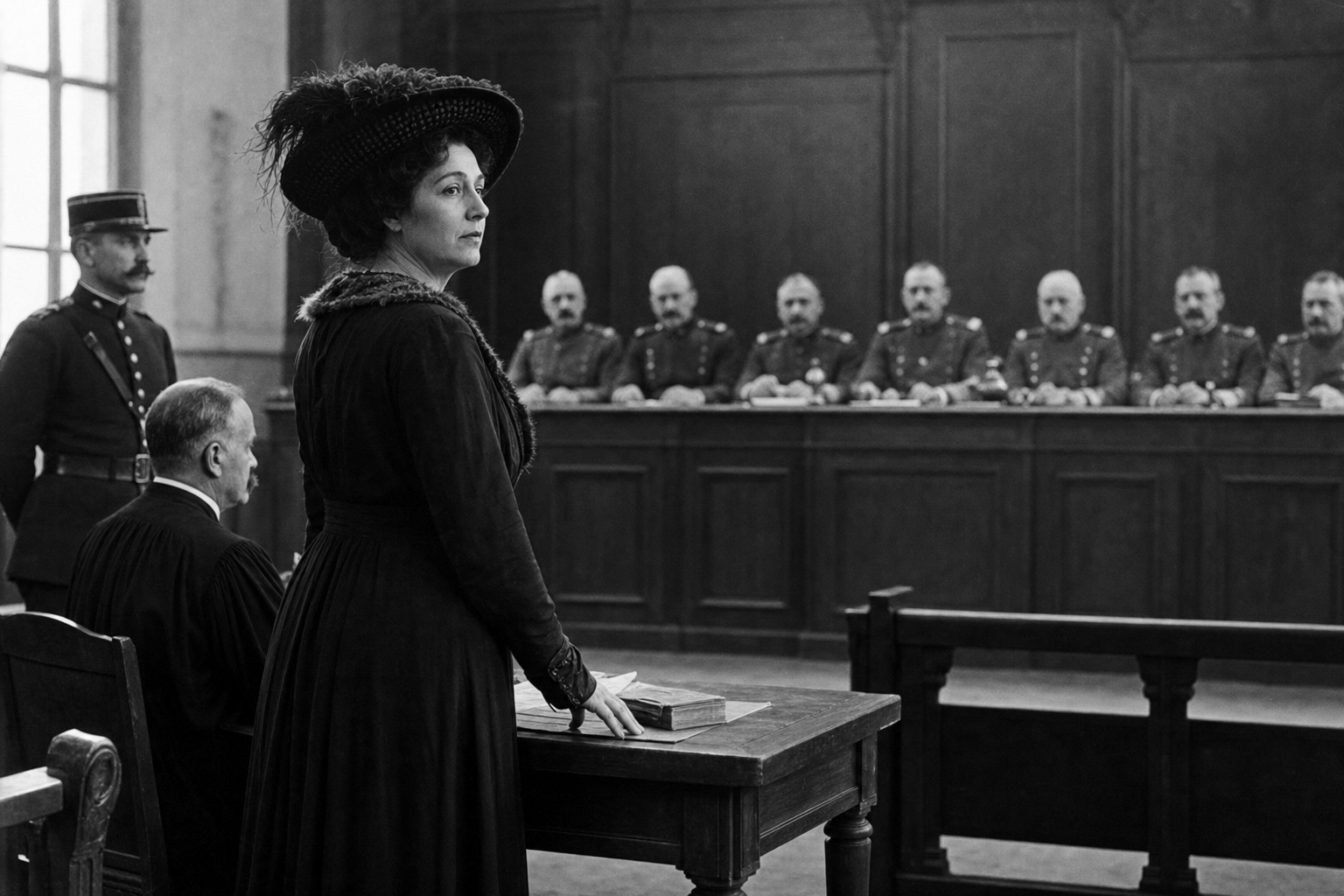
Dutch-born dancer and courtesan Mata Hari went on trial before a closed French military court in Paris on 24 July 1917. Accused of spying for Germany during the First World War, she faced eight espionage charges in a case shaped by intercepted messages, her international relationships and France’s increasingly desperate wartime climate.
From stage celebrity to suspected spy
Born Margaretha Geertruida Zelle in the Netherlands in 1876, she moved to Paris after an unsuccessful marriage and reinvented herself as the exotic dancer Mata Hari. Her performances, which began attracting attention in 1905, made her a European celebrity. As her dancing career declined, she became a courtesan whose lovers reportedly included wealthy businessmen, diplomats and senior military officers.
Wartime travel attracts attention
The Netherlands remained neutral during the war, allowing Mata Hari to travel across borders more freely than citizens of the belligerent countries. That mobility, combined with her influential contacts, attracted the attention of several intelligence services. In 1915, she accepted 20,000 francs from a German official but later maintained that the money represented compensation for possessions confiscated in Germany. She subsequently agreed to gather intelligence for France, although the arrangement appears to have been poorly organised.

Evidence remains disputed
French intelligence intercepted German communications referring to an agent identified as H-21, whose activities appeared to correspond with Mata Hari’s movements. These messages became a central part of the prosecution’s case. However, the charges reportedly failed to identify a decisive military secret that she had supplied to Germany. Claims that her actions had contributed to the deaths of tens of thousands of French soldiers were also unsupported by specific evidence presented during the proceedings.
France searches for an explanation
The trial began at a particularly difficult moment for France. The country was suffering heavy casualties, declining public confidence and widespread military unrest following the failed Nivelle Offensive. Historians have consequently questioned whether Mata Hari’s celebrity, foreign identity and unconventional private life made her a convenient symbol of betrayal. Her spending, lovers and carefully constructed stage persona featured prominently in a case that often appeared to judge her character alongside the espionage allegations.
Verdict creates an enduring legend
The military court found Mata Hari guilty on 25 July 1917 and sentenced her to death. Attempts to overturn or commute the sentence were unsuccessful. She was executed by firing squad at Vincennes, near Paris, on 15 October 1917, aged 41.
Her name subsequently became synonymous with the seductive female spy, influencing books, films and popular culture. Yet the surviving record presents a less certain picture: a celebrity who accepted German money, became entangled with competing intelligence services and exercised poor judgement, but whose reputation as a highly effective master spy remains open to serious doubt.
Newshub Editorial in Europe – 24 July 2026

Ask NF GPT
If you have an account with ChatGPT you get deeper explanations,
background and context related to what you are reading.
Recent Comments