
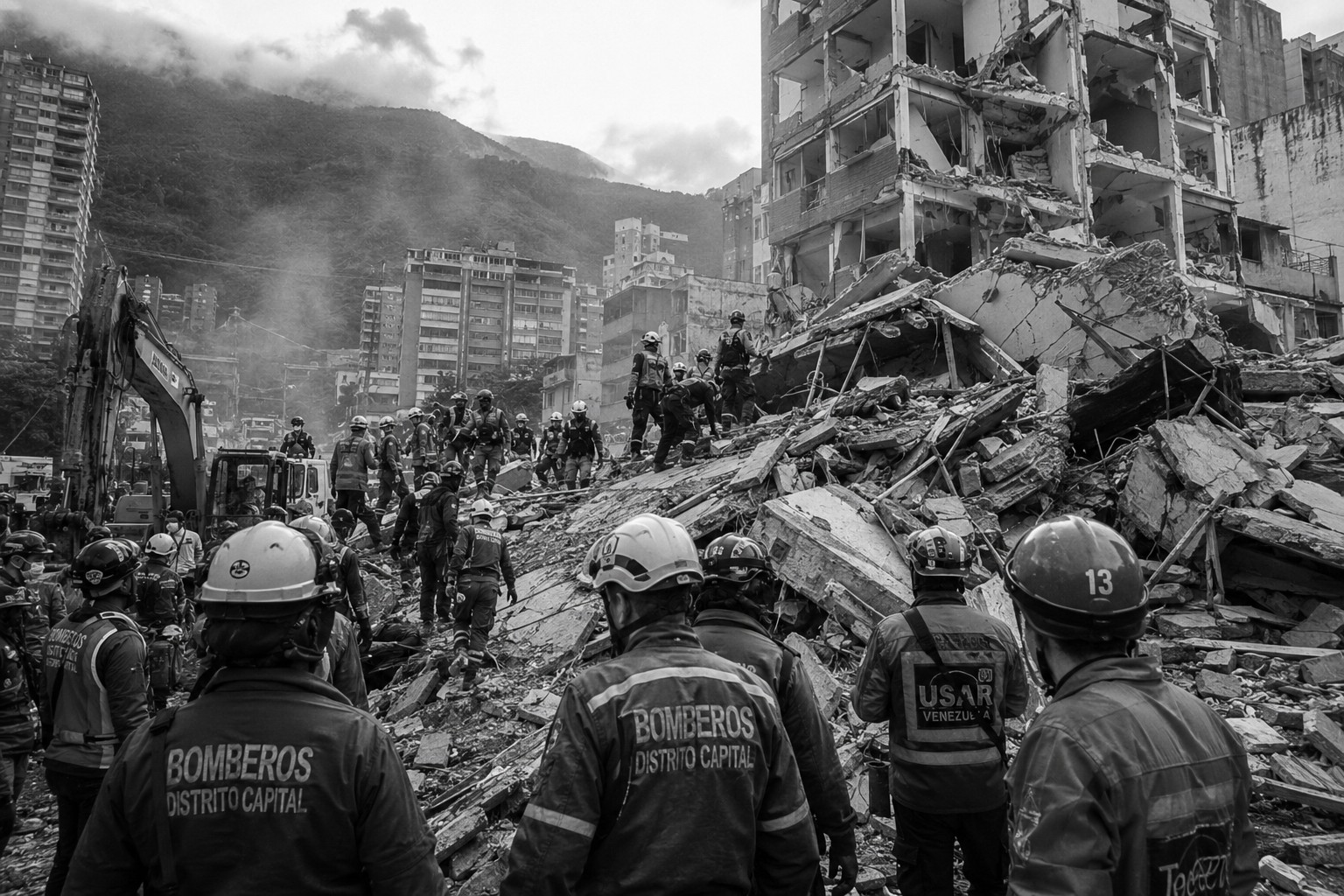
International rescue teams are pouring into Venezuela after two powerful earthquakes devastated the country’s northern coast, flattening buildings, crippling infrastructure and leaving at least 235 people confirmed dead. Authorities fear the final death toll could rise dramatically as thousands remain unaccounted for beneath the rubble.
A nation in crisis
The twin earthquakes, measuring magnitude 7.2 and 7.5, struck less than a minute apart on Wednesday afternoon, making them the strongest seismic event to hit Venezuela in more than a century. The coastal state of La Guaira, along with parts of Caracas and neighbouring communities, suffered catastrophic damage as apartment blocks, offices and public buildings collapsed within seconds.

Officials have confirmed more than 4,300 injuries, while emergency services continue to search collapsed structures where many survivors are believed to be trapped. Repeated aftershocks have complicated rescue operations and forced temporary evacuations of already damaged buildings.
Global response mobilises
Countries from across the Americas and Europe have rapidly deployed specialised urban search-and-rescue teams, heavy equipment, medical personnel and humanitarian aid. The United States announced immediate assistance, focusing on search operations during the critical first 72 hours after the disaster, widely regarded as the period offering the greatest chance of finding survivors alive.
The United Nations has also begun coordinating international relief efforts, while humanitarian organisations are preparing emergency shelters, medical supplies, food and clean water for tens of thousands of displaced residents.
Infrastructure severely damaged
The disaster has dealt another major blow to a country already facing significant economic and humanitarian challenges. Simón Bolívar International Airport, Venezuela’s principal international gateway, sustained extensive damage, disrupting relief flights during the crucial early stages of the emergency. Roads, bridges, electricity networks and telecommunications infrastructure have also been affected across several regions.
Officials estimate that hundreds of buildings have either collapsed or suffered structural damage, leaving entire neighbourhoods inaccessible to rescue crews without heavy engineering equipment.
Race against the clock
Emergency workers continue to dig through collapsed buildings by hand alongside international rescue specialists, as families wait anxiously for news of missing relatives. Authorities warn that casualty figures are expected to rise significantly as access is gained to the worst-affected districts.
For Venezuela, the coming days will not only determine how many lives can still be saved but also mark the beginning of what is likely to become one of the country’s largest reconstruction efforts in modern history.
Newshub Editorial | South America – 26 June 2026

If you have an account with ChatGPT you get deeper explanations,
background and context related to what you are reading.
Open an account:
Open an account
Recent Comments