
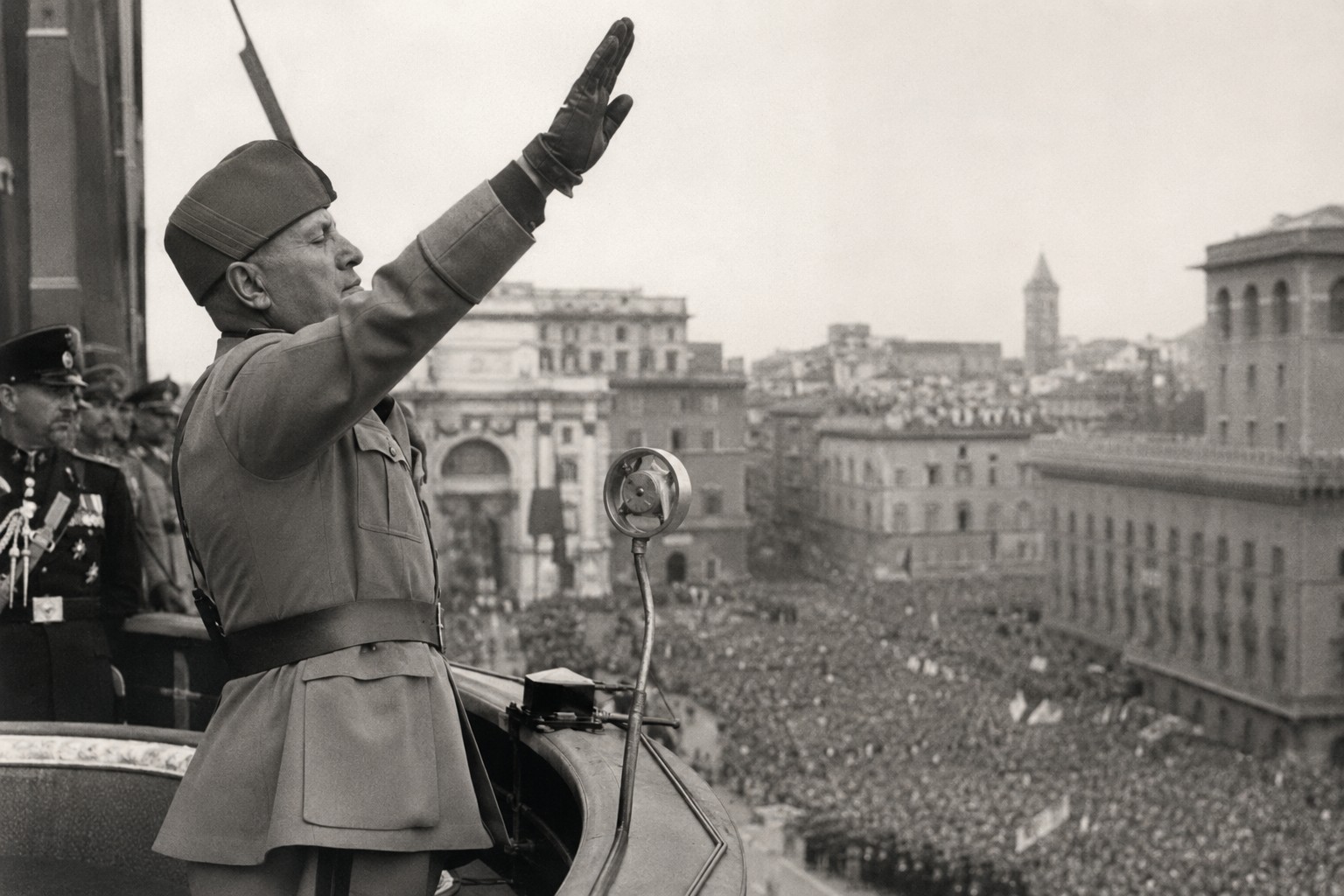
On 10 June 1940, Fascist Italy under the leadership of Benito Mussolini formally declared war on France and Great Britain, bringing the country into the Second World War. The decision marked a pivotal moment in European history, opening a new front in the conflict and aligning Italy more closely with Nazi Germany under Adolf Hitler.
Mussolini seeks a place among the victors
By the summer of 1940, Germany had achieved a series of rapid military victories across Europe. Following the invasions of Poland, Denmark, Norway, Belgium, the Netherlands and France, Hitler appeared unstoppable. Mussolini, who had maintained a position of “non-belligerence” since the outbreak of war in September 1939, feared that Italy would be excluded from any future peace settlement if it remained on the sidelines.
Believing that France was on the verge of collapse and that Britain would soon seek terms, Mussolini concluded that the time had come to join the conflict. Speaking from the balcony of Palazzo Venezia in Rome, he announced Italy’s declaration of war to cheering crowds gathered below.

A declaration against weakened opponents
Italy entered the war at a moment when France was already suffering a devastating military defeat at the hands of Germany. Italian forces launched limited operations across the Alpine frontier against French troops, although the campaign achieved only modest gains before France signed an armistice later that month.
At the same time, Italy declared war on Great Britain, immediately expanding the conflict into the Mediterranean and North Africa. British and Italian forces would soon clash in Egypt, Libya, East Africa and across the Mediterranean Sea, creating a major theatre of war that lasted for years.
Military ambitions meet harsh realities
Mussolini envisioned the creation of a new Roman Empire stretching across the Mediterranean and parts of Africa. However, Italy’s armed forces were poorly prepared for a prolonged conflict. Shortages of equipment, fuel, industrial capacity and modern weaponry soon became apparent.
Military campaigns in Greece, North Africa and the Balkans exposed significant weaknesses in Italian planning and logistics. Germany was repeatedly forced to intervene to support its ally, placing increasing strain on the Axis partnership.
The road to Italy’s collapse
As the war progressed, Allied forces gained the upper hand in the Mediterranean. Following the Allied invasion of Sicily in 1943, Mussolini was removed from power and arrested by his own government. Italy later surrendered to the Allies, although fighting continued on Italian soil until the end of the war in Europe in 1945.
The declaration of war on 10 June 1940 remains one of the defining decisions of Mussolini’s regime. What was intended as a short path to territorial expansion and prestige instead led Italy into a devastating conflict that resulted in military defeat, economic ruin and the collapse of Fascist rule.
Newshub Editorial in Europe – June 10, 2026

If you have an account with ChatGPT you get deeper explanations,
background and context related to what you are reading.
Open an account:
Open an account
Recent Comments