
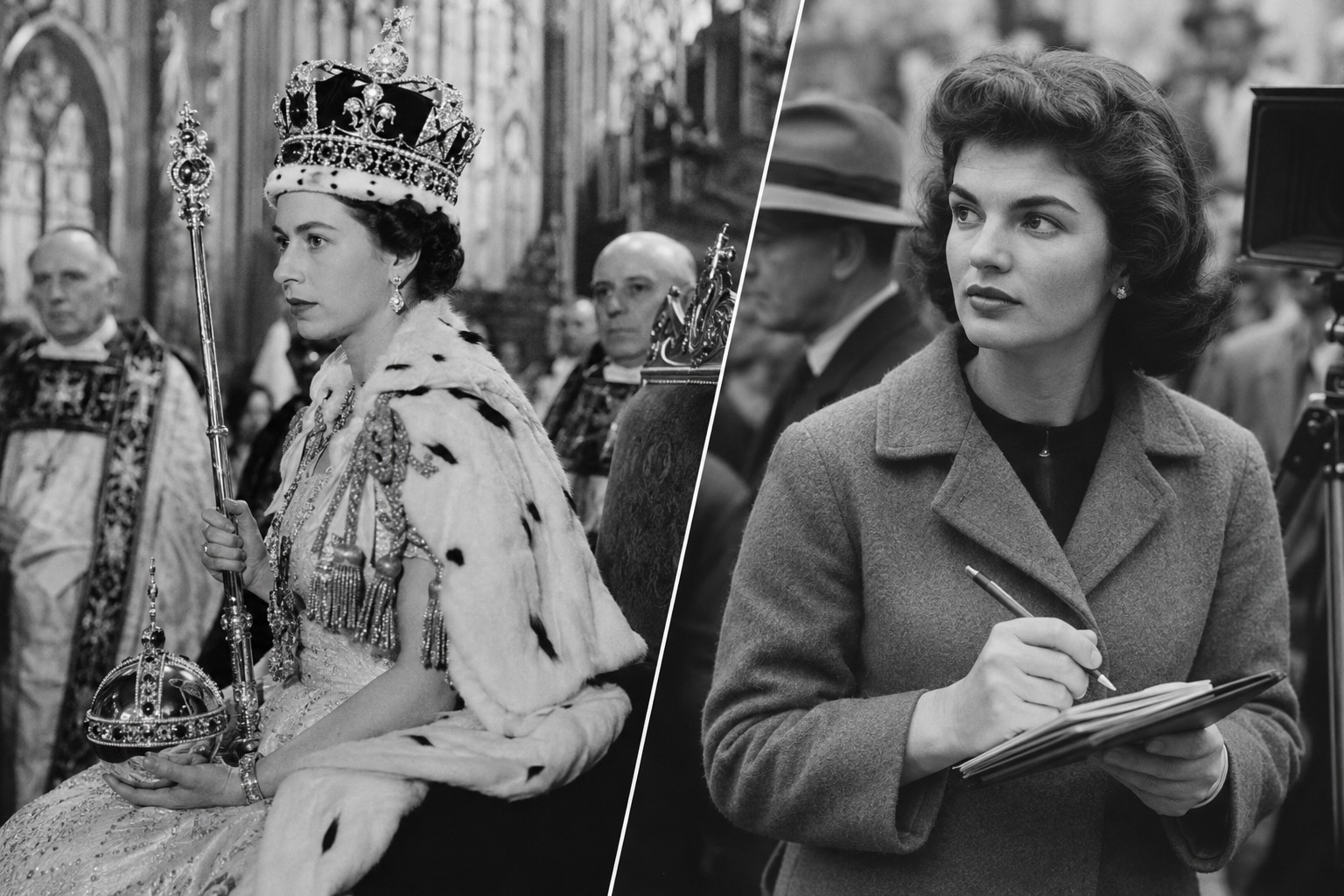
On 2 June 1953, millions around the world watched as Princess Elizabeth became Queen Elizabeth II in a coronation ceremony that symbolised continuity, duty and the endurance of the British monarchy. Less remembered, however, is the role played by a young American journalist named Jacqueline Bouvier—later known to history as Jackie Kennedy—who travelled to London to cover the event for a US newspaper.
A coronation for the television age
The coronation of Elizabeth II at Westminster Abbey marked one of the most significant royal ceremonies of the twentieth century. Following the death of her father, George VI, in February 1952, Elizabeth had already become queen. The coronation, however, formally confirmed her position before the nation and the Commonwealth.
The ceremony attracted global attention not only because of its historic importance but also because it became one of the first major international events to be widely televised. Millions gathered around television sets, many for the first time, helping accelerate the adoption of television across Britain and beyond.

The young monarch, then just 27 years old, represented a bridge between the hardships of the Second World War and a new era of post-war optimism. The image of Elizabeth wearing the Imperial State Crown became one of the defining photographs of the century.
Jackie Bouvier’s assignment
Among the hundreds of journalists dispatched to London was a 23-year-old reporter named Jacqueline Kennedy Onassis. At the time, she was still Jacqueline Bouvier, a rising journalist working for the Washington Times-Herald.
Her editors sent her to Britain to cover the coronation and the social atmosphere surrounding the event. Unlike many traditional reporters, Bouvier focused on people, personalities and public sentiment rather than purely ceremonial details. Her observations offered American readers a more personal glimpse into British society and the excitement surrounding the young queen.
The assignment proved significant for Bouvier’s own career. Only months later, in September 1953, she married John F. Kennedy, beginning a partnership that would eventually place her at the centre of American political life and global celebrity.
A meeting of two twentieth-century icons
Although their lives followed very different paths, Elizabeth II and Jackie Kennedy became two of the most recognisable women of the modern era. One embodied constitutional monarchy and public service; the other became a symbol of American elegance, culture and political glamour.
Their paths crossed several times in later years, most notably during the Kennedy presidency. Historians have often reflected on the contrast between the reserved British monarch and the charismatic First Lady, both of whom captured the imagination of people around the world.
The fact that Jackie Kennedy first entered the international spotlight while reporting on Elizabeth’s coronation adds an intriguing historical footnote. Before becoming a global icon herself, she was documenting the rise of another woman who would come to define an era.
A legacy that endures
More than seven decades later, the coronation of Elizabeth II remains one of the most important royal events ever staged. It ushered in a reign that lasted seventy years and became the longest in British history.
At the same time, Jackie Kennedy’s presence in London serves as a reminder that history often brings together remarkable figures before the world fully understands their future significance. On that June day in 1953, one young woman was being crowned queen, while another was quietly recording the story—unaware that she too would soon become part of history.
Newshub Editorial in Europe – 2 June 2026

If you have an account with ChatGPT you get deeper explanations,
background and context related to what you are reading.
Open an account:
Open an account
Recent Comments