
Companies across the United States are increasingly using automation not simply to improve productivity, but to reduce the bargaining power and wage premiums of certain groups of workers, according to new research from economists at Massachusetts Institute of Technology. The findings suggest that automation may be contributing more to wage inequality than to measurable gains in efficiency, particularly in sectors where experienced employees traditionally commanded higher pay due to specialised knowledge or operational leverage.
Automation targeting higher-paid workers
The research found that firms often introduce automation in areas where workers receive what economists describe as a “wage premium” — salaries above the market average due to bargaining power, union strength, technical expertise or institutional experience.
Rather than focusing exclusively on eliminating repetitive labour, companies frequently automate tasks performed by employees whose higher compensation levels are viewed as costly relative to competitors. This includes roles within logistics, administration, finance, customer support and industrial coordination.

The result is a labour market where automation increasingly affects middle-income and experienced workers rather than only low-skilled positions traditionally associated with industrial mechanisation.
Productivity gains remain uncertain
One of the study’s most significant conclusions is that automation does not always generate substantial productivity improvements. In many cases, firms appeared motivated primarily by labour-cost reduction rather than operational transformation.
Economists noted that replacing experienced workers with automated systems may reduce payroll expenses while failing to produce proportional increases in output or innovation. This raises broader questions regarding how companies define efficiency and whether financial markets reward cost-cutting more heavily than long-term capability development.
Critics argue that excessive focus on wage suppression may weaken institutional knowledge, workforce stability and long-term competitiveness.
Inequality concerns continue to grow
The findings also reinforce concerns that automation may accelerate income inequality within advanced economies. Workers with practical operational expertise, once protected by experience and institutional dependence, are increasingly exposed to software-driven substitution.
At the same time, executives, technology providers and highly specialised AI engineers often capture a disproportionate share of productivity-related gains. This dynamic risks creating a more polarised labour market divided between highly paid technical elites and lower-paid service-sector employment.
Labour economists warn that younger workers may also face reduced opportunities to accumulate practical workplace experience if entry-level functions become heavily automated.
Corporate monitoring expanding alongside AI systems
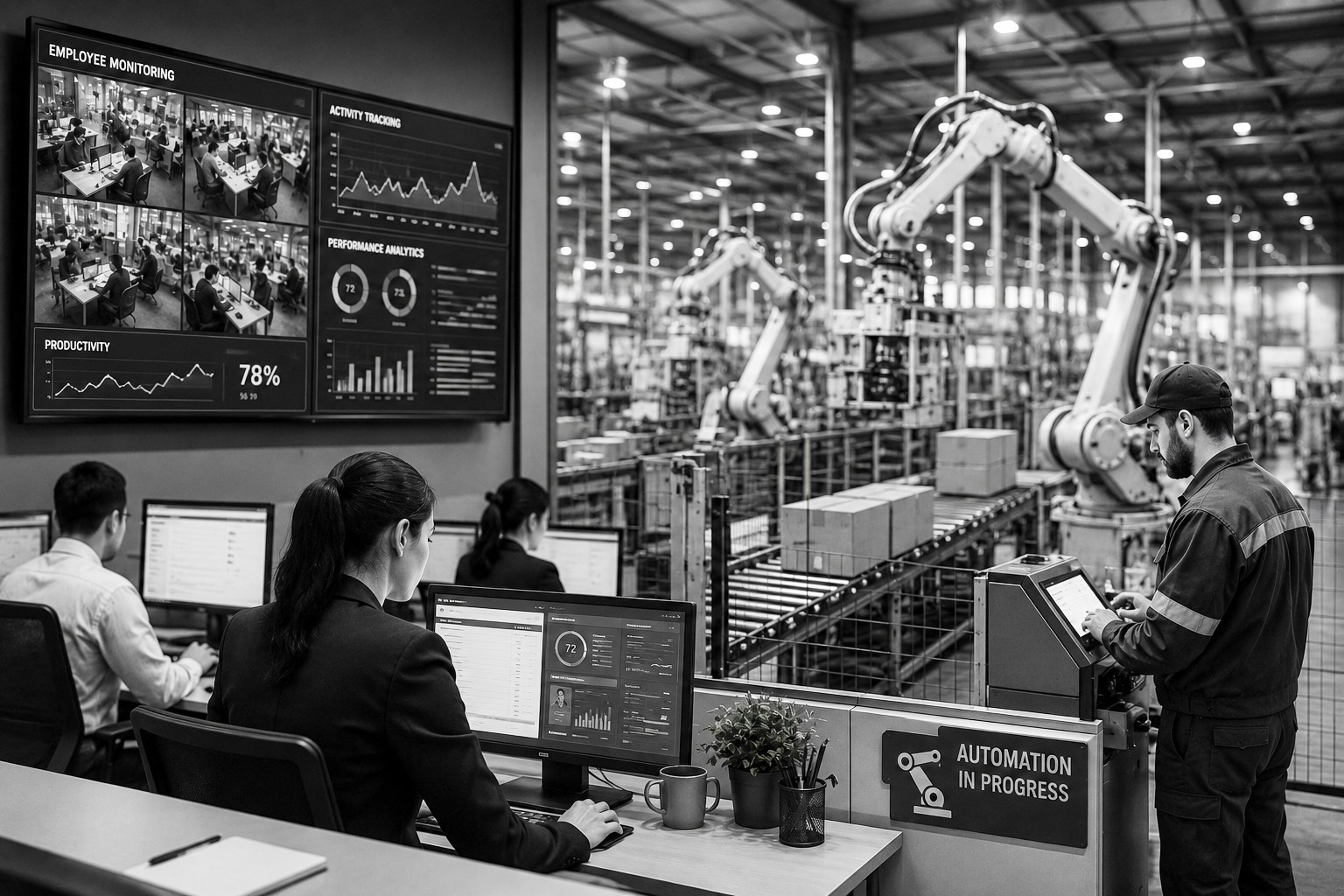
The expansion of artificial intelligence and workplace analytics is also allowing firms to monitor employee performance in increasingly detailed ways. Automated management systems can now track output, communication speed, scheduling patterns and customer interactions in real time.
Supporters argue that these systems improve efficiency and accountability. Critics, however, believe they may strengthen employer leverage while reducing worker autonomy and negotiating power.
The broader concern is that automation may increasingly function as a tool of labour control rather than purely technological progress.
Debate over the future of work intensifies
The MIT findings arrive amid growing global debate regarding how artificial intelligence and automation will reshape labour markets during the coming decade. Governments, unions and economists continue to discuss whether stronger labour protections, retraining systems or new forms of income support may become necessary as technology adoption accelerates.
Some analysts argue that automation ultimately creates new industries and employment categories over time. Others warn that the transition period may produce prolonged instability, particularly for middle-income workers whose roles become partially or fully digitised.
What appears increasingly clear is that the future impact of automation may depend less on the technology itself and more on how corporations choose to deploy it.
Newshub Editorial in North America – 17 May 2026

If you have an account with ChatGPT you get deeper explanations,
background and context related to what you are reading.
Open an account:
Open an accountCompanies across the United States are increasingly using automation not simply to improve productivity, but to reduce the bargaining power and wage premiums of certain groups of workers, according to new research from economists at Massachusetts Institute of Technology. The findings suggest that automation may be contributing more to wage inequality than to measurable gains in efficiency, particularly in sectors where experienced employees traditionally commanded higher pay due to specialised knowledge or operational leverage.
Recent Comments