
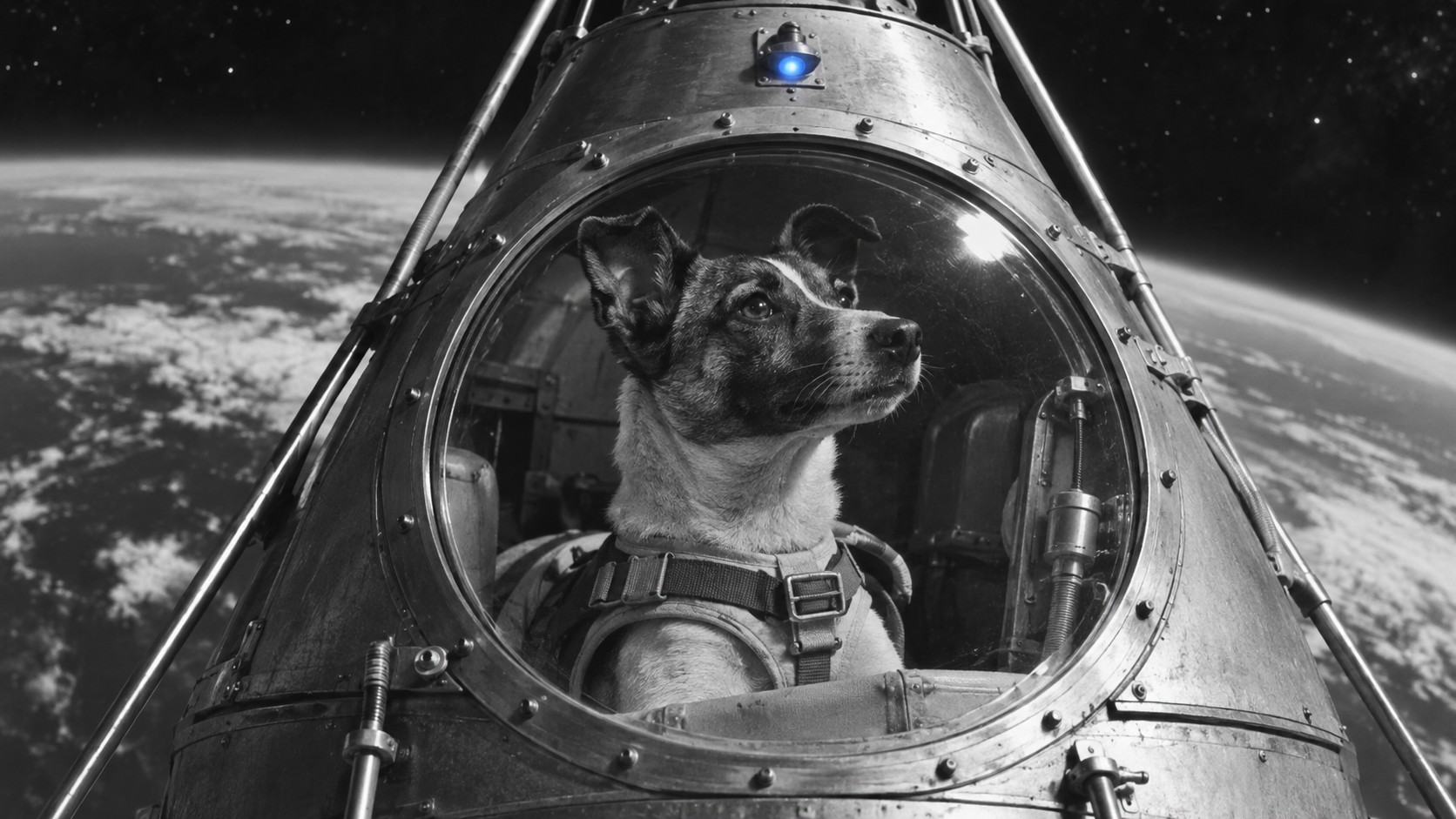
On 3 November 1957, the Soviet Union made history by launching Sputnik 2 into orbit with a small dog named Laika aboard. The mission marked a major milestone in space exploration, demonstrated Soviet technological capabilities and intensified the Cold War rivalry that would ultimately carry humanity to the Moon.
A historic mission beyond Earth
Just one month after launching Sputnik 1, the world’s first artificial satellite, Soviet engineers achieved another extraordinary breakthrough.


Sputnik 2 lifted off from the Baikonur launch site carrying Laika, a stray dog selected from the streets of Moscow. She became the first animal to orbit Earth, providing scientists with an unprecedented opportunity to study how a living organism responded to the conditions of spaceflight.
The spacecraft weighed approximately 508 kilograms, considerably more than its predecessor, and contained equipment designed to monitor Laika’s biological responses during the mission.
A triumph overshadowed by tragedy
Although Soviet authorities initially presented the mission as a remarkable scientific success, Laika’s journey had a tragic outcome.
The spacecraft had no recovery system, meaning she was never expected to return to Earth. Later disclosures revealed that she survived only a few hours after launch, dying from overheating and physiological stress.
Her death subsequently raised important ethical questions about the use of animals in scientific experimentation.
Nevertheless, the information gathered during the mission contributed to preparations for future human spaceflight.
NASA+1
The Cold War reaches space
The successful launch of Sputnik 2 delivered another political and technological victory for Moscow at a time when the United States was struggling to match Soviet achievements.
Washington recognised that space exploration was becoming central to national security, technological leadership and international prestige.
The growing competition accelerated American investment in aerospace research and helped bring about the establishment of NASA in 1958.
By April 1961, Soviet cosmonaut Yuri Gagarin became the first human to orbit Earth, building upon the experimental foundations laid by missions such as Laika’s.
NASA+1
A legacy beyond the Space Race
Laika’s journey remains one of the most recognisable episodes in the history of space exploration.
Her mission demonstrated both the remarkable possibilities of scientific progress and the ethical consequences of pursuing technological breakthroughs under intense political pressure.
Sixty-nine years later, the space industry has evolved into a global economic sector encompassing satellite communications, navigation, commercial launch services and scientific research.
Yet the historic flight of a small Moscow street dog remains a powerful reminder of the sacrifices made during humanity’s earliest attempts to explore beyond Earth.
NewsHub Finance | History | 3 November 2026
On 3 November 1957, the Soviet Union made history by launching Sputnik 2 into orbit with a small dog named Laika aboard. The mission marked a major milestone in space exploration, demonstrated Soviet technological capabilities and intensified the Cold War rivalry that would ultimately carry humanity to the Moon.

Recent Comments