
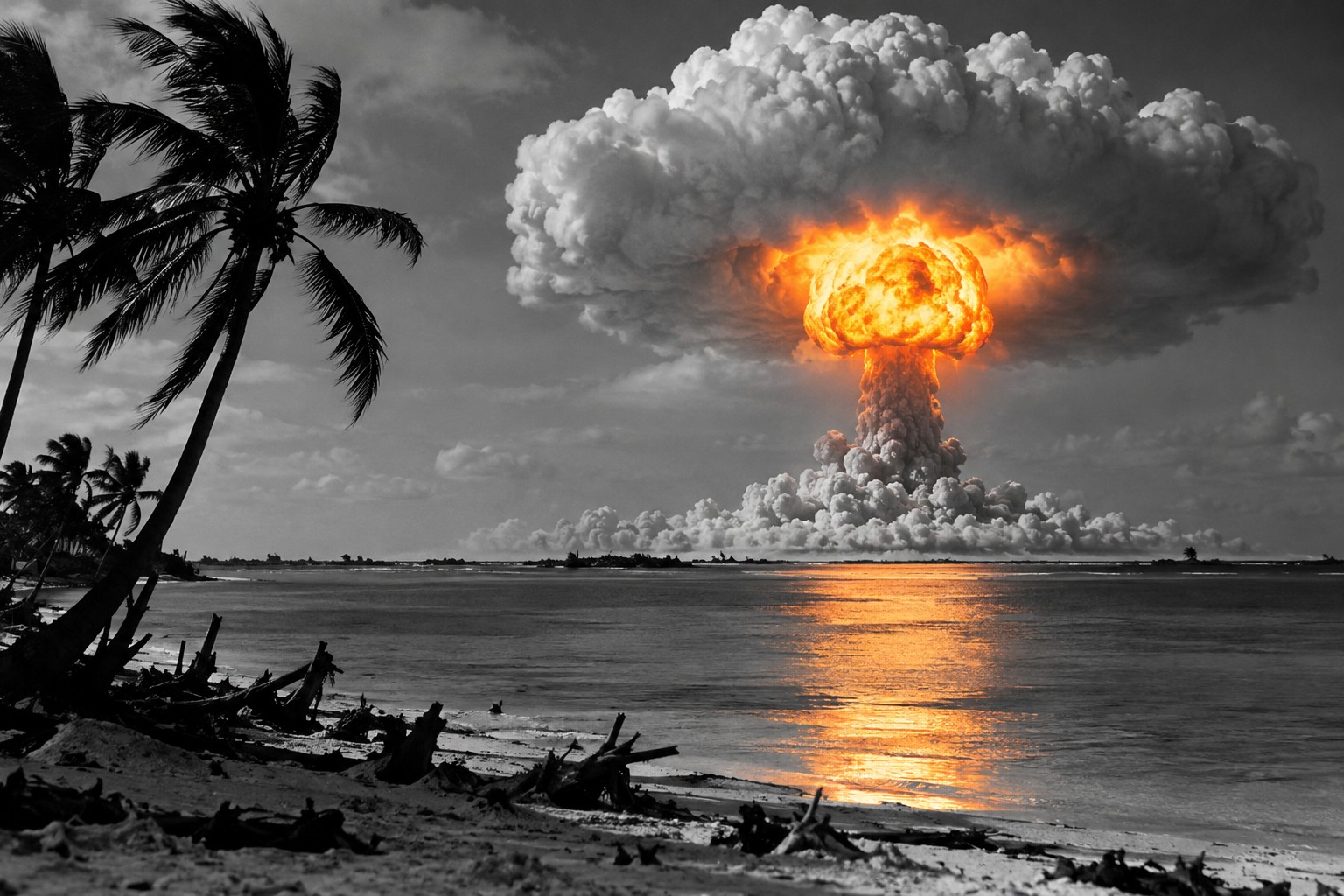
On 1 November 1952, the United States entered a new and terrifying chapter in nuclear history when scientists successfully detonated the world’s first full-scale thermonuclear device on Enewetak Atoll in the Marshall Islands. The explosion, developed through research associated with physicist Edward Teller and other American scientists, demonstrated destructive power far beyond that of the atomic bombs used during the Second World War.
A new era of nuclear destruction
At 7:15 a.m. local time, the experimental device, codenamed Ivy Mike, exploded on the small island of Elugelab in the Pacific Ocean.


The blast released energy equivalent to 10.4 million tonnes of TNT, approximately 700 times the explosive power of the bomb dropped on Hiroshima in August 1945.
The resulting fireball expanded several kilometres across, while a gigantic mushroom cloud rose into the atmosphere. Elugelab disappeared completely, leaving an underwater crater approximately 1.9 kilometres wide.
The test proved that humanity had developed weapons capable of destroying entire cities with a single explosion.
Brookings+1
Edward Teller and the hydrogen bomb
Hungarian-born American physicist Edward Teller played a central role in advancing the concept of thermonuclear weapons.
Together with mathematician Stanislaw Ulam, Teller helped establish the theoretical principles that made the hydrogen bomb possible.
Unlike conventional atomic bombs, which release energy primarily through nuclear fission, thermonuclear weapons use an initial fission explosion to create the extreme temperatures and pressures necessary for nuclear fusion.
The process combines light atomic nuclei, releasing enormous quantities of energy. The Ivy Mike device also generated substantial additional energy through fission.
Although scientifically successful, the experimental weapon was too large and complicated for practical military deployment, weighing approximately 74 tonnes and requiring specialised cooling equipment.
nuclearweaponarchive.org+1
The Cold War enters a dangerous phase
The explosion occurred during growing tensions between the United States and the Soviet Union.
President Harry S. Truman had authorised accelerated thermonuclear weapons development in 1950, following the Soviet Union’s first atomic bomb test the previous year.
Ivy Mike demonstrated American technological superiority at that moment, but also intensified the nuclear arms race.
Within the following years, both superpowers developed increasingly powerful and deliverable hydrogen bombs, fundamentally changing international security and military strategy.
A legacy that continues today
The Marshall Islands became one of the principal locations for American nuclear testing, with lasting environmental consequences and serious effects on local communities.
The 1952 explosion marked far more than a scientific achievement. It demonstrated humanity’s ability to unleash destructive forces on a previously unimaginable scale.
Seventy-four years later, the first hydrogen bomb remains a defining moment in modern history and a reminder of the dangers associated with nuclear proliferation.
NewsHub Finance | History | 1 November 2026
On 1 November 1952, the United States entered a new and terrifying chapter in nuclear history when scientists successfully detonated the world's first full-scale thermonuclear device on Enewetak Atoll in the Marshall Islands. The explosion, developed through research associated with physicist Edward Teller and other American scientists, demonstrated destructive power far beyond that of the atomic bombs used during the Second World War.

Recent Comments