
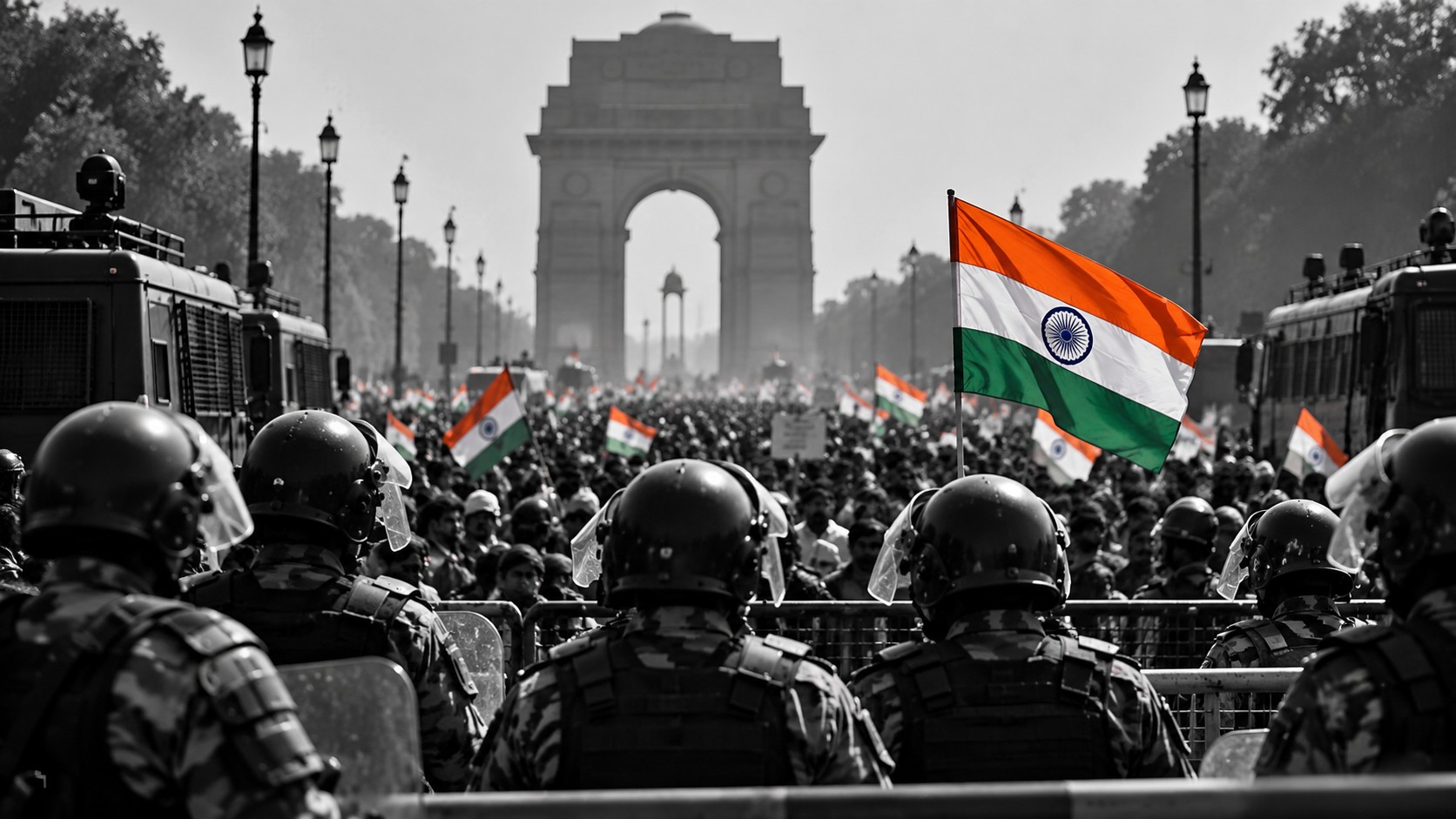
Hundreds of thousands of demonstrators are expected to gather in India’s capital on Sunday as opposition parties demand the resignation of the country’s chief election commissioner over controversial changes to electoral registers. Security forces have deployed riot-control vehicles and reinforced police units across New Delhi amid growing political tensions.
NEW DELHI — Indian authorities have significantly increased security around central Delhi ahead of a major opposition demonstration on 1 November, with police carrying shields and batons stationed near the Ramlila Maidan protest ground.
The march, led by Congress party leader Rahul Gandhi and supported by the opposition INDIA alliance, is expected to attract large crowds protesting against changes to voter registration procedures.


Organisers describe the demonstration as a direct challenge to Prime Minister Narendra Modi and his ruling Bharatiya Janata Party (BJP).
Opposition demands election chief’s resignation
At the centre of the dispute is Chief Election Commissioner Gyanesh Kumar, whom opposition leaders accuse of overseeing electoral register revisions that could disproportionately disadvantage minority communities and opposition supporters.
Since the revision process began last year, more than 130 million names have been removed from electoral lists.
Official classifications include approximately 28 million deceased voters, 63 million people who relocated and 30 million individuals whose whereabouts could not be established.
Opposition parties argue that the changes risk excluding legitimate voters, particularly Muslims and other minority groups.
The Election Commission rejects allegations of political bias, maintaining that the revisions are necessary to preserve electoral integrity and that wrongly removed voters can register again.
Security forces prepare for major demonstrations
Authorities have announced traffic restrictions and possible diversions along the approximately 1.5-kilometre march route towards Ramlila Maidan.
Police and riot-control vehicles have been deployed around the rally venue, while officers have urged demonstrators to cooperate with security arrangements.
The mobilisation follows weeks of almost daily protests involving opposition organisations, students and the youth-led Cockroach Janta Party movement.
The unrest intensified following reports in September that senior election officials had raised internal concerns about voter registration procedures and digital electoral systems.
Growing political pressure on Modi
The protests represent one of the most significant political challenges facing Modi since he came to power in 2014.
The BJP insists that electoral revisions are legitimate administrative measures and accuses opposition parties of undermining public confidence in democratic institutions.
Despite the growing demonstrations, Modi’s government remains politically stable, with India’s next general election scheduled for 2029.
Democratic confidence at stake
Beyond the immediate political confrontation, the dispute raises broader questions about electoral transparency and public trust in the world’s most populous democracy.
With millions of voters potentially affected by changes to electoral records, the controversy has become a national debate over representation, accountability and the independence of election authorities.
Sunday’s demonstration is expected to test both the opposition’s ability to mobilise public support and the government’s response to mounting demands for electoral scrutiny.
NewsHub Finance | Asia | 1 November 2026
Hundreds of thousands of demonstrators are expected to gather in India's capital on Sunday as opposition parties demand the resignation of the country's chief election commissioner over controversial changes to electoral registers. Security forces have deployed riot-control vehicles and reinforced police units across New Delhi amid growing political tensions.

Recent Comments