
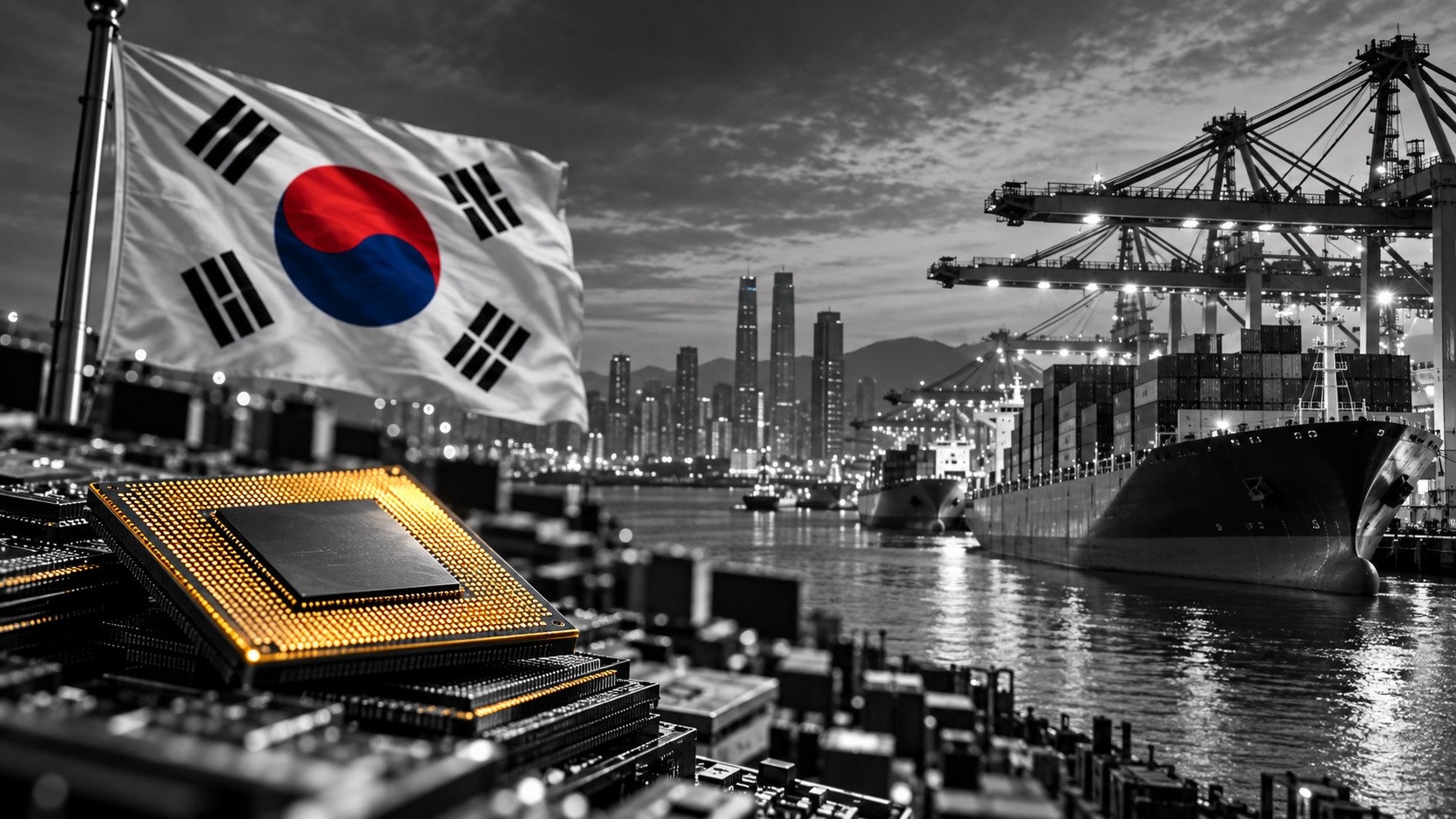
The AI boom is driving an export record. But the country’s own central bank has already modelled what happens if the spending behind it slows.
By the NHX Investigative Desk | NewsHub Finance
FOLLOW THE MONEY. VERIFY THE POWER.


SEOUL — South Korea is approaching an extraordinary economic milestone. Exports reached $115.28 billion in October, an increase of 93.7% from a year earlier and the strongest annual growth since January 1974. Shipments totalled $930 billion during the first ten months of 2026, putting the country on course to exceed $1 trillion in November.
But behind the record lies a growing concentration of economic risk. Semiconductors accounted for $56.44 billion in October exports, almost half the total. Much of that demand is being driven by global investment in artificial intelligence infrastructure.
The headline survives the calendar adjustment
October benefited from additional working days because of the timing of the Chuseok holiday. Nevertheless, average daily exports increased by approximately 76%, confirming that the expansion cannot be explained by the calendar alone.
Computer exports surged 496.6%, reflecting extraordinary demand for AI servers and associated infrastructure.
The central bank’s $100 billion warning
On 27 October, the Bank of Korea disclosed a pessimistic scenario examining what might happen if major American technology companies reduce AI infrastructure spending in 2027.
Under that scenario, semiconductor exports could fall $50 billion to $100 billion below earlier forecasts.
The central bank estimated that the resulting shock could reduce South Korea’s economic growth by approximately 0.4 percentage point.
Its calculations assumed a 10% decline in semiconductor prices.
These figures represent a hypothetical risk assessment, not a prediction that the downturn will occur.
Five companies and a global dependency
Amazon, Google, Microsoft, Meta and Oracle are central to the investment cycle underpinning AI infrastructure demand.
The Bank of Korea’s assessment indicates that their combined capital expenditure could increase from approximately $80 billion in 2026 to $110 billion in 2027.
For South Korea, the implication is significant: decisions made by a handful of American corporations increasingly influence export performance, industrial investment and national growth expectations.
Beyond the semiconductor boom
South Korea’s wider export economy is also expanding. Automobile shipments increased 18.1% in October, while petroleum-product exports rose 80%.
Nevertheless, the semiconductor industry’s dominance makes the national economy unusually sensitive to changes in AI investment.
The central question is no longer whether South Korea can reach $1 trillion in exports.
It is whether the country can sustain that achievement if the global AI spending cycle eventually slows.
NHX conclusion
South Korea’s export performance demonstrates the extraordinary economic power of artificial intelligence investment. It also reveals the vulnerability created when one industry becomes the principal engine of national growth.
The $1 trillion milestone will be historic.
Its durability remains the real investigation.
NewsHub Finance | NHX Investigations | 1 November 2026
The AI boom is driving an export record. But the country’s own central bank has already modelled what happens if the spending behind it slows.

Recent Comments