
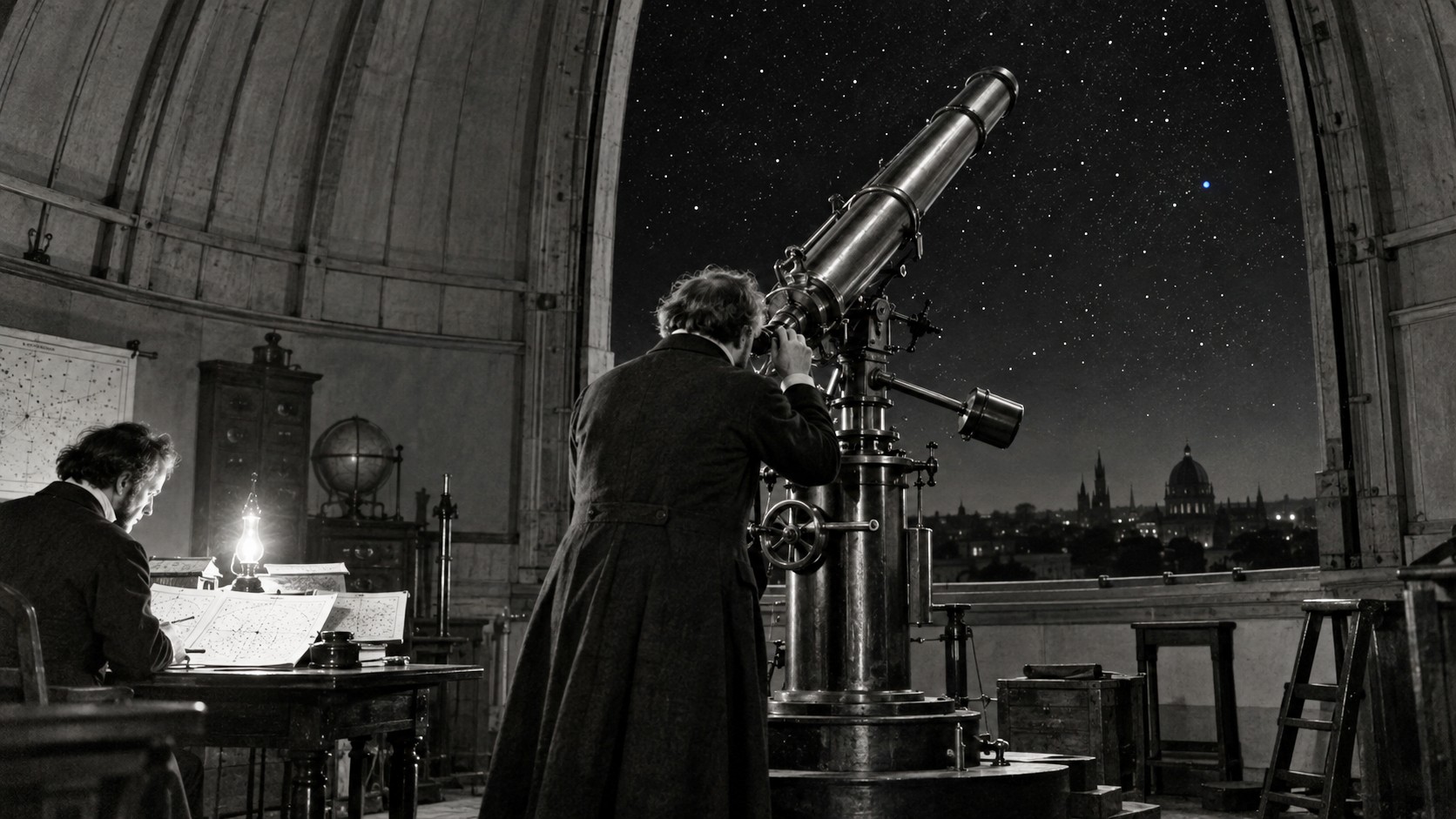
On 23 September 1846, astronomer Johann Gottfried Galle identified Neptune at the Berlin Observatory, close to a position predicted by mathematics. The discovery gave astronomers an eighth planet and showed that the motion of a known world could reveal an unseen one.
A clue in Uranus’s orbit
Uranus was not moving quite as astronomers expected. One possible explanation was the gravitational pull of a planet farther from the Sun. Working independently, the French mathematician Urbain Le Verrier and the British mathematician John Couch Adams calculated where such a planet might be found. Le Verrier sent his prediction to Galle in Berlin.
Galle began searching on the night of 23–24 September. With help from Heinrich Louis d’Arrest, who compared the view through the telescope with a star chart, he located an object absent from the chart. It lay within about one degree of Le Verrier’s predicted position. Further observation established that it was a planet.

A discovery with a qualification
Galle is credited with identifying Neptune as a planet, but he was not the first person ever to see it. Earlier observers had recorded it without recognising what it was. The distinction matters: the achievement in 1846 was to predict the location of an unseen planet and then identify it in the night sky.
Neptune remains the most distant major planet in the Solar System. It takes roughly 165 Earth years to orbit the Sun, so it completed its first full circuit since its discovery only in 2011. The observation in Berlin began with a small discrepancy in Uranus’s path and ended by extending the known boundaries of the planetary system.
Newshub Editorial in Europe – 23 September 2026

Ask NF GPT
If you have an account with ChatGPT you get deeper explanations,
background and context related to what you are reading.
Recent Comments