
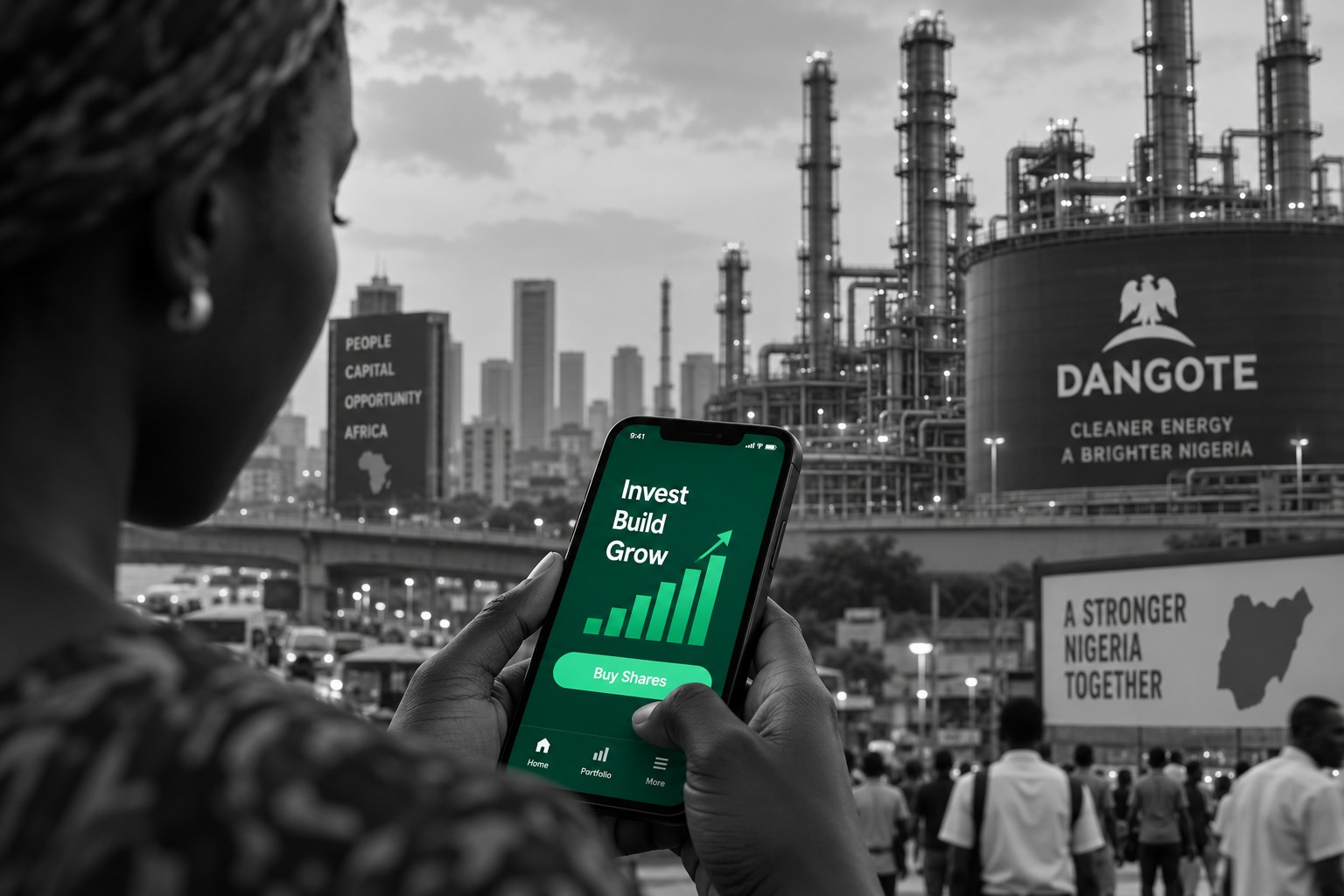
Nigeria is providing a striking example of the leapfrog economy in action. Africa’s largest-ever share offering is using fintech platforms, mobile technology and extremely low investment thresholds to give ordinary Nigerians access to a capital market traditionally dominated by banks, brokers and wealthier investors.
A $4 doorway into the stock market
Dangote Petroleum Refinery launched a $1.6 billion initial public offering this week, with shares being distributed through banks, mobile operators and Nigerian fintech platforms.
The minimum investment has been set at only 10 shares — approximately $4.

That changes the economics of participation.
Instead of opening a conventional brokerage relationship and navigating a financial system designed primarily for established investors, Nigerians can increasingly access investments through the same digital infrastructure already used for other financial services.
Fintech becomes financial infrastructure
Demand has been sufficiently intense to expose weaknesses in the system.
Investment platform Bamboo experienced traffic around ten times normal levels within 30 minutes of the IPO going live. Other digital platforms, including Cowrywise and InvestNaija, also experienced difficulties as investors attempted to subscribe.
The technical problems are significant, but so is what caused them.
Nigeria is attempting to bring mass retail participation into its capital markets through digital distribution rather than waiting for a traditional branch-and-broker infrastructure to reach the wider population.
That is a classic leapfrog model.
From mobile payments to mobile ownership
Africa’s first major financial leapfrog was mobile money. Millions of people gained access to payments and transfers without first becoming customers of conventional branch-based banks.
Nigeria’s developing investment ecosystem suggests that the same principle can move further up the financial chain.
A smartphone can become not only a payment device, but also an investment platform.
Dangote has said he expects 10 million people to buy refinery shares, although the company and its underwriters have not released figures confirming current demand.
The next financial leap
There are risks. Nigeria’s Securities and Exchange Commission has warned investors to watch for phishing, impersonation and fraudulent investment schemes as inexperienced investors enter the market. Digital infrastructure will also need greater capacity if mass-market investing continues to expand.
But the broader development is important.
Leapfrog economies are not simply replacing cash with mobile payments anymore.
They are beginning to use the same digital rails to distribute credit, savings, insurance and investments.
Nigeria’s IPO experiment demonstrates where that evolution could lead: from financial inclusion to financial participation — without requiring every stage of the traditional banking and brokerage system to be built first.
Newshub Editorial in Africa – 19 September 2026
Recent Comments