
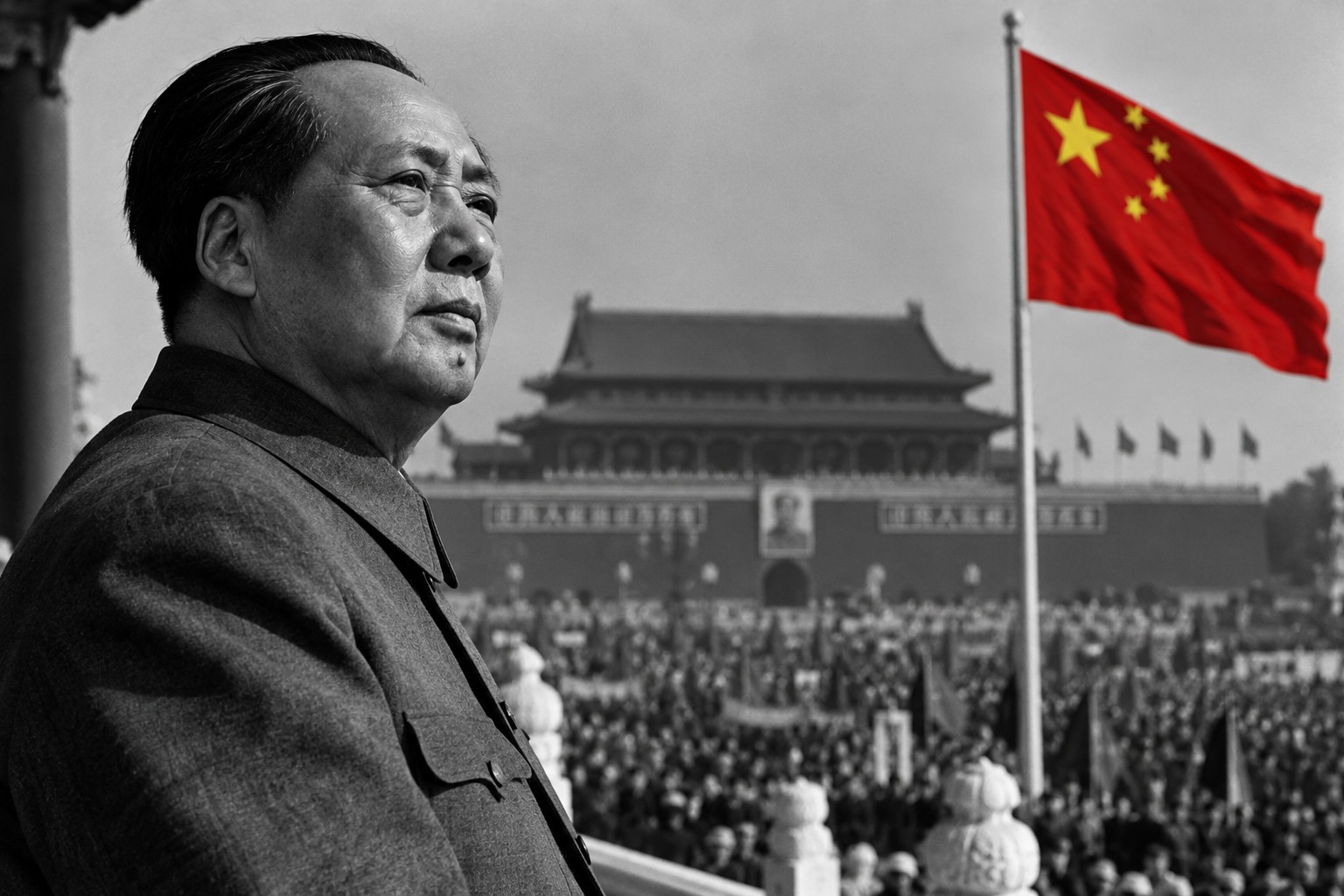
On 9 September 1976, Mao Zedong died in Beijing after dominating Chinese politics for nearly three decades. Fifty years later, the founder of the People’s Republic of China remains one of the most consequential and controversial figures of the twentieth century – celebrated for unifying and transforming China, but condemned for policies that caused immense human suffering.
From revolutionary to ruler
Born in Shaoshan in 1893, Mao became an early member of the Chinese Communist Party and gradually emerged as its dominant leader. His strategy differed from orthodox Soviet communism by placing China’s vast peasant population at the centre of revolution.
After decades of civil war and conflict with Japan, Mao’s Communist forces defeated Chiang Kai-shek’s Nationalists. On 1 October 1949, Mao proclaimed the People’s Republic of China in Beijing.

The Great Leap Forward
Mao sought to transform an overwhelmingly agricultural country into a socialist industrial power at extraordinary speed. The Great Leap Forward, launched in 1958, collectivised agriculture and attempted to dramatically increase industrial production.
The programme proved disastrous. Agricultural disruption, unrealistic production targets and government policies contributed to a catastrophic famine. Estimates of the death toll vary considerably, but historians agree that tens of millions died during the period.
The Cultural Revolution
In 1966, Mao launched the Cultural Revolution, mobilising young Red Guards against supposed bourgeois, capitalist and counter-revolutionary influences.
Schools and universities were disrupted, officials and intellectuals were persecuted, historical and cultural objects were destroyed and millions of people were displaced or subjected to political campaigns. The upheaval lasted until Mao’s death and the subsequent arrest of the Gang of Four.
The opening to America
Yet Mao also fundamentally changed China’s international position. One of the defining moments came in 1972 when US President Richard Nixon travelled to Beijing.
The meeting helped end more than two decades of hostility between Washington and Communist China and altered the Cold War balance between China, the United States and the Soviet Union.
The death of Mao
By 1976, Mao’s health had deteriorated severely. He died in Beijing shortly after midnight on 9 September, aged 82. China entered an official period of mourning as uncertainty surrounded the succession.
Within weeks, the Gang of Four was arrested. Deng Xiaoping subsequently emerged as China’s paramount leader and moved the country towards economic reform and greater engagement with international markets.
A legacy China still lives with
Half a century after his death, Mao remains deeply embedded in Chinese political identity. His portrait still dominates Tiananmen Square, while his historical role continues to be defended by the Communist Party even as the disastrous consequences of some of his policies are acknowledged.
The contradiction remains extraordinary: Mao helped create the modern Chinese state, while the economic system that ultimately made China a global powerhouse departed dramatically from many of his ideas.
Fifty years after his death, China has changed almost beyond recognition. Mao’s shadow, however, has never entirely disappeared.
Newshub Editorial in Asia – 9 September 2026

Ask NF GPT
If you have an account with ChatGPT you get deeper explanations,
background and context related to what you are reading.
Recent Comments