
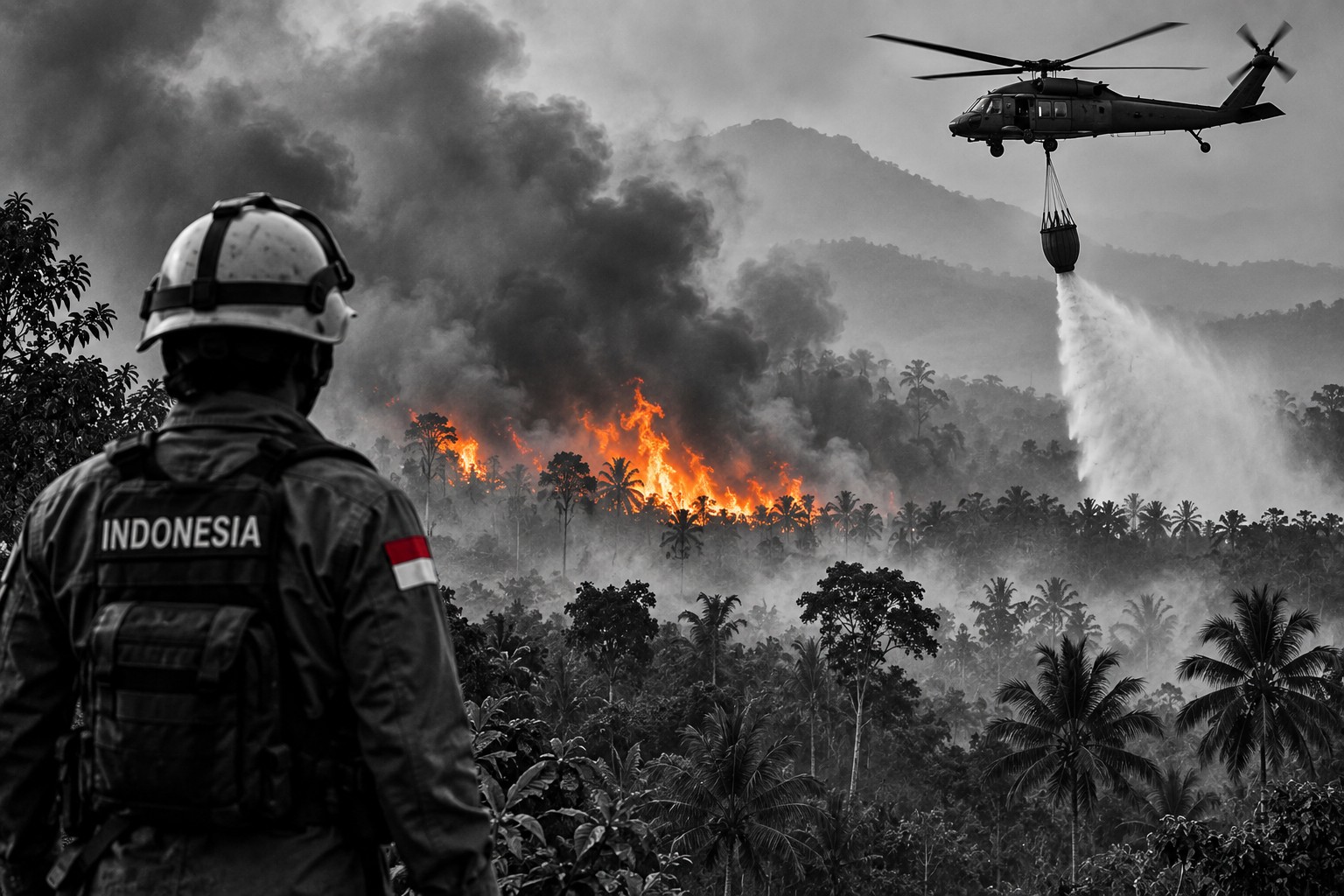
Indonesia is intensifying its battle against widespread forest and peatland fires as exceptionally dry conditions fuel one of Southeast Asia’s most serious environmental emergencies in years, spreading hazardous haze across national borders and putting communities, agriculture and economic activity under increasing pressure.
Nearly 77,000 hectares burned
Approximately 76,933 hectares of land have now burned across Indonesia, with authorities concentrating resources on six of the worst-affected provinces on Sumatra and Borneo.
The situation has deteriorated as prolonged dry weather reduces water supplies and makes Indonesia’s peatlands particularly difficult to extinguish.


Firefighters in West Kalimantan have reported going more than 60 days without meaningful rainfall in some locations.
Indonesia has deployed thousands of military personnel and more than 50 aircraft for water bombing and cloud-seeding operations.
Japan sends military helicopters
The scale of the emergency is now attracting international assistance.
Japan is deploying three CH-47 Chinook helicopters and around 180 crew members to Indonesia. The aircraft are expected to operate from Pontianak in West Kalimantan, currently the province worst affected by the fires.
Operations are scheduled to begin this weekend and continue until 19 September.
Finding sufficient water for firefighting operations has become a significant problem, with Indonesian forces drilling new water sources in affected areas.
Haze spreads across borders
The environmental consequences are no longer confined to Indonesia.
Smoke from burning forests and carbon-rich peatlands has produced severe air pollution and raised concerns in neighbouring Malaysia and Singapore.
Malaysia has already declared an emergency in Serian in Sarawak after pollution reached critical levels, while Kuching has also experienced hazardous air quality.
The Philippines has also reported effects from the wider regional haze.
El Niño intensifies the danger
Southeast Asia is experiencing substantial rainfall deficits associated with El Niño, particularly across Indonesia, Malaysia, Brunei and parts of the Philippines, Thailand, Cambodia and Vietnam.
Indonesia’s current dry season has significantly increased the danger of fires spreading through forests and drained peatlands.
Scientists have long warned that climate change can amplify extreme heat and drought conditions, creating environments in which wildfires become more difficult to control.
An economic threat for Southeast Asia
The consequences extend beyond environmental damage.
Indonesia is the world’s largest palm-oil producer, and prolonged fires can disrupt plantations, transport and agricultural production. Haze also affects aviation, tourism, schools and public health across national borders.
The crisis therefore illustrates one of Southeast Asia’s most difficult climate challenges: environmental disruption in one country can rapidly become an economic and health problem for an entire region.
With September expected to be Indonesia’s toughest month for firefighting, the battle against the fires may still be approaching its most difficult stage.
Newshub Editorial in Asia – 9 September 2026

Ask NF GPT
If you have an account with ChatGPT you get deeper explanations,
background and context related to what you are reading.
Indonesia is intensifying its battle against widespread forest and peatland fires as exceptionally dry conditions fuel one of Southeast Asia’s most serious environmental emergencies in years, spreading hazardous haze across national borders and putting communities, agriculture and economic activity under increasing pressure.
Recent Comments