
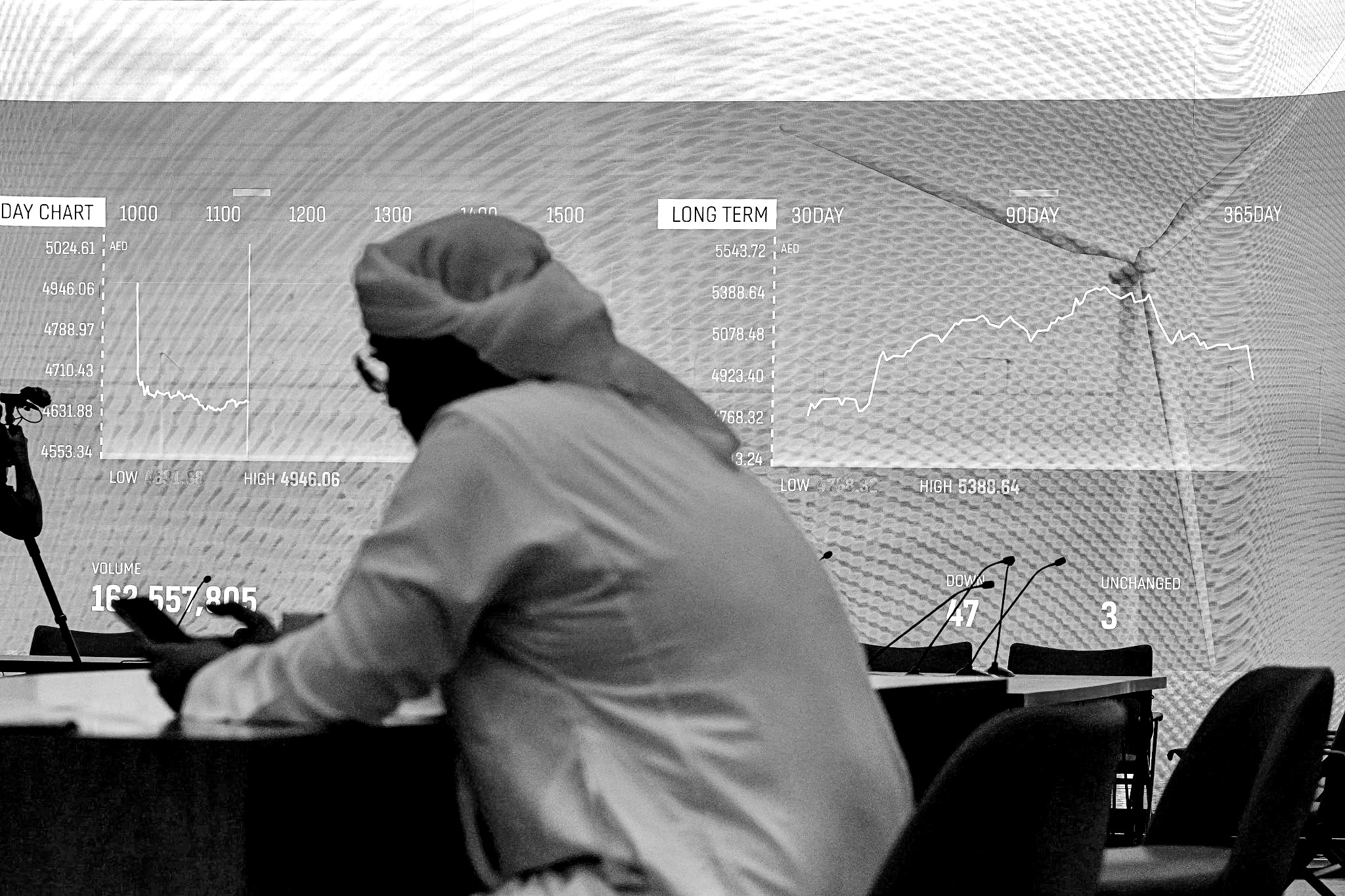
Arab stock markets opened mixed on Monday as sharply higher oil prices supported energy-producing economies, while renewed military tension between the United States and Iran increased uncertainty across the Gulf.
UAE markets begin in positive territory
The Dubai Financial Market General Index gained approximately 0.3 per cent in early trading, reaching around 5,883 points. Abu Dhabi’s benchmark index advanced about 0.1 per cent to approximately 10,055 points.
Banking, telecommunications and selected energy shares provided support as both UAE exchanges resumed regular trading following the weekend.


Saudi market remains cautious
Saudi Arabia’s Tadawul All Share Index opened close to 11,159 points after falling 0.7 per cent during Sunday’s session. Mining and banking shares had led the earlier decline, with Saudi Arabian Mining and Saudi National Bank among the weakest major companies.
Higher crude prices may support Saudi energy revenues, but investors remained cautious about the wider economic consequences of renewed conflict near the Strait of Hormuz.
Qatar and Egypt under pressure
Qatar’s QE General Index traded close to 9,863 points after slipping approximately 0.1 per cent during the previous session. Weakness among financial shares was partly offset by gains in selected energy-related companies.
Egypt’s EGX 30 remained near 54,937 points following a softer opening. Although Egypt can benefit from higher energy export revenues, rising oil prices also increase domestic transport, production and import costs.
Oil and interest rates dominate trading
Brent crude rose by nearly 3 per cent to above $90 a barrel after US forces attacked Iranian launchers and Iran responded with strikes against American positions. The escalation raised renewed concerns about the security of shipping and energy exports through the Gulf.
Regional markets were also affected by expectations that the US Federal Reserve could raise interest rates in September. Most Gulf currencies are linked to the US dollar, making local financial conditions particularly sensitive to changes in American monetary policy.
The early session therefore reflected two competing forces: stronger oil prices supporting government revenues and energy companies, while geopolitical risk and higher borrowing costs limited wider investor confidence.
Newshub Editorial in the Middle East – 31 August 2026

Ask NF GPT
If you have an account with ChatGPT you get deeper explanations,
background and context related to what you are reading.
Arab stock markets opened mixed on Monday as sharply higher oil prices supported energy-producing economies, while renewed military tension between the United States and Iran increased uncertainty across the Gulf.
Recent Comments