
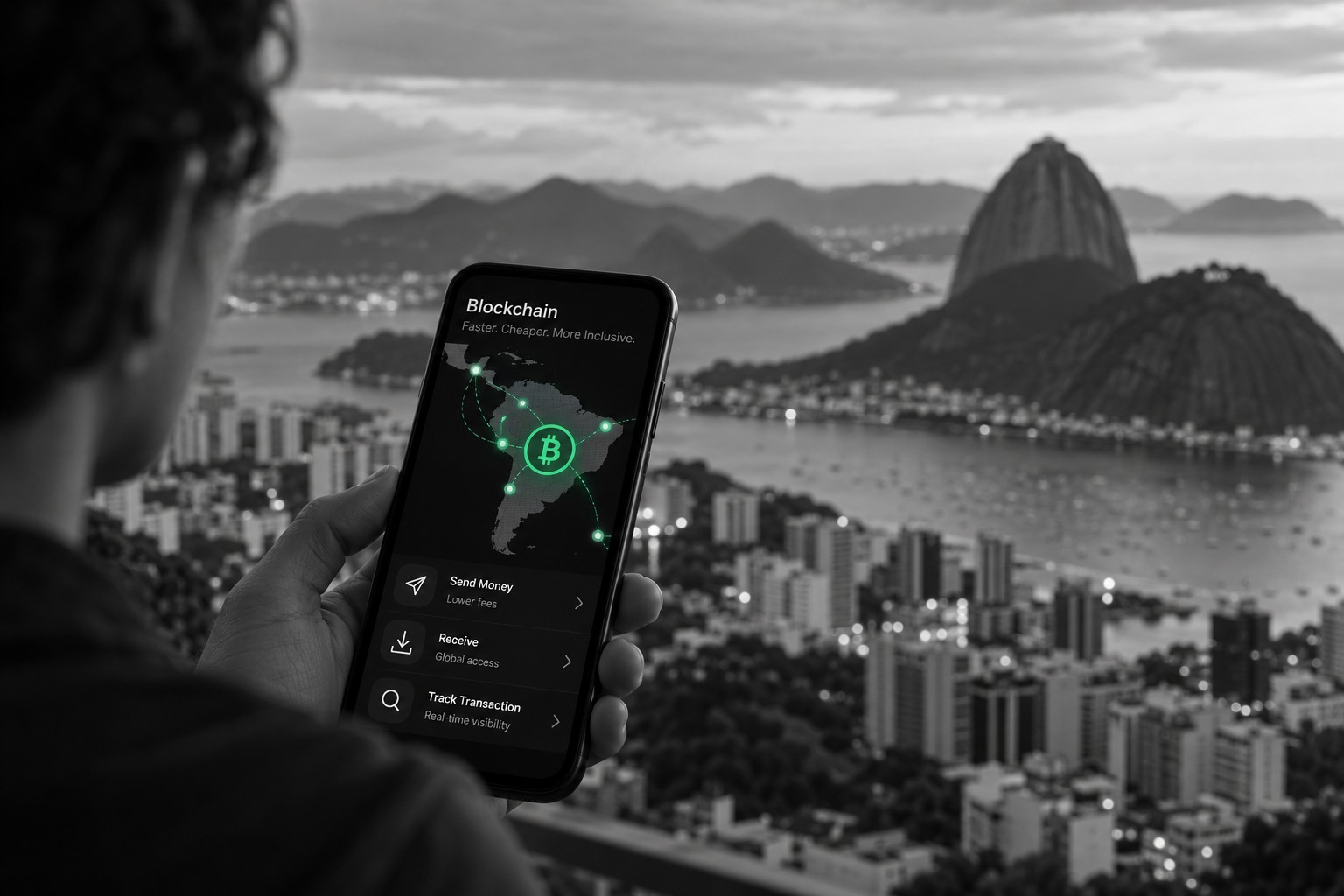
Blockchain technology is increasingly being used across Latin America’s financial sector to improve cross-border payments, increase transparency and widen access to financial services. While the region still faces regulatory and infrastructure challenges, public institutions, banks and fintech groups are testing practical applications that could make finance faster, cheaper and more traceable.
Cross-border payments and remittances
One of the clearest financial uses for blockchain in Latin America is international payments. The region depends heavily on remittances and cross-border transfers, yet these often remain costly and slow.
Recent projects backed by the Inter-American Development Bank have shown how blockchain can be used to tokenise money and execute transfers with better visibility over exchange rates, fees and transaction status. For users and institutions, the attraction lies not only in speed, but also in clearer records and reduced reliance on multiple intermediaries.


A tool for transparency and efficiency
Blockchain’s value in finance is not limited to payments. It is also being explored as a way to improve traceability and trust in financial operations.
Because transactions are recorded in a tamper-resistant ledger, institutions can monitor the movement of funds more easily. This can support auditing, reduce administrative friction and help strengthen oversight. In a region where trust in institutions and currencies can be uneven, these features are seen as particularly important.
Financial inclusion and digital access
Latin America has made progress in digital finance, but millions of people remain underbanked or outside the formal financial system. Blockchain-based tools, often used alongside digital wallets and fintech platforms, could help lower access barriers.
The potential lies in simpler transfers, more accessible digital assets and new ways of connecting users to payment services without requiring the same legacy banking infrastructure. In some markets, this has also encouraged experimentation with new lending, savings and settlement models.
Challenges remain
Despite the promise, blockchain is not a cure-all. Financial authorities and industry participants still face questions over regulation, interoperability, cybersecurity and fraud prevention.
The broader payments landscape in Latin America is also evolving quickly, with fast-payment systems and digital banking reforms sometimes offering similar benefits through more familiar structures. As a result, blockchain’s future role in the region is likely to depend on whether it can solve specific financial problems more effectively than existing tools.
NewsHub Finance | Fintech | 26 October 2026
Blockchain technology is increasingly being used across Latin America’s financial sector to improve cross-border payments, increase transparency and widen access to financial services. While the region still faces regulatory and infrastructure challenges, public institutions, banks and fintech groups are testing practical applications that could make finance faster, cheaper and more traceable.
Recent Comments