
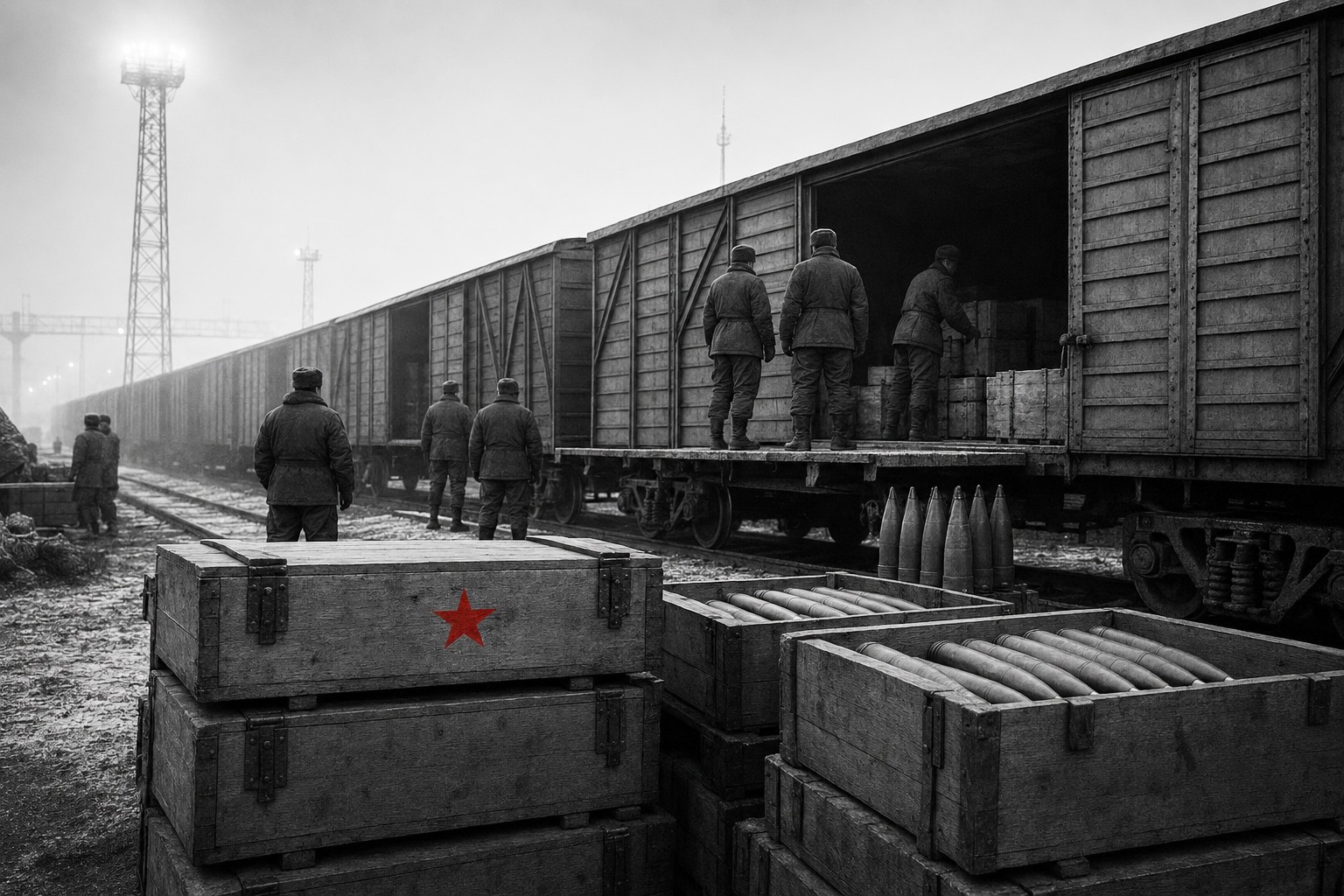
North Korea has supplied Russia with the equivalent of more than 15 million artillery rounds, according to a new assessment from South Korea’s Defence Ministry. The scale of the estimated deliveries reveals how deeply Pyongyang has become involved in sustaining Moscow’s war against Ukraine — while gaining military knowledge that could alter the security balance far beyond Europe.
A vast flow of ammunition
The South Korean assessment measures the shipments in equivalents of 152-millimetre artillery shells, the standard ammunition used by many Russian artillery systems. North Korea is also believed to have supplied short-range ballistic missiles and other weapons.
The estimate has not been independently verified. Moscow and Pyongyang have previously denied allegations of arms transfers, despite assessments from South Korea, Ukraine and Western governments that military supplies have moved from North Korea to Russia since 2023.
For Russia, access to North Korea’s large ammunition reserves provides an important advantage in a conflict where artillery consumption remains extraordinarily high. The arrangement also reduces some of the immediate pressure on Russia’s own defence factories.
Further troop deployments remain possible
South Korea’s Defence Ministry said North Korea was continuing preparations for an additional deployment of troops to Russia, although there were no signs that a new movement was imminent.
The statement followed a claim by Ukrainian President Volodymyr Zelenskyy that Pyongyang could send as many as 50,000 additional soldiers. Kim Yo Jong, the influential sister of North Korean leader Kim Jong Un, denied that such a deployment was planned.
North Korean troops have been deployed in support of Russia since 2024, according to Ukrainian, South Korean and Western assessments. Any substantial reinforcement would demonstrate that cooperation between Moscow and Pyongyang has moved beyond the exchange of weapons and technology into a more direct military partnership.
Ukraine becomes a weapons laboratory
The war is also providing North Korea with battlefield data that would be difficult to obtain through conventional testing. South Korean intelligence believes North Korean missiles used against Ukraine may have improved in accuracy through combat experience, Russian technical advice and access to additional components.
That development has consequences for South Korea, Japan and the United States. North Korea is reportedly approaching completion of several missile and multiple-launch rocket systems designed for a possible conflict on the Korean peninsula.
Its Hwasong-12 intermediate-range ballistic missile, capable of reaching the US territory of Guam, is also being prepared for operational deployment, according to the South Korean assessment.
Russia searches for more manpower
The report comes as Ukraine warns that Russia may seek to recruit another 300,000 troops following parliamentary elections scheduled for 18–20 September. Zelenskyy has suggested that Moscow’s longer-term target could reach 500,000 additional personnel by 2027, although Russia has not confirmed those figures.
The combination of Russian recruitment, North Korean ammunition and possible foreign troop reinforcements indicates that Moscow is preparing for a prolonged war rather than an early settlement.
The cost extends beyond the battlefield
Deeper military cooperation between Russia and North Korea complicates international efforts to isolate both countries. It also places greater pressure on Western governments to expand ammunition production, tighten sanctions enforcement and provide Ukraine with additional air-defence systems.
For Pyongyang, the partnership offers revenue, technology and combat experience. For Moscow, it delivers weapons and potentially soldiers. For Ukraine and its allies, it represents a widening war supply chain that is becoming increasingly difficult — and expensive — to contain.
Newshub Editorial in Europe – 24 August 2026

Recent Comments