
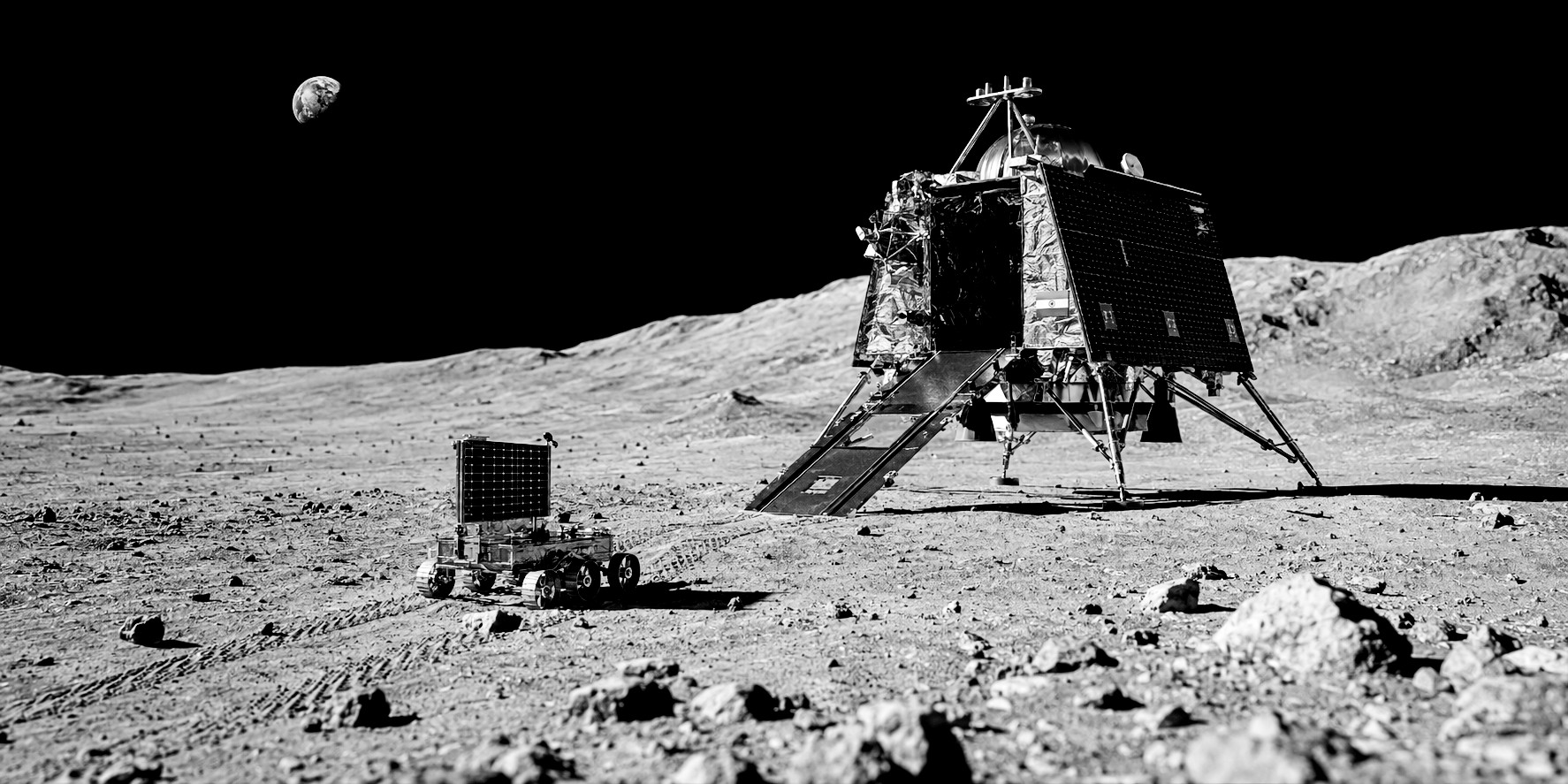
Three years ago today, India became only the fourth country to achieve a controlled landing on the Moon, marking a defining moment for its space programme and demonstrating that advanced exploration was no longer dominated exclusively by the world’s traditional space powers.
A historic descent
On 23 August 2023, the Chandrayaan-3 spacecraft successfully placed its Vikram lander near the Moon’s southern polar region. The achievement put India alongside the former Soviet Union, the United States and China as nations capable of completing a soft lunar landing.
India also became the first country to land in the Moon’s southern high latitudes. The region has attracted growing international interest because permanently shadowed craters may contain deposits of water ice, a resource that could eventually support longer missions and the production of fuel, oxygen and drinking water.

A mission built on earlier setbacks
Chandrayaan-3 followed the Chandrayaan-2 mission, whose lander crashed during its final descent in September 2019. Rather than abandoning the programme, the Indian Space Research Organisation, ISRO, studied the failure and redesigned critical systems.
The new lander incorporated improved navigation, stronger landing legs, additional fuel reserves and more advanced hazard-detection capabilities. Chandrayaan-3 was launched from Sriharikota on 14 July 2023 aboard India’s LVM3 rocket before beginning its journey towards lunar orbit.
The successful touchdown provided a powerful example of how technical failure can be converted into institutional knowledge and future progress.
Pragyan begins its work
After landing, Vikram deployed the small Pragyan rover onto the lunar surface. The solar-powered vehicle travelled approximately 101 metres while examining the soil and rocks surrounding the landing site.
Its instruments conducted elemental analysis of the surface, while equipment aboard Vikram gathered information about temperature, plasma conditions and seismic activity. The rover detected several elements, including sulphur, aluminium, calcium, iron and titanium.
The lander and rover were designed to operate for one lunar day, equivalent to roughly 14 Earth days. Although their operational period was limited, the mission completed its primary objectives of demonstrating a safe landing, rover mobility and scientific investigation.
Economic and strategic significance
Chandrayaan-3 strengthened India’s reputation for developing sophisticated space technology through disciplined engineering and comparatively restrained expenditure. The mission also supported the country’s ambition to expand its commercial space sector, attract private investment and increase participation in the international satellite and launch markets.
India’s space capabilities have practical economic importance beyond exploration. Satellite systems contribute to telecommunications, agriculture, weather forecasting, navigation, disaster management and infrastructure planning across the country.
The lunar landing also carried considerable diplomatic value. It demonstrated that a major emerging economy could independently execute a technically demanding mission and contribute meaningful scientific data to global lunar research.
A national milestone
India subsequently declared 23 August National Space Day, while the landing site was named Shiv Shakti Point. Three years later, Chandrayaan-3 remains both a scientific achievement and a symbol of India’s growing technological confidence.
The mission did more than place machinery on the Moon. It established India as a central participant in the next phase of international space exploration.
Newshub Editorial in Asia – 23 August 2026

Ask NF GPT
If you have an account with ChatGPT you get deeper explanations,
background and context related to what you are reading.
Recent Comments