
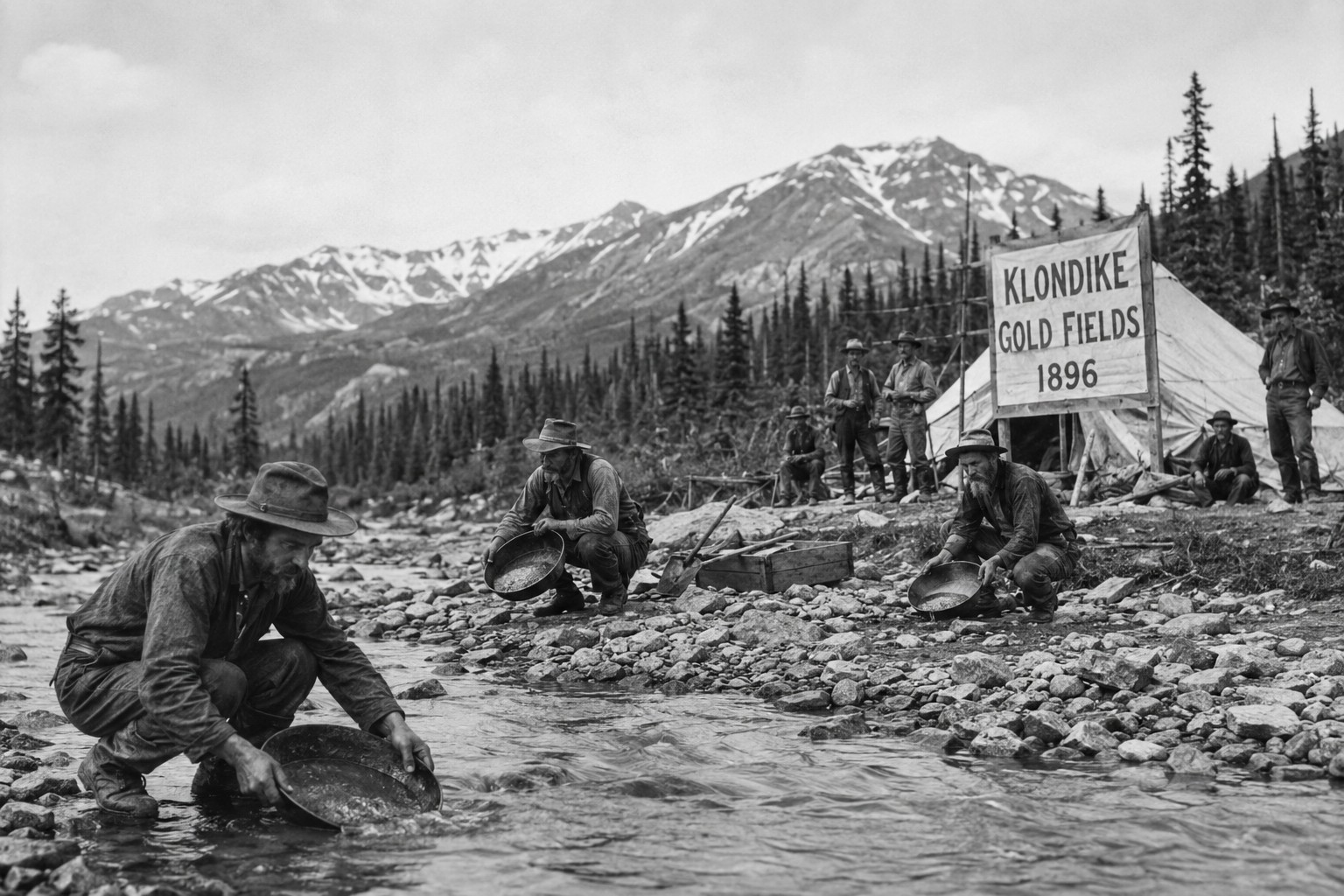
On 17 August 1896, a group of prospectors filed claims for gold discovered along a remote creek in Canada’s Yukon Territory, setting in motion one of history’s most famous gold rushes. The Klondike discovery would ultimately draw around 100,000 fortune seekers north, transform settlements into boomtowns and reshape the economy of the Pacific Northwest.
A discovery on Bonanza Creek
The story began the previous day, 16 August, when George Washington Carmack, Keish – better known as Skookum Jim Mason – and Káa Goox, known as Dawson Charlie, discovered significant quantities of gold on Rabbit Creek, a tributary of the Klondike River. Shaaw Tláa, or Kate Carmack, was also part of the group associated with the discovery. Rabbit Creek was subsequently renamed Bonanza Creek.
On 17 August, claims were registered at Fortymile, the nearest administrative settlement. Carmack filed the Discovery Claim in his name, although historical accounts differ over precisely who first spotted the gold. The discovery immediately attracted miners who were already operating in the Yukon, and within days much of Bonanza Creek and nearby Eldorado Creek had been claimed.

News takes almost a year to reach the world
The Klondike was extraordinarily isolated. Although the discovery occurred in August 1896, the outside world did not fully understand its scale for almost 11 months. That changed dramatically in July 1897 when ships carrying successful miners and large quantities of Yukon gold reached ports on the west coast of North America.
The arrival of the SS Portland in Seattle proved particularly important. The vessel carried dozens of miners and more than a tonne of gold, providing visible evidence that the reports from the Yukon were more than rumours. Newspapers spread the story rapidly and the Klondike stampede began in earnest.
Around 100,000 people head north
An estimated 100,000 prospective miners eventually set out for the Klondike. Seattle became the principal supply centre, with roughly 70,000 stampeders passing through the city. Merchants sold clothing, mining equipment, food and other supplies to people prepared to gamble their savings on the possibility of finding gold.
The journey was brutal. Many travelled through Skagway or Dyea in Alaska before crossing the White Pass or Chilkoot Pass. Prospectors then had to travel hundreds of miles through the Yukon river system before reaching Dawson City and the goldfields. Canadian authorities required travellers to carry substantial provisions, meaning equipment and supplies often had to be transported over mountain passes in repeated journeys.
Boomtowns and broken dreams
Dawson City exploded in size as miners, merchants and entrepreneurs arrived. At its peak, the settlement became one of the largest communities in western Canada. Hotels, saloons, shops and entertainment businesses prospered alongside the mining industry.
Yet the popular image of thousands of prospectors becoming wealthy was largely a myth. By the time most stampeders reached Dawson in 1898, the richest claims had already been taken. Many returned home with less money than they had started with, while merchants, transport companies and suppliers frequently made more reliable fortunes than the miners themselves.
A rush that transformed the north
The Klondike Gold Rush was relatively brief. By 1899, new discoveries at Nome in Alaska drew prospectors away, and the great stampede rapidly subsided. But its economic and demographic consequences endured. Seattle emerged as a major commercial centre, transportation infrastructure expanded and the Yukon became permanently connected more closely with the wider North American economy.
What began with gold found in a remote Yukon creek in August 1896 became one of the defining economic migrations of the late nineteenth century – a powerful demonstration of how the promise of sudden wealth could move people, capital and commerce across a continent.
Newshub Editorial in North America – 17 August 2026

Ask NF GPT
If you have an account with ChatGPT you get deeper explanations,
background and context related to what you are reading.
Open article chatOpen an account
Recent Comments